
表观遗传时钟和端粒长度与实足年龄及死亡率独立相关。
The epigenetic clock and telomere length are independently associated with chronological age and mortality.
作者信息
Marioni Riccardo E, Harris Sarah E, Shah Sonia, McRae Allan F, von Zglinicki Thomas, Martin-Ruiz Carmen, Wray Naomi R, Visscher Peter M, Deary Ian J
机构信息
Queensland Brain Institute, University of Queensland, Brisbane, QLD, Australia Centre for Cognitive Ageing and Cognitive Epidemiology, University of Edinburgh, Edinburgh, UK Medical Genetics Section, Centre for Genomic and Experimental Medicine, Institute of Genetics and Molecular Medicine, University of Edinburgh, Edinburgh, UK
Centre for Cognitive Ageing and Cognitive Epidemiology, University of Edinburgh, Edinburgh, UK Medical Genetics Section, Centre for Genomic and Experimental Medicine, Institute of Genetics and Molecular Medicine, University of Edinburgh, Edinburgh, UK.
出版信息
Int J Epidemiol. 2018 Feb;45(2):424-432. doi: 10.1093/ije/dyw041. Epub 2016 Apr 13.
BACKGROUND
Telomere length and DNA methylation have been proposed as biological clock measures that track chronological age. Whether they change in tandem, or contribute independently to the prediction of chronological age, is not known.
METHODS
We address these points using data from two Scottish cohorts: the Lothian Birth Cohorts of 1921 (LBC1921) and 1936 (LBC1936). Telomere length and epigenetic clock estimates from DNA methylation were measured in 920 LBC1936 participants (ages 70, 73 and 76 years) and in 414 LBC1921 participants (ages 79, 87 and 90 years).
RESULTS
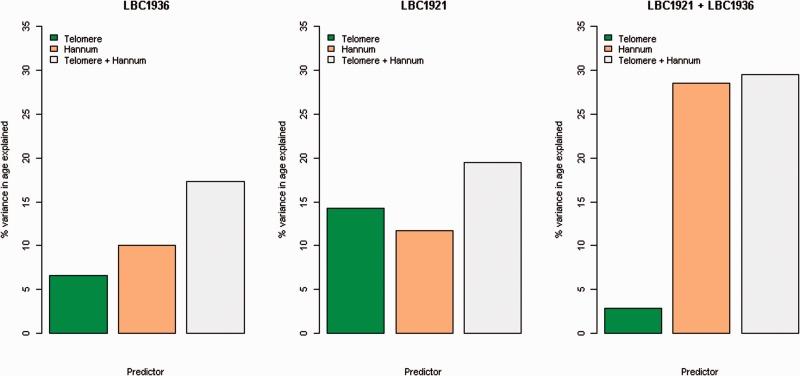
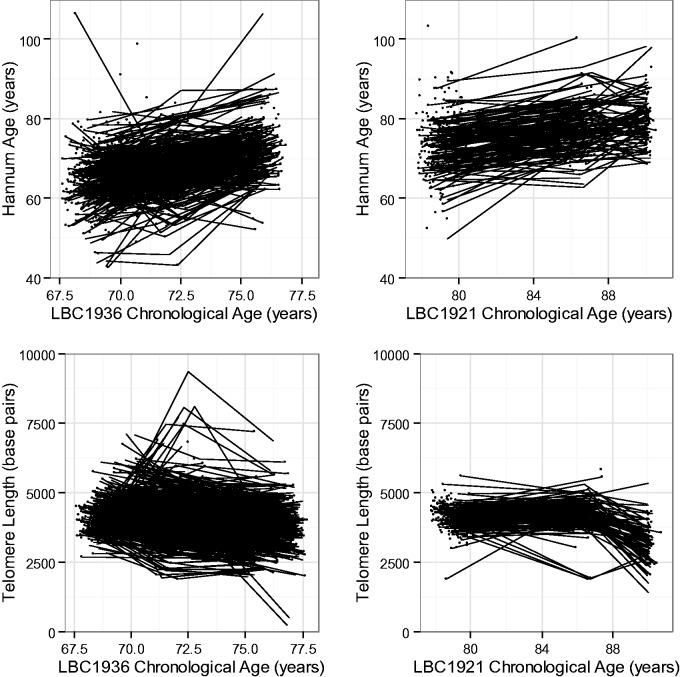
The epigenetic clock changed over time at roughly the same rate as chronological age in both cohorts. Telomere length decreased at 48-67 base pairs per year on average. Weak, non-significant correlations were found between epigenetic clock estimates and telomere length. Telomere length explained 6.6% of the variance in age in LBC1921, the epigenetic clock explained 10.0%, and combined they explained 17.3% (allP< 1 × 10). Corresponding figures for the LBC1936 cohort were 14.3%, 11.7% and 19.5% (allP< 1 × 10). In a combined cohorts analysis, the respective estimates were 2.8%, 28.5% and 29.5%. Also in a combined cohorts analysis, a one standard deviation increase in baseline epigenetic age was linked to a 22% increased mortality risk (P= 2.6 × 10) whereas, in the same model, a one standard deviation increase in baseline telomere length was independently linked to an 11% decreased mortality risk (P= 0.06).
CONCLUSIONS
These results suggest that telomere length and epigenetic clock estimates are independent predictors of chronological age and mortality risk.
背景
端粒长度和DNA甲基化已被提议作为追踪实际年龄的生物钟指标。它们是协同变化,还是独立地对实际年龄的预测有贡献,目前尚不清楚。
方法
我们使用来自两个苏格兰队列的数据来解决这些问题:1921年的洛锡安出生队列(LBC1921)和1936年的洛锡安出生队列(LBC1936)。在920名LBC1936参与者(年龄分别为70、73和76岁)和414名LBC1921参与者(年龄分别为79、87和90岁)中测量了端粒长度和基于DNA甲基化的表观遗传时钟估计值。
结果
在两个队列中,表观遗传时钟随时间的变化速率与实际年龄大致相同。端粒长度平均每年减少48 - 67个碱基对。在表观遗传时钟估计值和端粒长度之间发现了微弱的、不显著的相关性。在LBC1921中,端粒长度解释了年龄方差的6.6%,表观遗传时钟解释了10.0%,两者结合解释了17.3%(所有P < 1×10)。LBC1936队列的相应数字分别为14.3%、11.7%和19.5%(所有P < 1×10)。在联合队列分析中,各自的估计值分别为2.8%、28.5%和29.5%。同样在联合队列分析中,基线表观遗传年龄增加一个标准差与死亡风险增加22%相关(P = 2.6×10),而在同一模型中,基线端粒长度增加一个标准差独立地与死亡风险降低11%相关(P = 0.06)。
结论
这些结果表明,端粒长度和表观遗传时钟估计值是实际年龄和死亡风险的独立预测指标。
 Zotero 插件