
基于 DNA 甲基化的生物学年龄与 2 型糖尿病患者的长期死亡风险。
DNA Methylation-derived biological age and long-term mortality risk in subjects with type 2 diabetes.
机构信息
Department of Clinical and Molecular Sciences (DISCLIMO), Università Politecnica delle Marche, Ancona, Italy.
Clinic of Laboratory and Precision Medicine, IRCCS INRCA, Ancona, Italy.
出版信息
Cardiovasc Diabetol. 2024 Jul 13;23(1):250. doi: 10.1186/s12933-024-02351-7.
BACKGROUND
Individuals with type 2 diabetes (T2D) face an increased mortality risk, not fully captured by canonical risk factors. Biological age estimation through DNA methylation (DNAm), i.e. the epigenetic clocks, is emerging as a possible tool to improve risk stratification for multiple outcomes. However, whether these tools predict mortality independently of canonical risk factors in subjects with T2D is unknown.
METHODS
Among a cohort of 568 T2D patients followed for 16.8 years, we selected a subgroup of 50 subjects, 27 survived and 23 deceased at present, passing the quality check and balanced for all risk factors after propensity score matching. We analyzed DNAm from peripheral blood leukocytes using the Infinium Human MethylationEPIC BeadChip (Illumina) to evaluate biological aging through previously validated epigenetic clocks and assess the DNAm-estimated levels of selected inflammatory proteins and blood cell counts. We tested the associations of these estimates with mortality using two-stage residual-outcome regression analysis, creating a reference model on data from the group of survived patients.
RESULTS
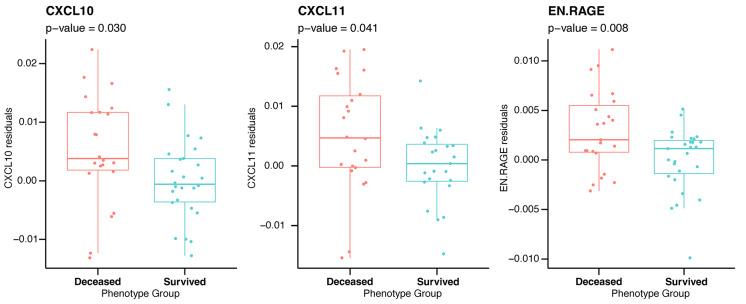
Deceased subjects had higher median epigenetic age expressed with DNAmPhenoAge algorithm (57.49 [54.72; 60.58] years. vs. 53.40 [49.73; 56.75] years; p = 0.012), and accelerated DunedinPoAm pace of aging (1.05 [1.02; 1.11] vs. 1.02 [0.98; 1.06]; p = 0.012). DNAm PhenoAge (HR 1.16, 95% CI 1.05-1.28; p = 0.004) and DunedinPoAm (HR 3.65, 95% CI 1.43-9.35; p = 0.007) showed an association with mortality independently of canonical risk factors. The epigenetic predictors of 3 chronic inflammation-related proteins, i.e. CXCL10, CXCL11 and enRAGE, C-reactive protein methylation risk score and DNAm-based estimates of exhausted CD8 + T cell counts were higher in deceased subjects when compared to survived.
CONCLUSIONS
These findings suggest that biological aging, as estimated through existing epigenetic tools, is associated with mortality risk in individuals with T2D, independently of common risk factors and that increased DNAm-surrogates of inflammatory protein levels characterize deceased T2D patients. Replication in larger cohorts is needed to assess the potential of this approach to refine mortality risk in T2D.
背景
2 型糖尿病(T2D)患者的死亡率较高,而这一风险不能完全用传统风险因素来解释。通过 DNA 甲基化(DNAm)进行生物年龄估计,即表观遗传时钟,正逐渐成为一种改善多种结局风险分层的可能手段。然而,这些工具在 T2D 患者中是否能独立于传统风险因素预测死亡率尚不清楚。
方法
在一项随访 16.8 年的 568 例 T2D 患者队列中,我们选择了一个亚组,共 50 例患者,其中 27 例仍存活,23 例已死亡。这些患者通过质量检查,并在倾向评分匹配后平衡了所有风险因素。我们使用经过验证的表观遗传时钟,分析了外周血白细胞中的 DNAm,以评估生物衰老,并评估选定的炎症蛋白和血细胞计数的 DNAm 估计水平。我们使用两阶段剩余结果回归分析来检验这些估计值与死亡率之间的关联,在存活患者的组中创建一个参考模型。
结果
死亡患者的中位表观遗传年龄(用 DNAmPhenoAge 算法表示)较高(57.49[54.72;60.58]岁,vs.53.40[49.73;56.75]岁;p=0.012),且 DunedinPoAm 衰老速度加快(1.05[1.02;1.11],vs.1.02[0.98;1.06];p=0.012)。DNAmPhenoAge(HR 1.16,95%CI 1.05-1.28;p=0.004)和 DunedinPoAm(HR 3.65,95%CI 1.43-9.35;p=0.007)与死亡率相关,独立于传统风险因素。死亡患者中,3 种与慢性炎症相关的蛋白质(即 CXCL10、CXCL11 和 enRAGE)、C 反应蛋白甲基化风险评分以及基于 DNAm 的耗尽 CD8+T 细胞计数的估计值较高。
结论
这些发现表明,通过现有的表观遗传工具估计的生物衰老与 T2D 患者的死亡风险相关,独立于常见的风险因素,并且增加的 DNAm-炎症蛋白水平的替代物可以描述死亡的 T2D 患者。需要在更大的队列中进行复制,以评估这种方法在细化 T2D 患者死亡率方面的潜力。



 Zotero 插件