
发现靶向亮氨酰 - tRNA合成酶的新型结核分枝杆菌口服蛋白质合成抑制剂。
Discovery of Novel Oral Protein Synthesis Inhibitors of Mycobacterium tuberculosis That Target Leucyl-tRNA Synthetase.
作者信息
Palencia Andrés, Li Xianfeng, Bu Wei, Choi Wai, Ding Charles Z, Easom Eric E, Feng Lisa, Hernandez Vincent, Houston Paul, Liu Liang, Meewan Maliwan, Mohan Manisha, Rock Fernando L, Sexton Holly, Zhang Suoming, Zhou Yasheen, Wan Baojie, Wang Yuehong, Franzblau Scott G, Woolhiser Lisa, Gruppo Veronica, Lenaerts Anne J, O'Malley Theresa, Parish Tanya, Cooper Christopher B, Waters M Gerard, Ma Zhenkun, Ioerger Thomas R, Sacchettini James C, Rullas Joaquín, Angulo-Barturen Iñigo, Pérez-Herrán Esther, Mendoza Alfonso, Barros David, Cusack Stephen, Plattner Jacob J, Alley M R K
机构信息
European Molecular Biology Laboratory, Grenoble, France.
Anacor Pharmaceuticals, Palo Alto, California, USA.
出版信息
Antimicrob Agents Chemother. 2016 Sep 23;60(10):6271-80. doi: 10.1128/AAC.01339-16. Print 2016 Oct.
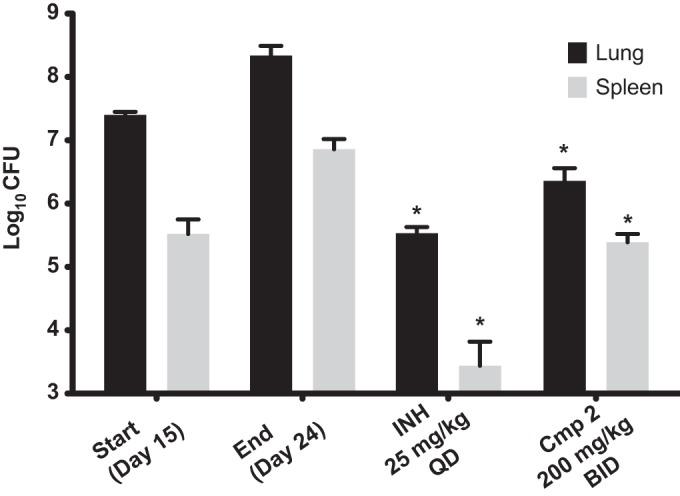
The recent development and spread of extensively drug-resistant and totally drug-resistant resistant (TDR) strains of Mycobacterium tuberculosis highlight the need for new antitubercular drugs. Protein synthesis inhibitors have played an important role in the treatment of tuberculosis (TB) starting with the inclusion of streptomycin in the first combination therapies. Although parenteral aminoglycosides are a key component of therapy for multidrug-resistant TB, the oxazolidinone linezolid is the only orally available protein synthesis inhibitor that is effective against TB. Here, we show that small-molecule inhibitors of aminoacyl-tRNA synthetases (AARSs), which are known to be excellent antibacterial protein synthesis targets, are orally bioavailable and effective against M. tuberculosis in TB mouse infection models. We applied the oxaborole tRNA-trapping (OBORT) mechanism, which was first developed to target fungal cytoplasmic leucyl-tRNA synthetase (LeuRS), to M. tuberculosis LeuRS. X-ray crystallography was used to guide the design of LeuRS inhibitors that have good biochemical potency and excellent whole-cell activity against M. tuberculosis Importantly, their good oral bioavailability translates into in vivo efficacy in both the acute and chronic mouse models of TB with potency comparable to that of the frontline drug isoniazid.
广泛耐药和完全耐药结核分枝杆菌菌株的近期发展与传播凸显了新型抗结核药物的必要性。从链霉素被纳入首批联合疗法开始,蛋白质合成抑制剂就在结核病(TB)治疗中发挥了重要作用。尽管胃肠外氨基糖苷类药物是耐多药结核病治疗的关键组成部分,但恶唑烷酮类药物利奈唑胺是唯一一种口服有效的、对结核病有效的蛋白质合成抑制剂。在此,我们表明,氨酰 - tRNA合成酶(AARSs)的小分子抑制剂在结核小鼠感染模型中口服具有生物利用度且对结核分枝杆菌有效,而AARSs是已知的优秀抗菌蛋白质合成靶点。我们将最初用于靶向真菌细胞质亮氨酰 - tRNA合成酶(LeuRS)的氧硼杂环丁烷tRNA捕获(OBORT)机制应用于结核分枝杆菌LeuRS。利用X射线晶体学指导设计对结核分枝杆菌具有良好生化活性和出色全细胞活性的LeuRS抑制剂。重要的是,它们良好的口服生物利用度转化为在结核病急性和慢性小鼠模型中的体内疗效,其效力与一线药物异烟肼相当。





 Zotero 插件