
用于嵌合抗原受体T细胞疗法的细胞因子诱导杀伤细胞和Vγ9Vδ2 T细胞的共扩增
Co-Expansion of Cytokine-Induced Killer Cells and Vγ9Vδ2 T Cells for CAR T-Cell Therapy.
作者信息
Du Shou-Hui, Li Zhendong, Chen Can, Tan Wee-Kiat, Chi Zhixia, Kwang Timothy Weixin, Xu Xue-Hu, Wang Shu
机构信息
Department of Biological Sciences, National University of Singapore, Singapore, 117543, Singapore.
Tessa Therapeutics, Pte Ltd., Singapore, 239351, Singapore.
出版信息
PLoS One. 2016 Sep 6;11(9):e0161820. doi: 10.1371/journal.pone.0161820. eCollection 2016.
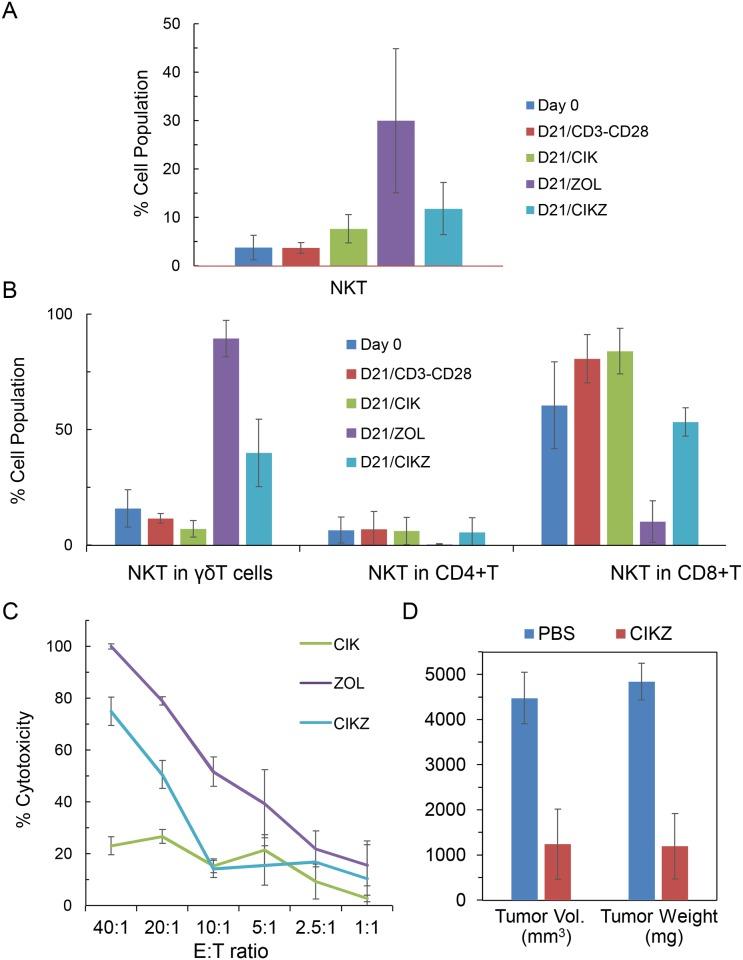
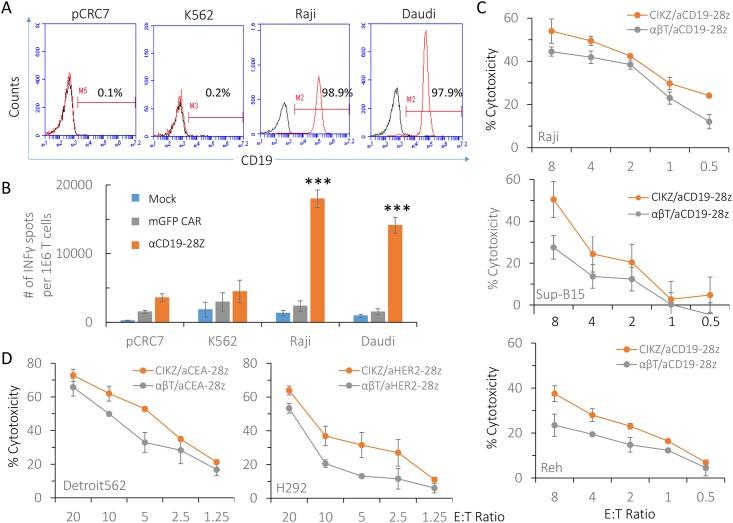
Gamma delta (γδ) T cells and cytokine-induced killer (CIK) cells, which are a heterogeneous population of T lymphocytes and natural killer T (NKT) cells, have been separately expanded ex vivo and shown to be capable of targeting and mediating cytotoxicity against various tumor cells in a major histocompatibility complex-unrestricted manner. However, the co-expansion and co-administration of these immune cells have not been explored. In this study we describe an efficient method to expand simultaneously both CIK and Vγ9Vδ2 T cells, termed as CIKZ cells, from human peripheral blood mononuclear cells (PBMCs) using Zometa, interferon-gamma (IFN-γ), interleukin 2 (IL-2), anti-CD3 antibody and engineered K562 feeder cells expressing CD64, CD137L and CD86. A 21-day culture of PBMCs with this method yielded nearly 20,000-fold expansion of CIKZ cells with γδ T cells making up over 20% of the expanded population. The expanded CIKZ cells exhibited antitumor cytotoxicity and could be modified to express anti-CD19 chimeric antigen receptor (CAR), anti-CEA CAR, and anti-HER2 CAR to enhance their specificity and cytotoxicity against CD19-, CEA-, or HER2-positive tumor cells. The tumor inhibitory activity of anti-CD19 CAR-modified CIKZ cells was further demonstrated in vivo in a Raji tumor mouse model. The findings herein substantiate the feasibility of co-expanding CIK and γδ cells for adoptive cellular immunotherapy applications such as CAR T-cell therapy against cancer.
γδ T细胞和细胞因子诱导的杀伤(CIK)细胞,它们是T淋巴细胞和自然杀伤T(NKT)细胞的异质群体,已在体外分别扩增,并显示能够以主要组织相容性复合体非限制性方式靶向并介导对各种肿瘤细胞的细胞毒性。然而,这些免疫细胞的共扩增和共同给药尚未得到探索。在本研究中,我们描述了一种有效的方法,使用唑来膦酸、干扰素-γ(IFN-γ)、白细胞介素2(IL-2)、抗CD3抗体和表达CD64、CD137L和CD86的工程化K562饲养细胞,从人外周血单个核细胞(PBMC)中同时扩增CIK和Vγ9Vδ2 T细胞,称为CIKZ细胞。用这种方法对PBMC进行21天培养,可使CIKZ细胞扩增近20000倍,其中γδ T细胞占扩增群体的20%以上。扩增后的CIKZ细胞表现出抗肿瘤细胞毒性,并可被修饰以表达抗CD19嵌合抗原受体(CAR)、抗CEA CAR和抗HER2 CAR,以增强其对CD19、CEA或HER2阳性肿瘤细胞的特异性和细胞毒性。在Raji肿瘤小鼠模型中进一步在体内证明了抗CD19 CAR修饰的CIKZ细胞的肿瘤抑制活性。本文的研究结果证实了共扩增CIK和γδ细胞用于过继性细胞免疫治疗应用(如针对癌症的CAR T细胞治疗)的可行性。


 Zotero 插件