
对2419例实体癌脑转移患者的真实队列进行描述性统计分析。
Descriptive statistical analysis of a real life cohort of 2419 patients with brain metastases of solid cancers.
作者信息
Berghoff Anna S, Schur Sophie, Füreder Lisa M, Gatterbauer Brigitte, Dieckmann Karin, Widhalm Georg, Hainfellner Johannes, Zielinski Christoph C, Birner Peter, Bartsch Rupert, Preusser Matthias
机构信息
Department of Medicine I, Medical University of Vienna, Vienna, Austria; Comprehensive Cancer Center, Medical University of Vienna, Vienna, Austria.
Comprehensive Cancer Center, Medical University of Vienna, Vienna, Austria; Department of Neurosurgery, Medical University of Vienna, Vienna, Austria.
出版信息
ESMO Open. 2016 Mar 16;1(2):e000024. doi: 10.1136/esmoopen-2015-000024. eCollection 2016.
AIM
We provide a descriptive statistical analysis of baseline characteristics and the clinical course of a large real-life cohort of brain metastases (BM) patients.
METHODS
We performed a retrospective chart review for patients treated for BM of solid cancers at the Medical University of Vienna between 1990 and 2011.
RESULTS
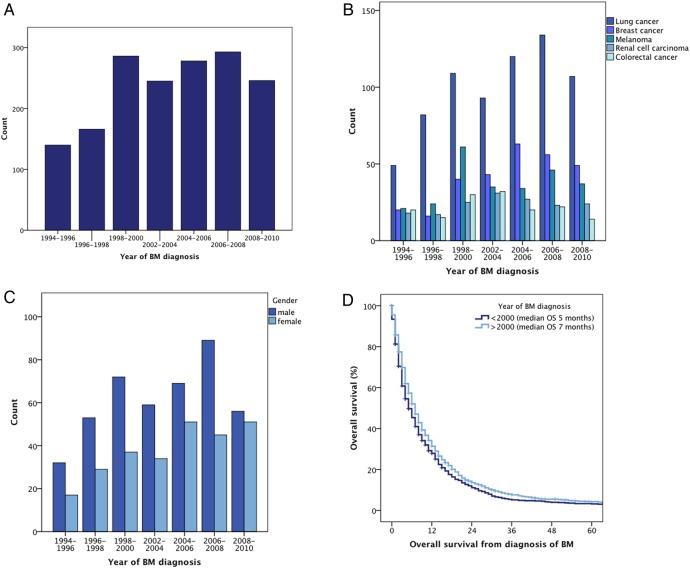
We identified a total of 2419 BM patients (50.5% male, 49.5% female, median age 59 years). The primary tumour was lung cancer in 43.2%, breast cancer in 15.7%, melanoma in 16.4%, renal cell carcinoma in 9.1%, colorectal cancer in 9.3% and unknown in 1.4% of cases. Rare tumour types associated with BM included genitourinary cancers (4.1%), sarcomas (0.7%). gastro-oesophageal cancer (0.6%) and head and neck cancers (0.2%). 48.7% of patients presented with a singular BM, 27.7% with 2-3 and 23.5% with >3 BM. Time from primary tumour to BM diagnosis was shortest in lung cancer (median 11 months; range 1-162) and longest in breast cancer (median 44 months; 1-443; p<0.001). Multiple BM were most frequent in breast cancer (30.6%) and least frequent in colorectal cancer (8.5%; p<0.001). Patients with breast cancer had the longest median overall survival times (8 months), followed by patients with lung cancer (7 months), renal cell carcinoma (7 months), melanoma (5 months) and colorectal cancer (4 months; p<0.001; log rank test). Recursive partitioning analysis and graded prognostic assessment scores showed significant correlation with overall survival (both p<0.001, log rank test). Evaluation of the disease status in the past 2 months prior to patient death showed intracranial progression in 35.9%, extracranial progression in 27.5% and combined extracranial and intracranial progression in 36.6% of patients.
CONCLUSIONS
Our data highlight the heterogeneity in presentation and clinical course of BM patients in the everyday clinical setting and may be useful for rational planning of clinical studies.
目的
我们对大量脑转移瘤(BM)患者的真实队列的基线特征和临床病程进行描述性统计分析。
方法
我们对1990年至2011年间在维也纳医科大学接受实体癌BM治疗的患者进行了回顾性病历审查。
结果
我们共识别出2419例BM患者(男性占50.5%,女性占49.5%,中位年龄59岁)。原发肿瘤为肺癌的占43.2%,乳腺癌的占15.7%,黑色素瘤的占16.4%,肾细胞癌的占9.1%,结直肠癌的占9.3%,1.4%的病例原发肿瘤未知。与BM相关的罕见肿瘤类型包括泌尿生殖系统癌症(4.1%)、肉瘤(0.7%)、胃食管癌(0.6%)和头颈癌(0.2%)。48.7%的患者表现为单个BM,27.7%的患者表现为2 - 3个BM,23.5%的患者表现为超过3个BM。从原发肿瘤到BM诊断的时间在肺癌中最短(中位时间11个月;范围1 - 162个月),在乳腺癌中最长(中位时间44个月;1 - 443个月;p<0.001)。多发BM在乳腺癌中最常见(30.6%),在结直肠癌中最不常见(8.5%;p<0.001)。乳腺癌患者的中位总生存时间最长(8个月),其次是肺癌患者(7个月)、肾细胞癌患者(7个月)、黑色素瘤患者(5个月)和结直肠癌患者(4个月;p<0.001;对数秩检验)。递归划分分析和分级预后评估评分与总生存显著相关(均为p<0.001,对数秩检验)。对患者死亡前2个月的疾病状态评估显示,35.9%的患者有颅内进展,27.5%的患者有颅外进展,36.6%的患者有颅外和颅内联合进展。
结论
我们的数据突出了日常临床环境中BM患者表现和临床病程的异质性,可能有助于合理规划临床研究。


 Zotero 插件