
CRISPR/Cas9诱导的拟南芥非同源末端连接突变体中的双链断裂修复
CRISPR/Cas9-Induced Double-Strand Break Repair in Arabidopsis Nonhomologous End-Joining Mutants.
作者信息
Shen Hexi, Strunks Gary D, Klemann Bart J P M, Hooykaas Paul J J, de Pater Sylvia
机构信息
Department of Molecular and Developmental Genetics, Institute of Biology, Leiden University, 2333 BE, The Netherlands.
Department of Molecular and Developmental Genetics, Institute of Biology, Leiden University, 2333 BE, The Netherlands
出版信息
G3 (Bethesda). 2017 Jan 5;7(1):193-202. doi: 10.1534/g3.116.035204.
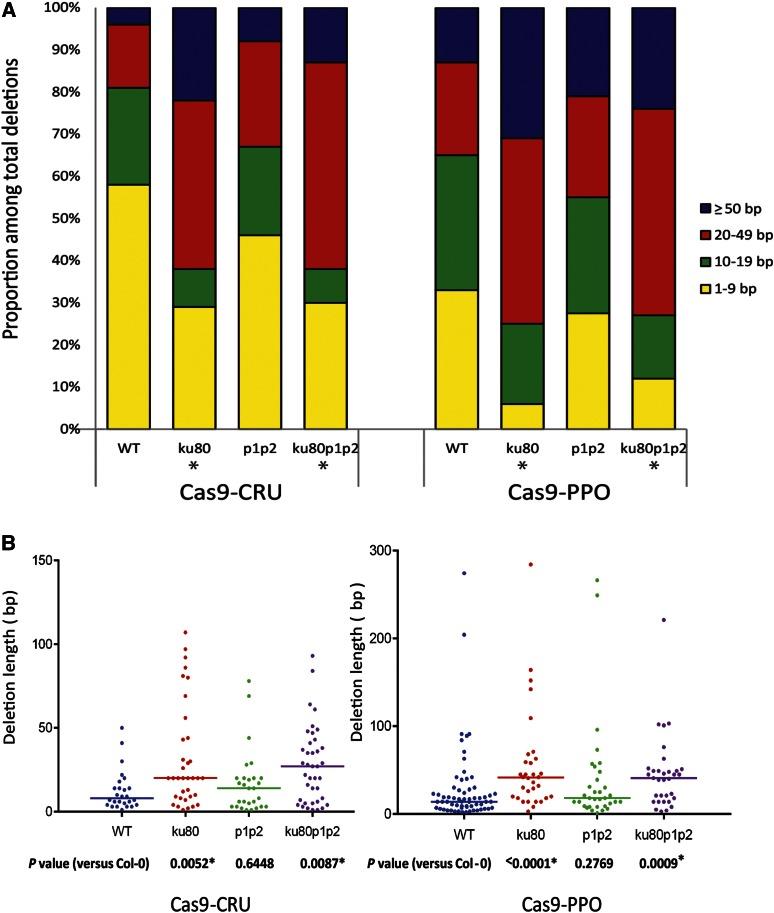
Double-strand breaks (DSBs) are one of the most harmful DNA lesions. Cells utilize two main pathways for DSB repair: homologous recombination (HR) and nonhomologous end-joining (NHEJ). NHEJ can be subdivided into the KU-dependent classical NHEJ (c-NHEJ) and the more error-prone KU-independent backup-NHEJ (b-NHEJ) pathways, involving the poly (ADP-ribose) polymerases (PARPs). However, in the absence of these factors, cells still seem able to adequately maintain genome integrity, suggesting the presence of other b-NHEJ repair factors or pathways independent from KU and PARPs. The outcome of DSB repair by NHEJ pathways can be investigated by using artificial sequence-specific nucleases such as CRISPR/Cas9 to induce DSBs at a target of interest. Here, we used CRISPR/Cas9 for DSB induction at the Arabidopsis cruciferin 3 (CRU3) and protoporphyrinogen oxidase (PPO) genes. DSB repair outcomes via NHEJ were analyzed using footprint analysis in wild-type plants and plants deficient in key factors of c-NHEJ (ku80), b-NHEJ (parp1 parp2), or both (ku80 parp1 parp2). We found that larger deletions of >20 bp predominated after DSB repair in ku80 and ku80 parp1 parp2 mutants, corroborating with a role of KU in preventing DSB end resection. Deletion lengths did not significantly differ between ku80 and ku80 parp1 parp2 mutants, suggesting that a KU- and PARP-independent b-NHEJ mechanism becomes active in these mutants. Furthermore, microhomologies and templated insertions were observed at the repair junctions in the wild type and all mutants. Since these characteristics are hallmarks of polymerase θ-mediated DSB repair, we suggest a possible role for this recently discovered polymerase in DSB repair in plants.
双链断裂(DSBs)是最有害的DNA损伤之一。细胞利用两种主要途径进行DSB修复:同源重组(HR)和非同源末端连接(NHEJ)。NHEJ可细分为依赖KU的经典NHEJ(c-NHEJ)和更易出错的不依赖KU的备用NHEJ(b-NHEJ)途径,这涉及多聚(ADP-核糖)聚合酶(PARPs)。然而,在缺乏这些因子的情况下,细胞似乎仍能够充分维持基因组完整性,这表明存在其他不依赖KU和PARPs的b-NHEJ修复因子或途径。通过使用人工序列特异性核酸酶如CRISPR/Cas9在感兴趣的靶点诱导DSBs,可以研究NHEJ途径的DSB修复结果。在这里,我们使用CRISPR/Cas9在拟南芥十字花科蛋白3(CRU3)和原卟啉原氧化酶(PPO)基因处诱导DSBs。通过足迹分析在野生型植物以及c-NHEJ(ku80)、b-NHEJ(parp1 parp2)或两者(ku80 parp1 parp2)关键因子缺陷的植物中分析了经由NHEJ的DSB修复结果。我们发现,在ku80和ku80 parp1 parp2突变体中,DSB修复后大于20 bp的更大缺失占主导,这证实了KU在防止DSB末端切除中的作用。ku80和ku80 parp1 parp2突变体之间的缺失长度没有显著差异,这表明一种不依赖KU和PARP的b-NHEJ机制在这些突变体中变得活跃。此外,在野生型和所有突变体的修复连接处观察到了微同源性和模板化插入。由于这些特征是聚合酶θ介导的DSB修复的标志,我们认为这种最近发现的聚合酶在植物DSB修复中可能发挥作用。


 Zotero 插件