
皮质醇对精神压力的反应与白细胞端粒损耗之间的纵向关系。
The Longitudinal Relationship Between Cortisol Responses to Mental Stress and Leukocyte Telomere Attrition.
作者信息
Steptoe Andrew, Hamer Mark, Lin Jue, Blackburn Elizabeth H, Erusalimsky Jorge D
机构信息
Department of Epidemiology and Public Health, University College London, London WC1E 6BT, United Kingdom.
School of Sport, Exercise, and Health Sciences, Loughborough University, Loughborough LE11 3TU, United Kingdom.
出版信息
J Clin Endocrinol Metab. 2017 Mar 1;102(3):962-969. doi: 10.1210/jc.2016-3035.
CONTEXT
Chronic psychological stress has been associated with shorter telomeres, but the underlying mechanisms are poorly understood. One possibility is that the neuroendocrine responses to stress exposure are involved.
OBJECTIVE
To test the hypothesis that greater cortisol responsivity to acute stressors predicts more rapid telomere attrition.
DESIGN
We measured salivary cortisol responses to 2 challenging behavioral tasks. Leukocyte telomere length was measured at the time of mental stress testing and 3 years later.
PARTICIPANTS
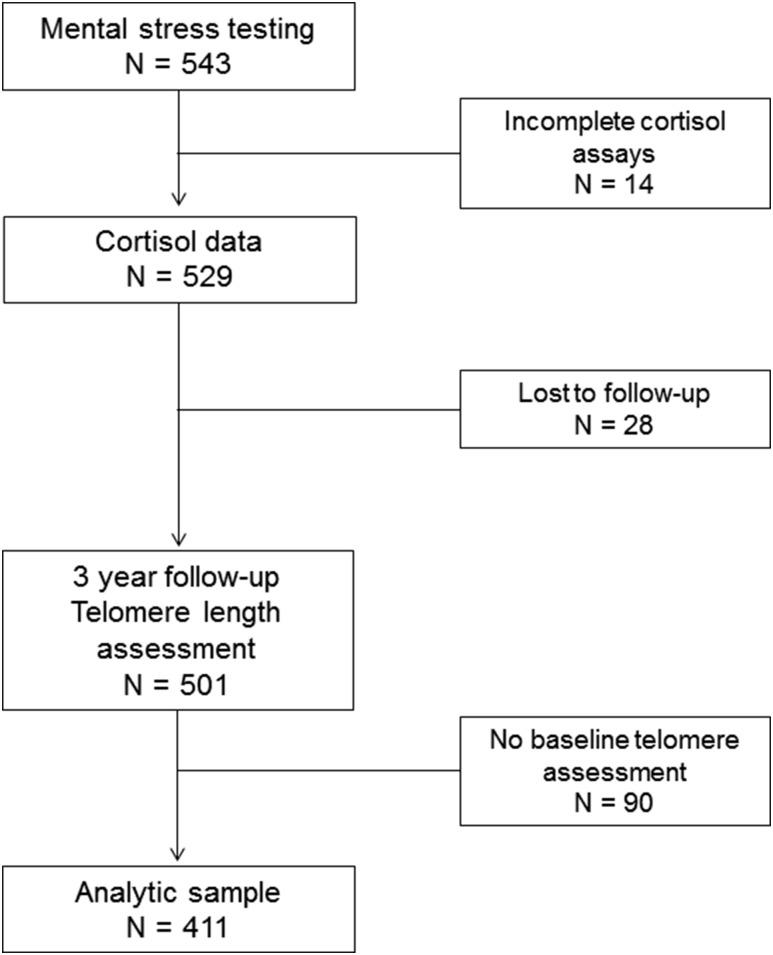
We studied 411 initially healthy men and women aged 54 to 76 years.
MAIN OUTCOME MEASURE
Leukocyte telomere length.
RESULTS
Cortisol responses to this protocol were small; we divided participants into cortisol responders (n = 156) and nonresponders (n = 255) using a criterion (≥20% increase in cortisol concentration) previously shown to predict increases in cardiovascular disease risk. There was no significant association between cortisol responsivity and baseline telomere length, although cortisol responders tended to have somewhat shorter telomeres (β = -0.061; standard error, 0.049). But cortisol responders had shorter telomeres and more rapid telomere attrition than nonresponders on follow-up, after controlling statistically for age, sex, socioeconomic status, smoking, time of day of stress , and baseline telomere length (β = -0.10; standard error, 0.046; P = 0.029). The association was maintained after additional control for cardiovascular risk factors (β = -0.11; P = 0.031). The difference between cortisol responders and nonresponders was equivalent to approximately 2 years in aging.
CONCLUSIONS
These findings suggest that cortisol responsivity may mediate, in part, the relationship between psychological stress and cellular aging.
背景
慢性心理压力与较短的端粒有关,但其潜在机制尚不清楚。一种可能性是涉及对应激暴露的神经内分泌反应。
目的
检验以下假设,即对急性应激源的皮质醇反应性越强,端粒损耗越快。
设计
我们测量了对两项具有挑战性的行为任务的唾液皮质醇反应。在心理压力测试时和3年后测量白细胞端粒长度。
参与者
我们研究了411名年龄在54至76岁之间、最初健康的男性和女性。
主要观察指标
白细胞端粒长度。
结果
对该方案的皮质醇反应较小;我们使用先前显示可预测心血管疾病风险增加的标准(皮质醇浓度增加≥20%)将参与者分为皮质醇反应者(n = 156)和无反应者(n = 255)。皮质醇反应性与基线端粒长度之间无显著关联,尽管皮质醇反应者的端粒往往略短(β = -0.061;标准误,0.049)。但在对年龄、性别、社会经济地位、吸烟、应激时间和基线端粒长度进行统计学控制后,随访时皮质醇反应者的端粒比无反应者短,端粒损耗更快(β = -0.10;标准误,0.046;P = 0.029)。在进一步控制心血管危险因素后,这种关联仍然存在(β = -0.11;P = 0.031)。皮质醇反应者和无反应者之间的差异相当于大约2年的衰老差异。
结论
这些发现表明,皮质醇反应性可能部分介导心理压力与细胞衰老之间的关系。


 Zotero 插件