
miR-4286抑制对黑色素瘤细胞的抗增殖和促凋亡作用
Antiproliferative and Pro-Apoptotic Effects of MiR-4286 Inhibition in Melanoma Cells.
作者信息
Komina Anna, Palkina Nadezhda, Aksenenko Mariya, Tsyrenzhapova Seseg, Ruksha Tatiana
机构信息
Department of Pathophysiology, Krasnoyarsk State Medical University, Krasnoyarsk, Russian Federation.
出版信息
PLoS One. 2016 Dec 22;11(12):e0168229. doi: 10.1371/journal.pone.0168229. eCollection 2016.
INTRODUCTION
MicroRNAs are essential regulators of gene expression at the post-transcriptional level. Their expression is altered in cancer tissues, and evaluation of these alterations is considered a promising tool used to diagnose and identify prognostic markers.
MATERIALS AND METHODS
The microRNA expression profiles of formalin-fixed, paraffin-embedded melanoma and melanocytic nevi samples were estimated with a microarray and subsequently validated by real-time PCR. Melanoma cells were transfected with miR-4286 inhibitor to evaluate the influence of this microRNA on the viability, proliferation, apoptosis, migration, and invasion of melanoma cells.
RESULTS
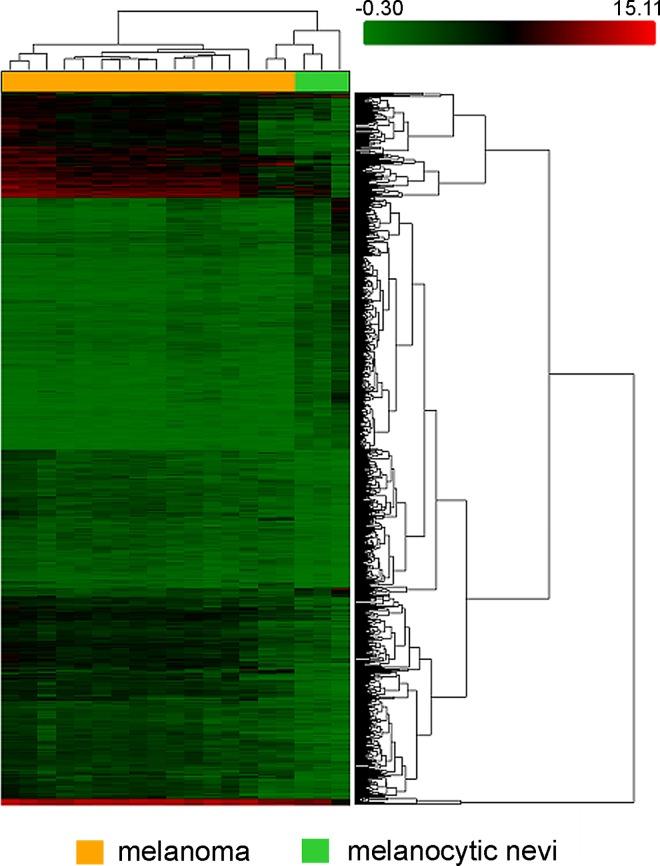
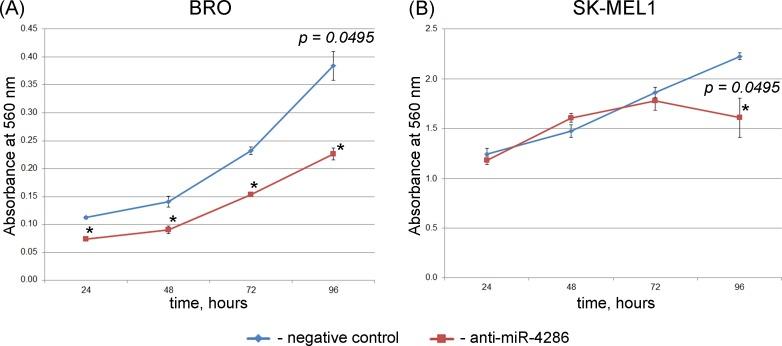
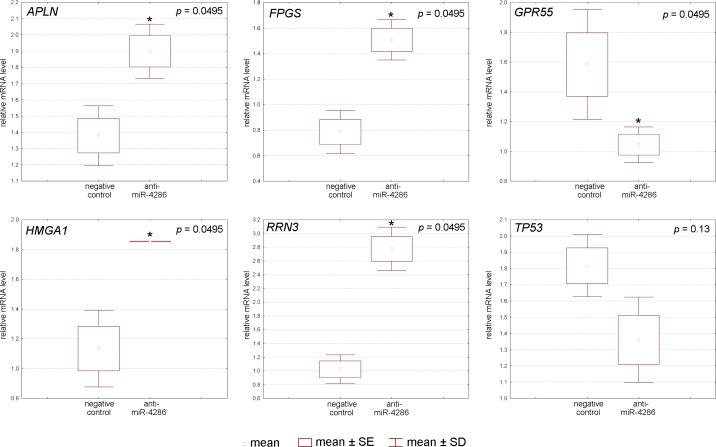
The microarray revealed that the expression of 1,171 microRNAs was altered in melanoma samples compared to melanocytic nevi. Real-time PCR validation experiments found the microRNA expression levels to correspond to the melanoma/melanocytic nevi microarray results. The pathway analysis identified 52 modulated pathways in melanoma. Moreover, the application of miR-4286 inhibitor to BRO melanoma cells resulted in a 2.6-fold increase in the apoptosis rate and a 1.7-fold decrease in the cell proliferation/viability but did not affect the invasiveness and migration of these cells. Furthermore, the use of miR-4286 inhibitor altered the mRNA expression of several miR-4286 gene targets: folylpolyglutamate synthase, RNA polymerase I-specific transcription initiation factor, apelin, G-protein-coupled receptor 55, and high-mobility group A1 protein, which have been implicated in cell proliferation/apoptosis regulation. Lastly, the transiently transfected SK-MEL-1 cells with miR-4286 inhibitor decreased proliferation rate and modulated folylpolyglutamate synthase rates of these cells.
CONCLUSION
Our results demonstrate that miR-4286 mediates proliferation and apoptosis in melanoma cells, these findings may represent a novel mechanism underlying these processes.
引言
微小RNA是转录后水平基因表达的重要调节因子。它们在癌组织中的表达会发生改变,对这些改变的评估被认为是用于诊断和识别预后标志物的一种有前景的工具。
材料与方法
使用微阵列估计福尔马林固定、石蜡包埋的黑色素瘤和黑素细胞痣样本的微小RNA表达谱,随后通过实时PCR进行验证。用miR-4286抑制剂转染黑色素瘤细胞,以评估该微小RNA对黑色素瘤细胞活力、增殖、凋亡、迁移和侵袭的影响。
结果
微阵列显示,与黑素细胞痣相比,黑色素瘤样本中1171种微小RNA的表达发生了改变。实时PCR验证实验发现微小RNA表达水平与黑色素瘤/黑素细胞痣微阵列结果相符。通路分析确定了黑色素瘤中52条受调控的通路。此外,将miR-4286抑制剂应用于BRO黑色素瘤细胞导致凋亡率增加2.6倍,细胞增殖/活力降低1.7倍,但不影响这些细胞的侵袭性和迁移。此外,使用miR-4286抑制剂改变了几个miR-4286基因靶点的mRNA表达:叶酰聚谷氨酸合成酶、RNA聚合酶I特异性转录起始因子、apelin、G蛋白偶联受体55和高迁移率族A1蛋白,这些蛋白与细胞增殖/凋亡调节有关。最后,用miR-4286抑制剂瞬时转染SK-MEL-1细胞降低了这些细胞的增殖率并调节了叶酰聚谷氨酸合成酶的活性。
结论
我们的结果表明,miR-4286介导黑色素瘤细胞的增殖和凋亡,这些发现可能代表了这些过程背后的一种新机制。





 Zotero 插件