
血清CCL-18水平是慢性阻塞性肺疾病(COPD)加重需住院治疗的一个危险因素。
Serum CCL-18 level is a risk factor for COPD exacerbations requiring hospitalization.
作者信息
Dilektasli Asli Gorek, Demirdogen Cetinoglu Ezgi, Uzaslan Esra, Budak Ferah, Coskun Funda, Ursavas Ahmet, Ercan Ilker, Ege Ercument
机构信息
Department of Pulmonary Disesaes.
Department of Immunology.
出版信息
Int J Chron Obstruct Pulmon Dis. 2017 Jan 5;12:199-208. doi: 10.2147/COPD.S118424. eCollection 2017.
INTRODUCTION
Chemokine (C-C motif) ligand 18 (CCL-18) has been shown to be elevated in chronic obstructive pulmonary disease (COPD) patients. This study primarily aimed to evaluate whether the serum CCL-18 level differentiates the frequent exacerbator COPD phenotype from infrequent exacerbators. The secondary aim was to investigate whether serum CCL-18 level is a risk factor for exacerbations requiring hospitalization.
MATERIALS AND METHODS
Clinically stable COPD patients and participants with smoking history but normal spirometry (NSp) were recruited for the study. Modified Medical Research Council Dyspnea Scale, COPD Assessment Test, spirometry, and 6-min walking test were performed. Serum CCL-18 levels were measured with a commercial ELISA Kit.
RESULTS
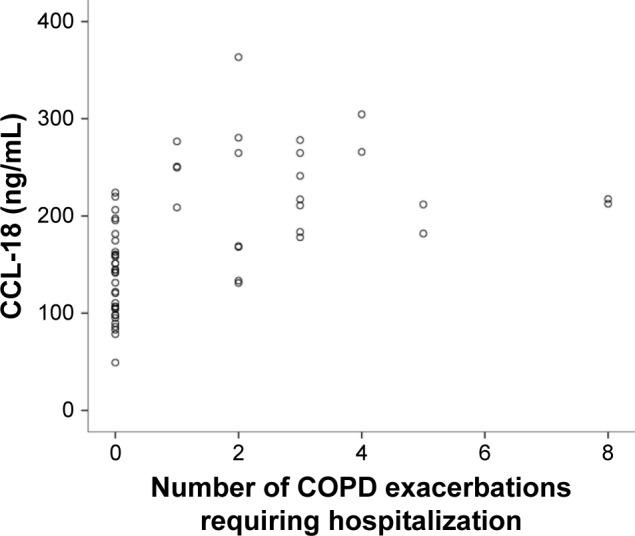
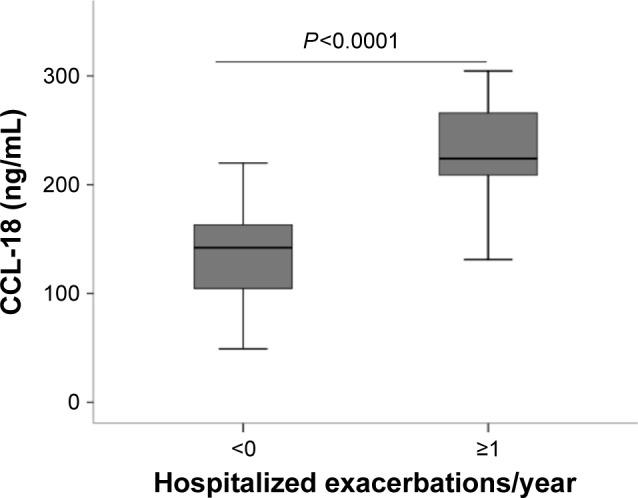
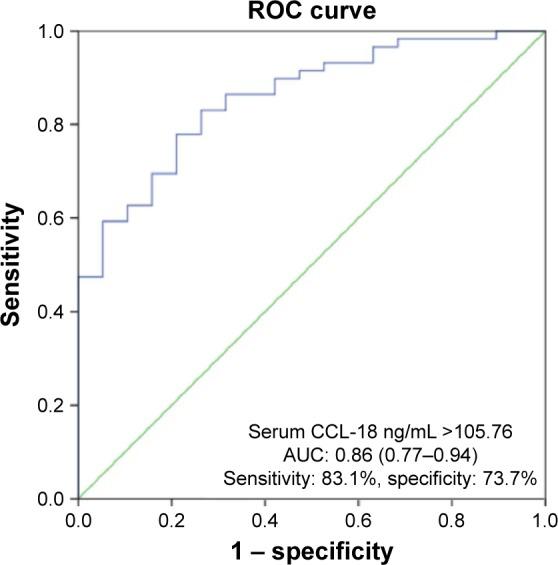
Sixty COPD patients and 20 NSp patients were recruited. Serum CCL-18 levels were higher in COPD patients than those in NSp patients (169 vs 94 ng/mL, <0.0001). CCL-18 level was significantly correlated with the number of exacerbations (=0.30, =0.026), although a difference in CCL-18 values between infrequent and frequent exacerbator COPD (168 vs 196 ng/mL) subgroups did not achieve statistical significance (=0.09). Serum CCL-18 levels were significantly higher in COPD patients who had experienced at least one exacerbation during the previous 12 months. Overall, ROC analysis revealed that a serum CCL-18 level of 181.71 ng/mL could differentiate COPD patients with hospitalized exacerbations from those who were not hospitalized with a 88% sensitivity and 88.2% specificity (area under curve: 0.92). Serum CCL-18 level had a strong correlation with the frequency of exacerbations requiring hospitalization (=0.68, <0.0001) and was found to be an independent risk factor for hospitalized exacerbations in the multivariable analysis.
CONCLUSION
CCL-18 is a promising biomarker in COPD, as it is associated with frequency of exacerbations, particularly with severe COPD exacerbations requiring hospitalization, as well as with functional parameters and symptom scores.
引言
趋化因子(C-C基序)配体18(CCL-18)已被证明在慢性阻塞性肺疾病(COPD)患者中升高。本研究主要旨在评估血清CCL-18水平是否能区分频繁急性加重型COPD表型与不频繁急性加重型。次要目的是研究血清CCL-18水平是否是需要住院治疗的急性加重的危险因素。
材料与方法
招募临床稳定的COPD患者以及有吸烟史但肺功能正常(NSp)的参与者进行研究。进行改良医学研究委员会呼吸困难量表、COPD评估测试、肺功能测定和6分钟步行试验。用商用ELISA试剂盒测量血清CCL-18水平。
结果
招募了60例COPD患者和20例NSp患者。COPD患者的血清CCL-18水平高于NSp患者(169对94 ng/mL,<0.0001)。CCL-18水平与急性加重次数显著相关(=0.30,=0.026),尽管不频繁和频繁急性加重型COPD亚组之间的CCL-18值差异(168对196 ng/mL)未达到统计学显著性(=0.09)。在过去12个月内经历过至少一次急性加重的COPD患者中,血清CCL-18水平显著更高。总体而言,ROC分析显示,血清CCL-18水平为181.71 ng/mL可区分因急性加重住院的COPD患者和未住院患者,敏感性为88%,特异性为88.2%(曲线下面积:0.92)。血清CCL-18水平与需要住院治疗的急性加重频率密切相关(=0.68,<0.0001),并且在多变量分析中被发现是住院急性加重的独立危险因素。
结论
CCL-18是COPD中有前景的生物标志物,因为它与急性加重频率相关,特别是与需要住院治疗的严重COPD急性加重相关,还与功能参数和症状评分相关。


 Zotero 插件