
视黄酸和转化生长因子-β信号协同作用以克服MYCN诱导的类维生素A耐药性。
Retinoic acid and TGF-β signalling cooperate to overcome MYCN-induced retinoid resistance.
作者信息
Duffy David J, Krstic Aleksandar, Halasz Melinda, Schwarzl Thomas, Konietzny Anja, Iljin Kristiina, Higgins Desmond G, Kolch Walter
机构信息
Systems Biology Ireland, University College Dublin, Belfield, Dublin 4, Ireland.
Conway Institute of Biomolecular & Biomedical Research, University College Dublin, Belfield, Dublin 4, Ireland.
出版信息
Genome Med. 2017 Feb 10;9(1):15. doi: 10.1186/s13073-017-0407-3.
BACKGROUND
Retinoid therapy is widely employed in clinical oncology to differentiate malignant cells into their more benign counterparts. However, certain high-risk cohorts, such as patients with MYCN-amplified neuroblastoma, are innately resistant to retinoid therapy. Therefore, we employed a precision medicine approach to globally profile the retinoid signalling response and to determine how an excess of cellular MYCN antagonises these signalling events to prevent differentiation and confer resistance.
METHODS
We applied RNA sequencing (RNA-seq) and interaction proteomics coupled with network-based systems level analysis to identify targetable vulnerabilities of MYCN-mediated retinoid resistance. We altered MYCN expression levels in a MYCN-inducible neuroblastoma cell line to facilitate or block retinoic acid (RA)-mediated neuronal differentiation. The relevance of differentially expressed genes and transcriptional regulators for neuroblastoma outcome were then confirmed using existing patient microarray datasets.
RESULTS
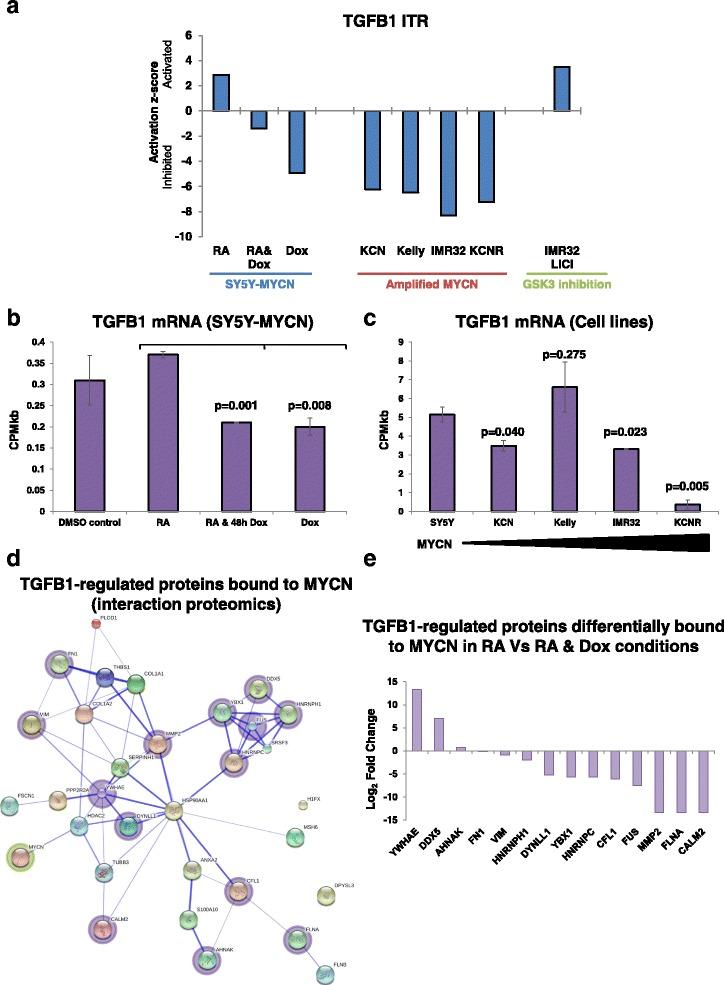
We determined the signalling networks through which RA mediates neuroblastoma differentiation and the inhibitory perturbations to these networks upon MYCN overexpression. We revealed opposing regulation of RA and MYCN on a number of differentiation-relevant genes, including LMO4, CYP26A1, ASCL1, RET, FZD7 and DKK1. Furthermore, we revealed a broad network of transcriptional regulators involved in regulating retinoid responsiveness, such as Neurotrophin, PI3K, Wnt and MAPK, and epigenetic signalling. Of these regulators, we functionally confirmed that MYCN-driven inhibition of transforming growth factor beta (TGF-β) signalling is a vulnerable node of the MYCN network and that multiple levels of cross-talk exist between MYCN and TGF-β. Co-targeting of the retinoic acid and TGF-β pathways, through RA and kartogenin (KGN; a TGF-β signalling activating small molecule) combination treatment, induced the loss of viability of MYCN-amplified retinoid-resistant neuroblastoma cells.
CONCLUSIONS
Our approach provides a powerful precision oncology tool for identifying the driving signalling networks for malignancies not primarily driven by somatic mutations, such as paediatric cancers. By applying global omics approaches to the signalling networks regulating neuroblastoma differentiation and stemness, we have determined the pathways involved in the MYCN-mediated retinoid resistance, with TGF-β signalling being a key regulator. These findings revealed a number of combination treatments likely to improve clinical response to retinoid therapy, including co-treatment with retinoids and KGN, which may prove valuable in the treatment of high-risk MYCN-amplified neuroblastoma.
背景
维甲酸疗法在临床肿瘤学中被广泛应用,用于将恶性细胞分化为更良性的细胞。然而,某些高危人群,如MYCN扩增的神经母细胞瘤患者,天生对维甲酸疗法耐药。因此,我们采用精准医学方法全面分析维甲酸信号反应,并确定细胞内过量的MYCN如何拮抗这些信号事件以阻止分化并产生耐药性。
方法
我们应用RNA测序(RNA-seq)和相互作用蛋白质组学,并结合基于网络的系统水平分析,以确定MYCN介导的维甲酸耐药的可靶向弱点。我们在MYCN诱导型神经母细胞瘤细胞系中改变MYCN表达水平,以促进或阻断视黄酸(RA)介导的神经元分化。然后使用现有的患者微阵列数据集确认差异表达基因和转录调节因子与神经母细胞瘤预后的相关性。
结果
我们确定了RA介导神经母细胞瘤分化的信号网络以及MYCN过表达对这些网络的抑制性干扰。我们揭示了RA和MYCN对许多与分化相关基因的相反调节作用,包括LMO4、CYP26A1、ASCL1、RET、FZD7和DKK1。此外,我们揭示了一个广泛的转录调节因子网络,参与调节维甲酸反应性,如神经营养因子、PI3K、Wnt和MAPK以及表观遗传信号。在这些调节因子中,我们通过功能验证发现MYCN驱动的对转化生长因子β(TGF-β)信号的抑制是MYCN网络的一个脆弱节点,并且MYCN和TGF-β之间存在多个水平的相互作用。通过RA和卡托金(KGN;一种TGF-β信号激活小分子)联合治疗共同靶向维甲酸和TGF-β途径,可诱导MYCN扩增的维甲酸耐药神经母细胞瘤细胞活力丧失。
结论
我们的方法为识别并非主要由体细胞突变驱动的恶性肿瘤(如儿科癌症)的驱动信号网络提供了一个强大的精准肿瘤学工具。通过将全局组学方法应用于调节神经母细胞瘤分化和干性的信号网络,我们确定了参与MYCN介导的维甲酸耐药的途径,其中TGF-β信号是关键调节因子。这些发现揭示了一些可能改善维甲酸治疗临床反应的联合治疗方法,包括维甲酸与KGN联合治疗,这可能对治疗高危MYCN扩增的神经母细胞瘤具有重要价值。



 Zotero 插件