
巨噬细胞向肌成纤维细胞的转变促成慢性肾移植损伤中的间质纤维化。
Macrophage-to-Myofibroblast Transition Contributes to Interstitial Fibrosis in Chronic Renal Allograft Injury.
作者信息
Wang Ying-Ying, Jiang Hong, Pan Jun, Huang Xiao-Ru, Wang Yu-Cheng, Huang Hong-Feng, To Ka-Fai, Nikolic-Paterson David J, Lan Hui-Yao, Chen Jiang-Hua
机构信息
Kidney Disease Center, The First Affiliated Hospital, School of Medicine, Zhejiang University, Hangzhou, China.
Department of Medicine and Therapeutics, Li Ka Shing Institute of Health Sciences, and The Chinese University of Hong Kong, Shenzhen Research Institute, and.
出版信息
J Am Soc Nephrol. 2017 Jul;28(7):2053-2067. doi: 10.1681/ASN.2016050573. Epub 2017 Feb 16.
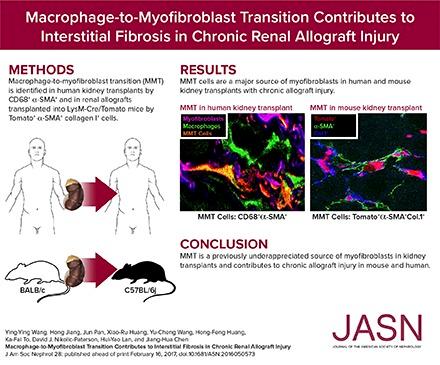
Interstitial fibrosis is an important contributor to graft loss in chronic renal allograft injury. Inflammatory macrophages are associated with fibrosis in renal allografts, but how these cells contribute to this damaging response is not clearly understood. Here, we investigated the role of macrophage-to-myofibroblast transition in interstitial fibrosis in human and experimental chronic renal allograft injury. In biopsy specimens from patients with active chronic allograft rejection, we identified cells undergoing macrophage-to-myofibroblast transition by the coexpression of macrophage (CD68) and myofibroblast (-smooth muscle actin [-SMA]) markers. CD68/-SMA cells accounted for approximately 50% of the myofibroblast population, and the number of these cells correlated with allograft function and the severity of interstitial fibrosis. Similarly, in C57BL/6J mice with a BALB/c renal allograft, cells coexpressing macrophage markers (CD68 or F4/80) and -SMA composed a significant population in the interstitium of allografts undergoing chronic rejection. Fate-mapping in Lyz2-Cre/Rosa26-Tomato mice showed that approximately half of -SMA myofibroblasts in renal allografts originated from recipient bone marrow-derived macrophages. Knockout of protected against interstitial fibrosis in renal allografts and substantially reduced the number of macrophage-to-myofibroblast transition cells. Furthermore, the majority of macrophage-to-myofibroblast transition cells in human and experimental renal allograft rejection coexpressed the M2-type macrophage marker CD206, and this expression was considerably reduced in -knockout recipients. In conclusion, our studies indicate that macrophage-to-myofibroblast transition contributes to interstitial fibrosis in chronic renal allograft injury. Moreover, the transition of bone marrow-derived M2-type macrophages to myofibroblasts in the renal allograft is regulated a Smad3-dependent mechanism.
间质纤维化是慢性肾移植损伤中导致移植物丢失的重要因素。炎性巨噬细胞与肾移植中的纤维化相关,但这些细胞如何促成这种损伤反应尚不清楚。在此,我们研究了巨噬细胞向肌成纤维细胞转变在人类和实验性慢性肾移植损伤间质纤维化中的作用。在活动性慢性移植排斥患者的活检标本中,我们通过巨噬细胞(CD68)和肌成纤维细胞(α-平滑肌肌动蛋白[α-SMA])标志物的共表达鉴定出正在经历巨噬细胞向肌成纤维细胞转变的细胞。CD68/α-SMA细胞约占肌成纤维细胞群体的50%,这些细胞的数量与移植物功能及间质纤维化的严重程度相关。同样,在接受BALB/c肾移植的C57BL/6J小鼠中,共表达巨噬细胞标志物(CD68或F4/80)和α-SMA的细胞在经历慢性排斥的移植肾间质中占显著比例。Lyz2-Cre/Rosa26-Tomato小鼠的命运图谱显示,肾移植中约一半的α-SMA肌成纤维细胞起源于受体骨髓来源的巨噬细胞。敲除Smad3可预防肾移植中的间质纤维化,并大幅减少巨噬细胞向肌成纤维细胞转变的细胞数量。此外,在人类和实验性肾移植排斥中,大多数巨噬细胞向肌成纤维细胞转变的细胞共表达M2型巨噬细胞标志物CD206,而在Smad3敲除受体中这种表达显著降低。总之,我们的研究表明巨噬细胞向肌成纤维细胞转变促成了慢性肾移植损伤中的间质纤维化。此外,肾移植中骨髓来源的M2型巨噬细胞向肌成纤维细胞的转变受Smad3依赖性机制调控。
 Zotero 插件