
用于三维肿瘤模型的工程化癌症微环境
Engineering cancer microenvironments for 3-D tumor models.
作者信息
Asghar Waseem, El Assal Rami, Shafiee Hadi, Pitteri Sharon, Paulmurugan Ramasamy, Demirci Utkan
机构信息
Demirci Bio-Acoustic-MEMS in Medicine (BAMM) Laboratories, Department of Radiology, Canary Center at Stanford for Cancer Early Detection, Stanford School of Medicine, Stanford University, Palo Alto, CA 94304, USA.
Department of Computer Engineering & Electrical Engineering and Computer Science, Florida Atlantic University, Boca Raton, FL 33431, USA.
出版信息
Mater Today (Kidlington). 2015 Dec;18(10):539-553. doi: 10.1016/j.mattod.2015.05.002.
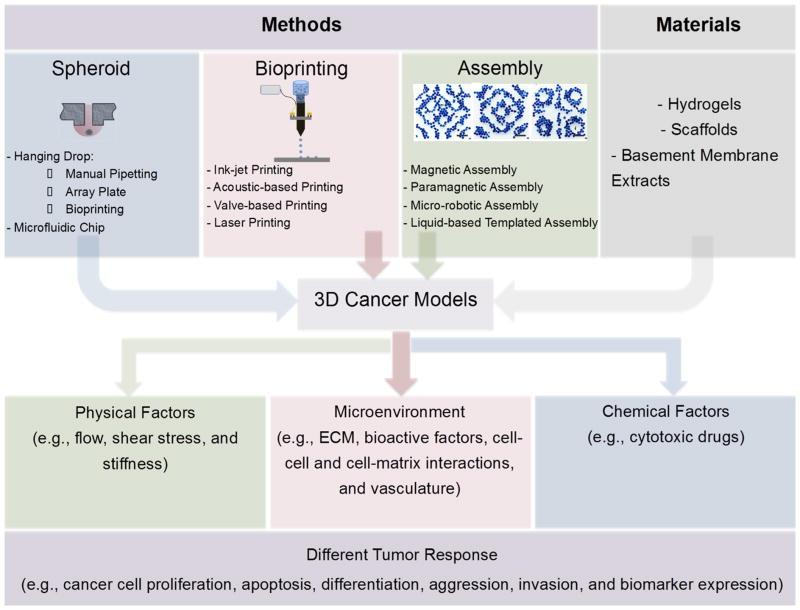
The natural microenvironment of tumors is composed of extracellular matrix (ECM), blood vasculature, and supporting stromal cells. The physical characteristics of ECM as well as the cellular components play a vital role in controlling cancer cell proliferation, apoptosis, metabolism, and differentiation. To mimic the tumor microenvironment outside the human body for drug testing, two-dimensional (2-D) and murine tumor models are routinely used. Although these conventional approaches are employed in preclinical studies, they still present challenges. For example, murine tumor models are expensive and difficult to adopt for routine drug screening. On the other hand, 2-D models are simple to perform, but they do not recapitulate natural tumor microenvironment, because they do not capture important three-dimensional (3-D) cell-cell, cell-matrix signaling pathways, and multi-cellular heterogeneous components of the tumor microenvironment such as stromal and immune cells. The three-dimensional (3-D) tumor models aim to closely mimic cancer microenvironments and have emerged as an alternative to routinely used methods for drug screening. Herein, we review recent advances in 3-D tumor model generation and highlight directions for future applications in drug testing.
肿瘤的天然微环境由细胞外基质(ECM)、血管系统和支持性基质细胞组成。ECM的物理特性以及细胞成分在控制癌细胞的增殖、凋亡、代谢和分化方面起着至关重要的作用。为了在人体外模拟肿瘤微环境以进行药物测试,常规使用二维(2-D)和小鼠肿瘤模型。尽管这些传统方法用于临床前研究,但它们仍然存在挑战。例如,小鼠肿瘤模型成本高昂,难以用于常规药物筛选。另一方面,二维模型操作简单,但无法重现天然肿瘤微环境,因为它们没有捕捉到重要的三维(3-D)细胞-细胞、细胞-基质信号通路以及肿瘤微环境中的多细胞异质成分,如基质细胞和免疫细胞。三维(3-D)肿瘤模型旨在紧密模拟癌症微环境,并已成为常规药物筛选方法的替代方案。在此,我们综述了三维肿瘤模型构建的最新进展,并强调了其在药物测试未来应用中的方向。


 Zotero 插件