
通过全蛋白质组学和遗传学分析揭示一株土壤来源的 Mn(II)氧化大肠杆菌锰氧化的作用机制。
Mechanistic insights into manganese oxidation of a soil-borne Mn(II)-oxidizing Escherichia coli strain by global proteomic and genetic analyses.
机构信息
State Key Laboratory of Agricultural Microbiology, Huazhong Agricultural University, Wuhan, 430070, China.
Agricultural Bio-resources Institute, Fujian Academy of Agricultural Sciences, Fuzhou, 350003, China.
出版信息
Sci Rep. 2017 May 2;7(1):1352. doi: 10.1038/s41598-017-01552-3.
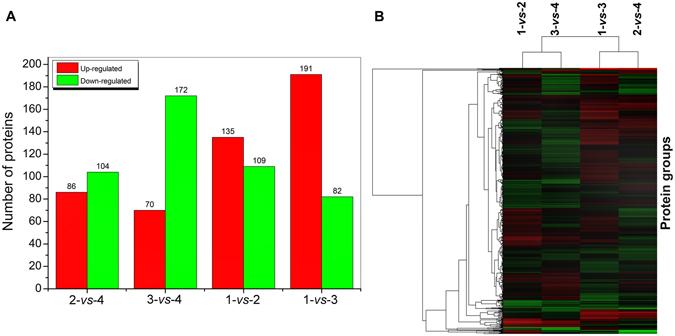
An iTRAQ-based comparative and quantitative proteomics analysis of a soil-borne Mn(II)-oxidizing bacterium, Escherichia coli MB266, was conducted during the exponential and stationary growth phases. A total of 1850 proteins were identified in 4 samples, of which 373 and 456 proteins were significantly up- or down-regulated in at least one pairwise comparison, respectively. The iTRAQ data indicated that several enzymes involved in fatty acid metabolism (i.e., FabA, FabD and FabZ) and pyruvate metabolism (particularly pyruvate oxidase PoxB) were significantly up-regulated, while those related to the tricarboxylic acid cycle (such as FrdB, FumB and AcnA) and methylcitrate cycle (i.e., PrpC) were inactivated in the presence of 1 mM Mn(II); the amounts of some stress response and signal transduction system-related proteins (i.e., Spy) were remarkably increased, and the cold shock protein CspD was significantly up-regulated during the exponential growth phase. However, all verified heat shock proteins remained unchanged. The reactive oxygen species response and some redox enzymes might also be involved in Mn oxidation processes. The involvement of several cellular proteins in Mn(II) oxidation, including PoxB, Spy and MCO266, was further confirmed by gene disruption and expression complementation experiments. Based on these results, a signal transduction mechanism coupled to Mn oxidation was proposed.
采用 iTRAQ 技术对土壤 Mn(II)氧化菌大肠杆菌 MB266 进行了指数生长和稳定生长阶段的比较和定量蛋白质组学分析。在 4 个样品中鉴定到了 1850 种蛋白质,其中 373 种和 456 种蛋白质在至少一个两两比较中显著上调或下调。iTRAQ 数据表明,参与脂肪酸代谢(即 FabA、FabD 和 FabZ)和丙酮酸代谢(特别是丙酮酸氧化酶 PoxB)的几种酶显著上调,而与三羧酸循环(如 FrdB、FumB 和 AcnA)和甲基柠檬酸循环(即 PrpC)相关的酶在存在 1mM Mn(II)时失活;一些应激反应和信号转导系统相关蛋白(如 Spy)的含量显著增加,在指数生长阶段冷休克蛋白 CspD 显著上调。然而,所有验证的热休克蛋白均保持不变。活性氧(ROS)响应和一些氧化还原酶也可能参与 Mn 氧化过程。通过基因敲除和表达互补实验进一步证实了几种细胞蛋白(包括 PoxB、Spy 和 MCO266)参与 Mn(II)氧化。基于这些结果,提出了一个与 Mn 氧化偶联的信号转导机制。
 Zotero 插件