
Fcγ嵌合受体工程化T细胞:方法、优势、局限性及临床相关性
FCγ Chimeric Receptor-Engineered T Cells: Methodology, Advantages, Limitations, and Clinical Relevance.
作者信息
Caratelli Sara, Sconocchia Tommaso, Arriga Roberto, Coppola Andrea, Lanzilli Giulia, Lauro Davide, Venditti Adriano, Del Principe Maria Ilaria, Buccisano Francesco, Maurillo Luca, Ferrone Soldano, Sconocchia Giuseppe
机构信息
Institute of Translational Pharmacology, CNR, Rome, Italy.
Department of Systems Medicine, University of Rome "Tor Vergata", Rome, Italy.
出版信息
Front Immunol. 2017 Apr 27;8:457. doi: 10.3389/fimmu.2017.00457. eCollection 2017.
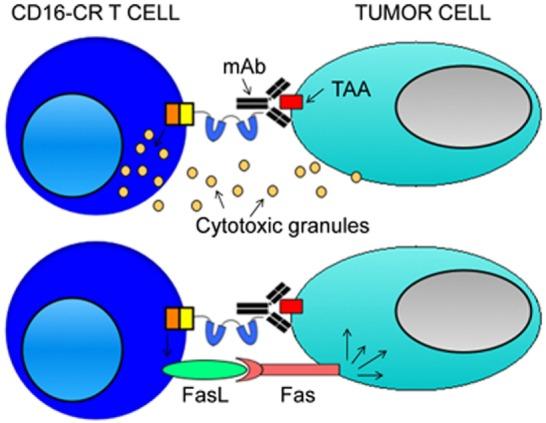
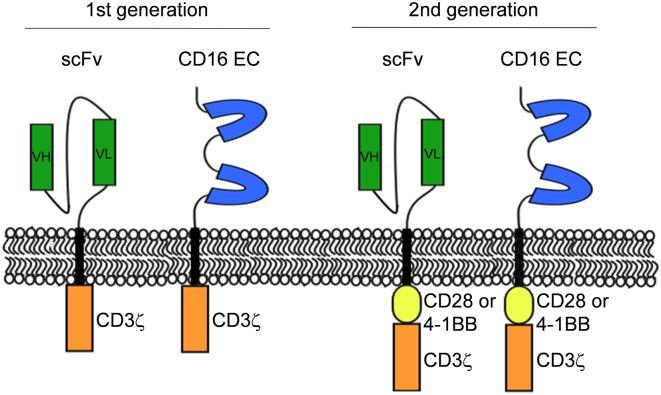
For many years, disappointing results have been generated by many investigations, which have utilized a variety of immunologic strategies to enhance the ability of a patient's immune system to recognize and eliminate malignant cells. However, in recent years, immunotherapy has been used successfully for the treatment of hematologic and solid malignancies. The impressive clinical responses observed in many types of cancer have convinced even the most skeptical clinical oncologists that a patient's immune system can recognize and reject his tumor if appropriate strategies are implemented. The success immunotherapy is due to the development of at least three therapeutic strategies. They include tumor-associated antigen (TAA)-specific monoclonal antibodies (mAbs), T cell checkpoint blockade, and TAA-specific chimeric antigen receptors (CARs) T cell-based immunotherapy. However, the full realization of the therapeutic potential of these approaches requires the development of strategies to counteract and overcome some limitations. They include off-target toxicity and mechanisms of cancer immune evasion, which obstacle the successful clinical application of mAbs and CAR T cell-based immunotherapies. Thus, we and others have developed the Fc gamma chimeric receptors (Fcγ-CRs)-based strategy. Like CARs, Fcγ-CRs are composed of an intracellular tail resulting from the fusion of a co-stimulatory molecule with the T cell receptor ζ chain. In contrast, the extracellular CAR single-chain variable fragment (scFv), which recognizes the targeted TAA, has been replaced with the extracellular portion of the FcγRIIIA (CD16). Fcγ-CR T cells have a few intriguing features. First, given in combination with mAbs, Fcγ-CR T cells mediate anticancer activity and by an antibody-mediated cellular cytotoxicity mechanism. Second, CD16-CR T cells can target multiple cancer types provided that TAA-specific mAbs with the appropriate specificity are available. Third, the off-target effect of CD16-CR T cells may be controlled by withdrawing the mAb administration. The goal of this manuscript was threefold. First, we review the current state-of-the-art of preclinical CD16-CR T cell technology. Second, we describe its and antitumor activity. Finally, we compare the advantages and limitations of the CD16-CR T cell technology with those of CAR T cell methodology.
多年来,许多研究产生了令人失望的结果,这些研究采用了多种免疫策略来增强患者免疫系统识别和消除恶性细胞的能力。然而,近年来,免疫疗法已成功用于治疗血液系统恶性肿瘤和实体瘤。在许多类型的癌症中观察到的令人印象深刻的临床反应甚至使最持怀疑态度的临床肿瘤学家相信,如果实施适当的策略,患者的免疫系统可以识别并排斥其肿瘤。免疫疗法的成功归功于至少三种治疗策略的发展。它们包括肿瘤相关抗原(TAA)特异性单克隆抗体(mAb)、T细胞检查点阻断和TAA特异性嵌合抗原受体(CAR)T细胞免疫疗法。然而,要充分实现这些方法的治疗潜力,需要制定策略来对抗和克服一些局限性。它们包括脱靶毒性和癌症免疫逃逸机制,这些阻碍了mAb和基于CAR T细胞的免疫疗法的成功临床应用。因此,我们和其他人开发了基于Fcγ嵌合受体(Fcγ-CR)的策略。与CAR一样,Fcγ-CR由共刺激分子与T细胞受体ζ链融合产生的细胞内尾部组成。相比之下,识别靶向TAA的细胞外CAR单链可变片段(scFv)已被FcγRIIIA(CD16)的细胞外部分取代。Fcγ-CR T细胞具有一些有趣的特征。首先,与mAb联合使用时,Fcγ-CR T细胞通过抗体介导的细胞毒性机制介导抗癌活性。其次,只要有具有适当特异性的TAA特异性mAb,CD16-CR T细胞就可以靶向多种癌症类型。第三,CD16-CR T细胞的脱靶效应可以通过停止施用mAb来控制。本手稿的目标有三个。首先,我们回顾临床前CD16-CR T细胞技术的当前技术水平。其次,我们描述其抗肿瘤活性。最后,我们将CD16-CR T细胞技术与CAR T细胞方法的优缺点进行比较。

 Zotero 插件