
人类SWI/SNF染色质重塑酶的BRG1 ATP酶作为癌症的驱动因素。
The BRG1 ATPase of human SWI/SNF chromatin remodeling enzymes as a driver of cancer.
作者信息
Wu Qiong, Lian Jane B, Stein Janet L, Stein Gary S, Nickerson Jeffrey A, Imbalzano Anthony N
机构信息
Department of Pediatrics, University of Massachusetts Medical School, 55 Lake Avenue North, Worcester, MA 01655, USA.
Department of Biochemistry, University of Vermont College of Medicine, 89 Beaumont Avenue, Burlington, VT 05405, USA.
出版信息
Epigenomics. 2017 Jun;9(6):919-931. doi: 10.2217/epi-2017-0034. Epub 2017 May 19.
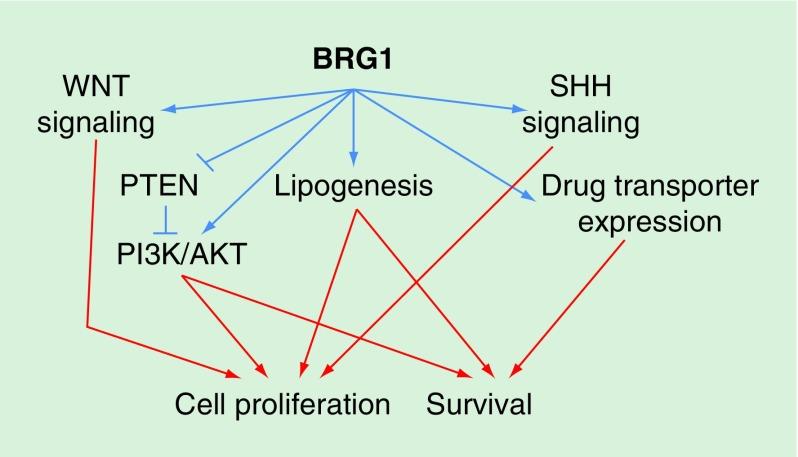
Mammalian SWI/SNF enzymes are ATP-dependent remodelers of chromatin structure. These multisubunit enzymes are heterogeneous in composition; there are two catalytic ATPase subunits, BRM and BRG1, that are mutually exclusive, and additional subunits are incorporated in a combinatorial manner. Recent findings indicate that approximately 20% of human cancers contain mutations in SWI/SNF enzyme subunits, leading to the conclusion that the enzyme subunits are critical tumor suppressors. However, overexpression of specific subunits without apparent mutation is emerging as an alternative mechanism by which cellular transformation may occur. Here we highlight recent evidence linking elevated expression of the BRG1 ATPase to tissue-specific cancers and work suggesting that inhibiting BRG1 may be an effective therapeutic strategy.
哺乳动物的SWI/SNF酶是依赖ATP的染色质结构重塑因子。这些多亚基酶在组成上具有异质性;有两个催化ATP酶亚基,BRM和BRG1,它们相互排斥,并且其他亚基以组合方式掺入。最近的研究结果表明,约20%的人类癌症在SWI/SNF酶亚基中存在突变,由此得出该酶亚基是关键肿瘤抑制因子的结论。然而,特定亚基无明显突变的过表达正成为细胞发生转化的一种替代机制。在此,我们着重介绍将BRG1 ATP酶表达升高与组织特异性癌症联系起来的最新证据,以及表明抑制BRG1可能是一种有效治疗策略的研究。
 Zotero 插件