
基于液滴的 3D 打印的高分辨率图案化细胞构建体。
High-Resolution Patterned Cellular Constructs by Droplet-Based 3D Printing.
机构信息
Department of Chemistry, University of Oxford, Oxford, OX1 3TA, UK.
School of Cellular and Molecular Medicine, University of Bristol, Bristol, BS8 1TD, UK.
出版信息
Sci Rep. 2017 Aug 1;7(1):7004. doi: 10.1038/s41598-017-06358-x.
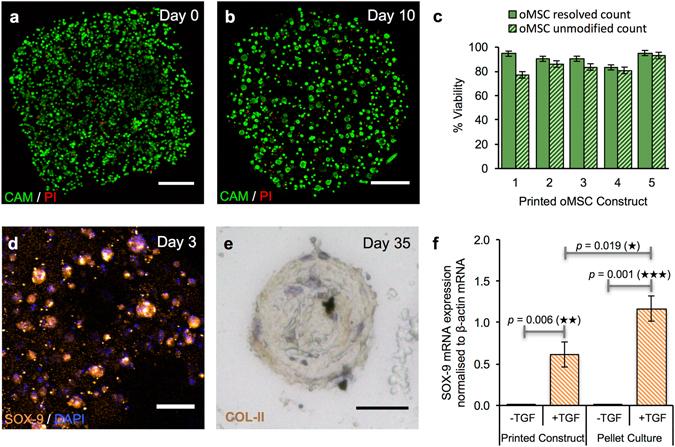
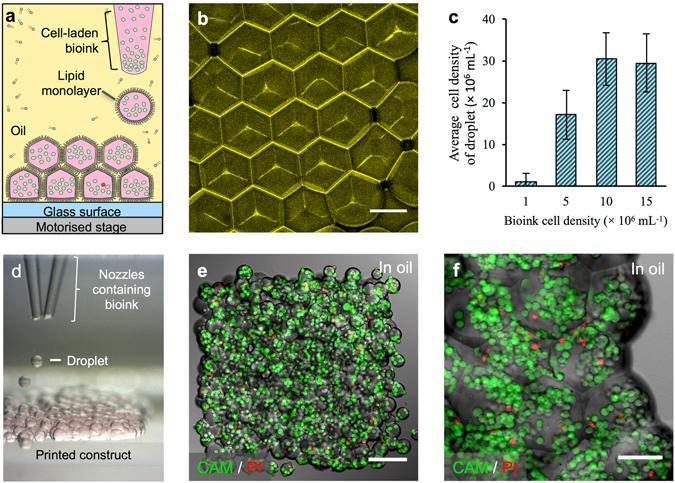
Bioprinting is an emerging technique for the fabrication of living tissues that allows cells to be arranged in predetermined three-dimensional (3D) architectures. However, to date, there are limited examples of bioprinted constructs containing multiple cell types patterned at high-resolution. Here we present a low-cost process that employs 3D printing of aqueous droplets containing mammalian cells to produce robust, patterned constructs in oil, which were reproducibly transferred to culture medium. Human embryonic kidney (HEK) cells and ovine mesenchymal stem cells (oMSCs) were printed at tissue-relevant densities (10 cells mL) and a high droplet resolution of 1 nL. High-resolution 3D geometries were printed with features of ≤200 μm; these included an arborised cell junction, a diagonal-plane junction and an osteochondral interface. The printed cells showed high viability (90% on average) and HEK cells within the printed structures were shown to proliferate under culture conditions. Significantly, a five-week tissue engineering study demonstrated that printed oMSCs could be differentiated down the chondrogenic lineage to generate cartilage-like structures containing type II collagen.
生物打印是一种新兴的制造活组织的技术,它可以使细胞按照预定的三维(3D)结构排列。然而,迄今为止,只有有限的例子证明了包含多种细胞类型的生物打印结构可以以高分辨率进行图案化。在这里,我们提出了一种低成本的工艺,它采用含有哺乳动物细胞的水性液滴的 3D 打印来在油中产生坚固的、图案化的结构,这些结构可以可重复地转移到培养基中。人类胚胎肾(HEK)细胞和绵羊间充质干细胞(oMSC)以组织相关的密度(10 个细胞/mL)和 1 nL 的高液滴分辨率进行打印。以≤200 μm 的特征打印出高分辨率的 3D 几何形状;这些特征包括树突状细胞连接、对角平面连接和骨软骨界面。打印的细胞表现出高活力(平均 90%),并且在培养条件下,打印结构内的 HEK 细胞被证明可以增殖。重要的是,为期五周的组织工程研究表明,打印的 oMSC 可以沿着软骨生成途径分化为生成含有 II 型胶原的软骨样结构。


 Zotero 插件