
韩国老年人社会经济地位与身高降低之间关系的性别差异:2008 - 2010年韩国国民健康与营养检查调查
Gender differences in the relationship between socioeconomic status and height loss among the elderly in South Korea: Korean National Health and Nutrition Examination Survey 2008-2010.
作者信息
Kim Yang-Hyun, Ahn Kyung-Sik, Cho Kyung-Hwan, Kang Chang Ho, Cho Sung Bum, Han Kyungdo, Rho Yong-Kyun, Park Yong-Gyu
机构信息
Department of Family Medicine Department of Radiology, Korea University College of Medicine Department of Biostatistics, Catholic University College of Medicine, Seoul Department of Family Medicine, Hallym University College of Medicine, Chunchon, Republic of Korea.
出版信息
Medicine (Baltimore). 2017 Aug;96(34):e7131. doi: 10.1097/MD.0000000000007131.
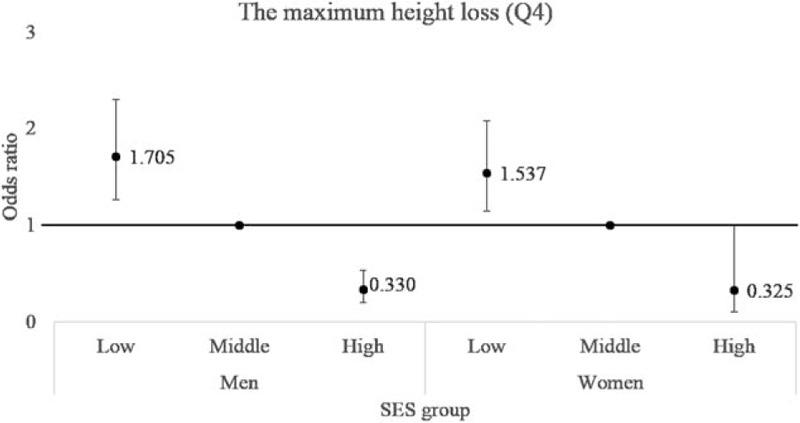
This study aimed to examine average height loss and the relationship between height loss and socioeconomic status (SES) among the elderly in South Korea.Data were obtained from the Korean National Health and Nutrition Examination Survey 2008-2010. A total of 5265 subjects (2818 men and 2447 women) were included. Height loss was calculated as the difference between the subject's self-reported maximum adult height and their measured current height. The height loss values were divided into quartiles (Q1-Q4) for men and women. SES was determined using a self-reported questionnaire for education level, family income, and occupation.Height loss was associated with SES in all age groups, and mean height loss increased with age. In the relationship between education level and maximum height loss (Q4), men with ≤6, 7-9, or 10-12 years of education had higher odds ratios for the prevalence of height loss (Q4) than men with the highest education level (≥13 years). With regard to the relationship between the income level and height loss (Q4), the subjects with the lowest income had an increased prevalence of maximum height loss (Q4) than the subjects with the highest income (odds ratios = 2.03 in men and 1.94 in women). Maximum height loss (Q4) was more prevalent in men and women with a low SES and less prevalent in men with a high SES than in men with a middle SES.Height loss (Q4) was associated with education level in men and with income level (especially low income) in men and women. Height loss was also associated with a low SES in men and women.
本研究旨在调查韩国老年人的平均身高损失情况以及身高损失与社会经济地位(SES)之间的关系。数据来自2008 - 2010年韩国国家健康与营养检查调查。共纳入5265名受试者(2818名男性和2447名女性)。身高损失通过受试者自我报告的最大成年身高与测量的当前身高之差来计算。男性和女性的身高损失值被分为四分位数(Q1 - Q4)。SES通过一份关于教育水平、家庭收入和职业的自我报告问卷来确定。身高损失在所有年龄组中都与SES相关,且平均身高损失随年龄增加。在教育水平与最大身高损失(Q4)的关系中,受教育年限≤6年、7 - 9年或10 - 12年的男性,其身高损失(Q4)患病率的优势比高于受教育水平最高(≥13年)的男性。关于收入水平与身高损失(Q4)的关系,收入最低的受试者最大身高损失(Q4)的患病率高于收入最高的受试者(男性优势比 = 2.03,女性优势比 = 1.94)。SES较低的男性和女性中最大身高损失(Q4)更为普遍,SES高的男性中最大身高损失(Q4)的患病率低于SES中等的男性。身高损失(Q4)在男性中与教育水平相关,在男性和女性中与收入水平(尤其是低收入)相关。身高损失在男性和女性中也与低SES相关。

 Zotero 插件