
间变性淋巴瘤激酶(ALK)信号级联通过新生血管形成和细胞增殖赋予胶质母细胞瘤细胞多种优势。
ALK signaling cascade confers multiple advantages to glioblastoma cells through neovascularization and cell proliferation.
作者信息
Chiba Risako, Akiya Masashi, Hashimura Miki, Oguri Yasuko, Inukai Madoka, Hara Atsuko, Saegusa Makoto
机构信息
Department of Pathology, Kitasato University School of Medicine, Minami-ku, Sagamihara, Kanagawa, Japan.
出版信息
PLoS One. 2017 Aug 24;12(8):e0183516. doi: 10.1371/journal.pone.0183516. eCollection 2017.
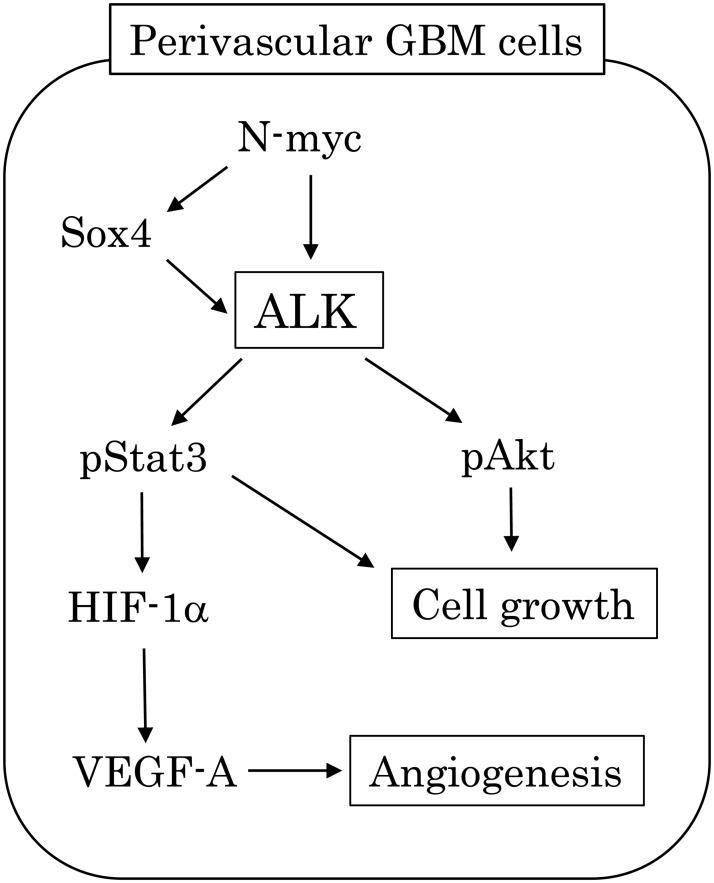
Anaplastic lymphoma kinase (ALK), which is a receptor tyrosine kinase, is essentially and transiently expressed in the developing nervous system. Here we examined the functional role of the ALK gene in glioblastomas (GBMs). In clinical samples of GBMs, high ALK expression without gene rearrangements or mutations was frequently observed in perivascular lesions, in contrast to the relatively low expression in the perinecrotic areas, which was positively correlated with N-myc and phosphorylated (p) Stat3 scores and Ki-67 labeling indices. ALK immunoreactivity was also found to be associated with neovascular features including vascular co-option and vascular mimicry. In astrocytoma cell lines, cells stably overexpressing full-length ALK showed an increase in expression of pStat3 and pAkt proteins, as well as hypoxia-inducible factor-1α (HIF-1α) and vascular endothelial growth factor-A (VEGF-A) mRNAs, in contrast to cells with knockdown of endogenous ALK which showed decreased expression of these molecules. Transfection of the constitutively active form of Stat3 induced an increase in HIF-1α promoter activity, and the overexpression of HIF-1α in turn resulted in enhancement of VEGF-A promoter activity. In addition, cells with overexpression or knockdown of ALK also showed a tendency toward increased and decreased proliferation, respectively, through changes in expression of pAkt and pStat3. Finally, ALK promoter was significantly activated by transfection of Sox4 and N-myc, which are known to contribute to neuronal properties. These findings therefore suggest that N-myc/Sox4-mediated ALK signaling cascades containing Stat3, Akt, HIF-1α, and VEGF-A confer multiple advantages to tumor growth through alterations in neovascularization and cell proliferation in GBMs.
间变性淋巴瘤激酶(ALK)是一种受体酪氨酸激酶,在发育中的神经系统中基本呈瞬时表达。在此,我们研究了ALK基因在胶质母细胞瘤(GBM)中的功能作用。在GBM的临床样本中,与坏死周围区域相对较低的表达相比,在血管周围病变中经常观察到无基因重排或突变的高ALK表达,这与N - myc和磷酸化(p)Stat3评分以及Ki - 67标记指数呈正相关。还发现ALK免疫反应性与包括血管套叠和血管拟态在内的新生血管特征有关。在星形细胞瘤细胞系中,稳定过表达全长ALK的细胞显示pStat3和pAkt蛋白表达增加,以及缺氧诱导因子 - 1α(HIF - 1α)和血管内皮生长因子 - A(VEGF - A)mRNA增加,而内源性ALK敲低的细胞则显示这些分子的表达降低。组成型活性形式的Stat3转染诱导HIF - 1α启动子活性增加,而HIF - 1α的过表达反过来导致VEGF - A启动子活性增强。此外,ALK过表达或敲低的细胞也分别通过pAkt和pStat3表达的变化显示出增殖增加和减少的趋势。最后,Sox4和N - myc转染显著激活了ALK启动子,已知Sox4和N - myc有助于神经元特性。因此,这些发现表明,包含Stat3、Akt、HIF - 1α和VEGF - A的N - myc / Sox4介导的ALK信号级联通过改变GBM中的新生血管形成和细胞增殖赋予肿瘤生长多种优势。


 Zotero 插件