
干扰素-γ通过靶向实验性自身免疫性关节炎中的坏死性凋亡来调节炎症细胞死亡。
Interferon-gamma regulates inflammatory cell death by targeting necroptosis in experimental autoimmune arthritis.
机构信息
The Rheumatism Research Center, Catholic Research Institute of Medical Science, College of Medicine, The Catholic University of Korea, Seoul, South Korea.
Impact Biotech, Seoul, 137-040, South Korea.
出版信息
Sci Rep. 2017 Aug 31;7(1):10133. doi: 10.1038/s41598-017-09767-0.
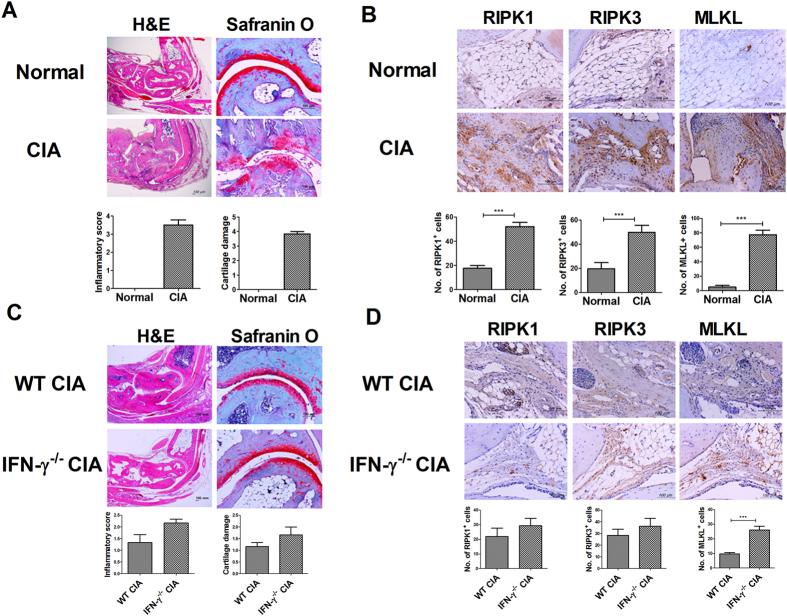
Interferon γ (IFN-γ) induces an inflammatory response and apoptotic cell death. Rheumatoid arthritis (RA) is a systemic inflammatory disease associated with increased levels of inflammatory mediators, including tumour necrosis factor α (TNF-α) and T helper (Th) 17 cells, and downregulation of apoptosis of inflammatory cells. We hypothesized that IFN-γ would reduce inflammatory cell death in vitro and that loss of IFN-γ would aggravate inflammation in vivo. IFN-γ downregulated necroptosis and the expression of cellular FLICE-like inhibitory protein (cFLIP) and mixed lineage kinase domain-like (MLKL). However, loss of IFN-γ promoted the production of cFLIP and MLKL, and necroptosis. IFN-γ deficiency increased Th17 cell number and upregulated the expression of IL-17 and TNF-α. Expression of MLKL, receptor interacting protein kinase (RIPK)1, and RIPK3 was increased in the joints of mice with collagen-induced arthritis (CIA). Compared with wild-type mice with CIA, IFN-γ CIA mice showed exacerbation of cartilage damage and joint inflammation, and acceleration of MLKL, RIPK1, and RIPK3 production in the joints. IFN-γ deficiency induced the activation of signal transducer and activator of transcription 3. These results suggest that IFN-γ regulates inflammatory cell death and may have potential for use in the treatment of RA.
干扰素 γ(IFN-γ)可诱导炎症反应和细胞凋亡。类风湿关节炎(RA)是一种与炎症介质水平升高相关的系统性炎症性疾病,包括肿瘤坏死因子 α(TNF-α)和辅助性 T 细胞 17(Th17)细胞,以及炎症细胞凋亡下调。我们假设 IFN-γ 可减少体外炎症细胞死亡,IFN-γ 缺失会加重体内炎症。IFN-γ 下调坏死和细胞 FLICE 样抑制蛋白(cFLIP)和混合谱系激酶结构域样(MLKL)的表达。然而,IFN-γ 缺失会促进 cFLIP 和 MLKL 的产生和坏死。IFN-γ 缺乏会增加 Th17 细胞数量,并上调白细胞介素 17(IL-17)和肿瘤坏死因子 α(TNF-α)的表达。胶原诱导关节炎(CIA)小鼠关节中 MLKL、受体相互作用蛋白激酶 1(RIPK1)和 RIPK3 的表达增加。与 CIA 野生型小鼠相比,IFN-γ CIA 小鼠表现出软骨损伤和关节炎症的加重,以及关节中 MLKL、RIPK1 和 RIPK3 产生的加速。IFN-γ 缺乏会诱导信号转导和转录激活因子 3 的激活。这些结果表明,IFN-γ 可调节炎症细胞死亡,可能具有治疗 RA 的潜力。

 Zotero 插件