
双侧前庭功能丧失中的姿势控制:其与视觉、本体感觉、前庭及认知输入的关系。
Postural Control in Bilateral Vestibular Failure: Its Relation to Visual, Proprioceptive, Vestibular, and Cognitive Input.
作者信息
Sprenger Andreas, Wojak Jann F, Jandl Nico M, Helmchen Christoph
机构信息
Department of Neurology, University of Lübeck, Lubeck, Germany.
Institute of Psychology II, University of Lübeck, Lubeck, Germany.
出版信息
Front Neurol. 2017 Sep 1;8:444. doi: 10.3389/fneur.2017.00444. eCollection 2017.
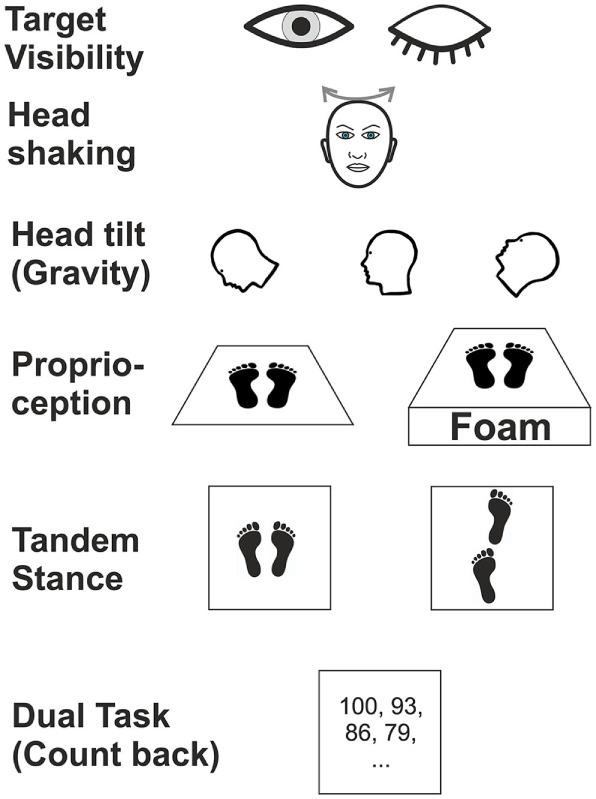
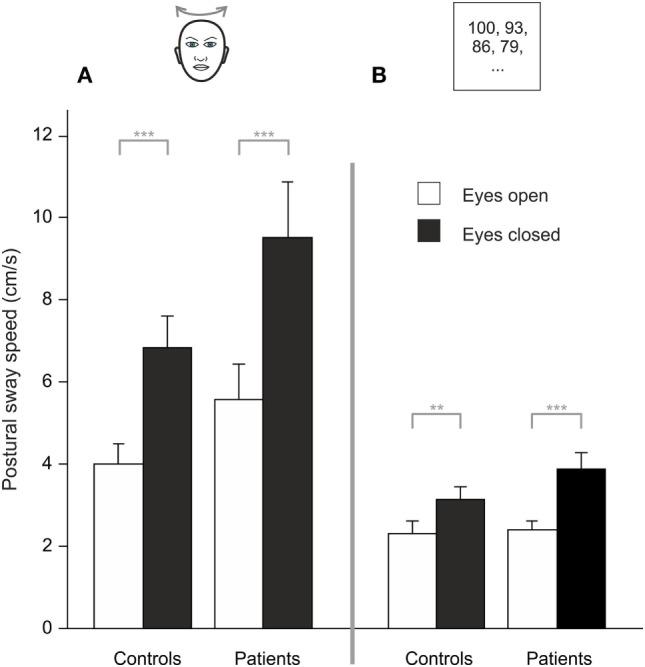
Patients with bilateral vestibular failure (BVF) suffer from postural and gait unsteadiness with an increased risk of falls. The aim of this study was to elucidate the differential role of otolith, semicircular canal (SSC), visual, proprioceptive, and cognitive influences on the postural stability of BVF patients. Center-of-pressure displacements were recorded by posturography under six conditions: target visibility; tonic head positions in the pitch plane; horizontal head shaking; sensory deprivation; dual task; and tandem stance. Between-group analysis revealed larger postural sway in BVF patients on eye closure; but with the eyes open, BVF did not differ from healthy controls (HCs). Head tilts and horizontal head shaking increased sway but did not differ between groups. In the dual task condition, BVF patients maintained posture indistinguishable from controls. On foam and tandem stance, postural sway was larger in BVF, even with the eyes open. The best predictor for the severity of bilateral vestibulopathy was standing on foam with eyes closed. Postural control of our BVF was indistinguishable from HCs once visual and proprioceptive feedback is provided. This distinguishes them from patients with vestibulo-cerebellar disorders or functional dizziness. It confirms previous reports and explains that postural unsteadiness of BVF patients can be missed easily if not examined by conditions of visual and/or proprioceptive deprivation. In fact, the best predictor for vestibular hypofunction (VOR gain) was examining patients standing on foam with the eyes closed. Postural sway in that condition increased with the severity of vestibular impairment but not with disease duration. In the absence of visual control, impaired otolith input destabilizes BVF with head retroflexion. Stimulating deficient SSC does not distinguish patients from controls possibly reflecting a shift of intersensory weighing toward proprioceptive-guided postural control. Accordingly, proprioceptive deprivation heavily destabilizes BVF, even when visual control is provided.
双侧前庭功能衰竭(BVF)患者存在姿势和步态不稳的问题,跌倒风险增加。本研究的目的是阐明耳石、半规管(SSC)、视觉、本体感觉和认知因素对BVF患者姿势稳定性的不同作用。通过姿势描记法在六种条件下记录压力中心位移:目标可见性;俯仰平面的强直性头部位置;水平头部晃动;感觉剥夺;双重任务;以及串联站立。组间分析显示,BVF患者闭眼时姿势摆动更大;但睁眼时,BVF患者与健康对照(HCs)无差异。头部倾斜和水平头部晃动会增加摆动,但两组之间无差异。在双重任务条件下,BVF患者维持的姿势与对照组无明显差异。在泡沫和串联站立时,即使睁眼,BVF患者的姿势摆动也更大。双侧前庭病变严重程度的最佳预测指标是闭眼站在泡沫上。一旦提供视觉和本体感觉反馈,我们研究中的BVF患者的姿势控制与HCs无明显差异。这使他们与前庭小脑疾病或功能性头晕患者有所区别。这证实了先前的报告,并解释了如果不通过视觉和/或本体感觉剥夺条件进行检查,BVF患者的姿势不稳很容易被忽视。事实上,前庭功能减退(VOR增益)的最佳预测指标是检查闭眼站在泡沫上的患者。在这种情况下,姿势摆动随着前庭损伤的严重程度增加而增加,但与病程无关。在没有视觉控制的情况下,受损的耳石输入会使头部后伸的BVF患者失去平衡。刺激不足的SSC并不能区分患者与对照组,这可能反映了感觉权重向本体感觉引导的姿势控制的转变。因此,即使提供视觉控制,本体感觉剥夺也会严重破坏BVF患者的平衡。



 Zotero 插件