
宿主体内流感病毒控制机制影响基于模型的抗病毒治疗评估与预测。
The Mechanisms for Within-Host Influenza Virus Control Affect Model-Based Assessment and Prediction of Antiviral Treatment.
作者信息
Cao Pengxing, McCaw James M
机构信息
School of Mathematics and Statistics, The University of Melbourne, Melbourne, Victoria 3010, Australia.
Centre for Epidemiology and Biostatistics, Melbourne School of Population and Global Health, The University of Melbourne, Melbourne, Victoria 3010, Australia.
出版信息
Viruses. 2017 Jul 26;9(8):197. doi: 10.3390/v9080197.
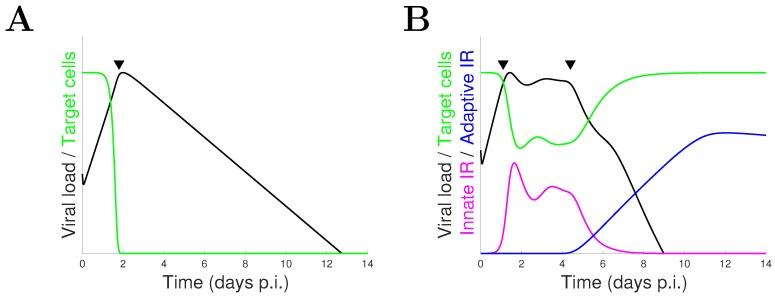
Models of within-host influenza viral dynamics have contributed to an improved understanding of viral dynamics and antiviral effects over the past decade. Existing models can be classified into two broad types based on the mechanism of viral control: models utilising target cell depletion to limit the progress of infection and models which rely on timely activation of innate and adaptive immune responses to control the infection. In this paper, we compare how two exemplar models based on these different mechanisms behave and investigate how the mechanistic difference affects the assessment and prediction of antiviral treatment. We find that the assumed mechanism for viral control strongly influences the predicted outcomes of treatment. Furthermore, we observe that for the target cell-limited model the assumed drug efficacy strongly influences the predicted treatment outcomes. The area under the viral load curve is identified as the most reliable predictor of drug efficacy, and is robust to model selection. Moreover, with support from previous clinical studies, we suggest that the target cell-limited model is more suitable for modelling in vitro assays or infection in some immunocompromised/immunosuppressed patients while the immune response model is preferred for predicting the infection/antiviral effect in immunocompetent animals/patients.
在过去十年中,宿主体内流感病毒动力学模型有助于人们更好地理解病毒动力学和抗病毒效果。现有的模型根据病毒控制机制可大致分为两类:一类是利用靶细胞耗竭来限制感染进程的模型,另一类是依靠先天免疫和适应性免疫反应的及时激活来控制感染的模型。在本文中,我们比较了基于这些不同机制的两个范例模型的行为方式,并研究了机制差异如何影响抗病毒治疗的评估和预测。我们发现,假定的病毒控制机制强烈影响治疗的预测结果。此外,我们观察到,对于靶细胞受限模型,假定的药物疗效强烈影响预测的治疗结果。病毒载量曲线下的面积被确定为药物疗效最可靠的预测指标,并且对模型选择具有鲁棒性。此外,在先前临床研究的支持下,我们建议靶细胞受限模型更适合用于模拟体外试验或某些免疫受损/免疫抑制患者的感染,而免疫反应模型更适合预测免疫健全动物/患者的感染/抗病毒效果。



 Zotero 插件