
用于镰状细胞贫血中红细胞分类的深度卷积神经网络。
A deep convolutional neural network for classification of red blood cells in sickle cell anemia.
作者信息
Xu Mengjia, Papageorgiou Dimitrios P, Abidi Sabia Z, Dao Ming, Zhao Hong, Karniadakis George Em
机构信息
Key Laboratory of Medical Image Computing of Ministry of Education, Northeastern University, Shenyang, China.
Division of Applied Mathematics, Brown University, Providence, Rhode Island, United States of America.
出版信息
PLoS Comput Biol. 2017 Oct 19;13(10):e1005746. doi: 10.1371/journal.pcbi.1005746. eCollection 2017 Oct.
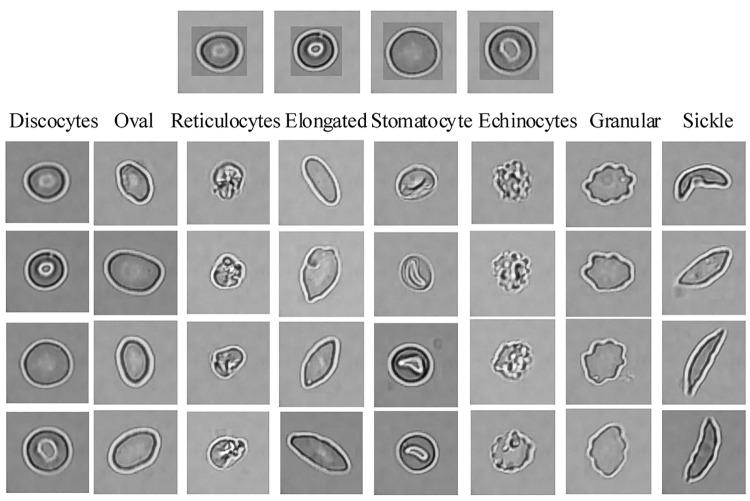
Sickle cell disease (SCD) is a hematological disorder leading to blood vessel occlusion accompanied by painful episodes and even death. Red blood cells (RBCs) of SCD patients have diverse shapes that reveal important biomechanical and bio-rheological characteristics, e.g. their density, fragility, adhesive properties, etc. Hence, having an objective and effective way of RBC shape quantification and classification will lead to better insights and eventual better prognosis of the disease. To this end, we have developed an automated, high-throughput, ex-vivo RBC shape classification framework that consists of three stages. First, we present an automatic hierarchical RBC extraction method to detect the RBC region (ROI) from the background, and then separate touching RBCs in the ROI images by applying an improved random walk method based on automatic seed generation. Second, we apply a mask-based RBC patch-size normalization method to normalize the variant size of segmented single RBC patches into uniform size. Third, we employ deep convolutional neural networks (CNNs) to realize RBC classification; the alternating convolution and pooling operations can deal with non-linear and complex patterns. Furthermore, we investigate the specific shape factor quantification for the classified RBC image data in order to develop a general multiscale shape analysis. We perform several experiments on raw microscopy image datasets from 8 SCD patients (over 7,000 single RBC images) through a 5-fold cross validation method both for oxygenated and deoxygenated RBCs. We demonstrate that the proposed framework can successfully classify sickle shape RBCs in an automated manner with high accuracy, and we also provide the corresponding shape factor analysis, which can be used synergistically with the CNN analysis for more robust predictions. Moreover, the trained deep CNN exhibits good performance even for a deoxygenated dataset and distinguishes the subtle differences in texture alteration inside the oxygenated and deoxygenated RBCs.
镰状细胞病(SCD)是一种血液系统疾病,可导致血管阻塞,伴有疼痛发作甚至死亡。SCD患者的红细胞(RBC)具有多种形状,这些形状揭示了重要的生物力学和生物流变学特征,例如它们的密度、脆性、粘附特性等。因此,拥有一种客观有效的红细胞形状量化和分类方法将有助于更好地了解该疾病,并最终实现更好的预后。为此,我们开发了一个自动化、高通量的体外红细胞形状分类框架,该框架由三个阶段组成。首先,我们提出了一种自动分层红细胞提取方法,从背景中检测红细胞区域(ROI),然后通过应用基于自动种子生成的改进随机游走方法,在ROI图像中分离接触的红细胞。其次,我们应用基于掩码的红细胞补丁大小归一化方法,将分割后的单个红细胞补丁的可变大小归一化为统一大小。第三,我们使用深度卷积神经网络(CNN)实现红细胞分类;交替的卷积和池化操作可以处理非线性和复杂模式。此外,我们研究了分类后的红细胞图像数据的特定形状因子量化,以开发一种通用的多尺度形状分析。我们通过5折交叉验证方法,对来自8名SCD患者的原始显微镜图像数据集(超过7000张单个红细胞图像)进行了多项实验,包括对氧合和脱氧红细胞的实验。我们证明,所提出的框架能够以高精度自动成功分类镰状红细胞,并提供相应的形状因子分析,该分析可与CNN分析协同使用,以进行更可靠的预测。此外,训练好的深度CNN即使对于脱氧数据集也表现出良好的性能,并且能够区分氧合和脱氧红细胞内部纹理变化的细微差异。








 Zotero 插件