
输尿管结石的药物排石疗法:基于双盲随机对照试验的系统评价和荟萃分析证据剖析
Medical expulsive therapy for ureteric stones: Analysing the evidence from systematic reviews and meta-analysis of powered double-blinded randomised controlled trials.
作者信息
Amer Tarik, Osman Banan, Johnstone Allan, Mariappan Martin, Gupta Ameet, Brattis Nikolaos, Jones Gareth, Somani Bhaskar K, Keeley Francis X, Aboumarzouk Omar M
机构信息
Glasgow Royal Infirmary, Glasgow, UK.
Bristol Urological Institutes, North Bristol NHS Trust, Bristol, UK.
出版信息
Arab J Urol. 2017 Apr 18;15(2):83-93. doi: 10.1016/j.aju.2017.03.005. eCollection 2017 Jun.
OBJECTIVE
To conduct a systematic review and meta-analysis investigating the efficacy and safety of medical expulsive therapy (MET) in low risk of bias (RoB) randomised controlled trials (RCTs).
METHODS
A Cochrane style systematic review was conducted on published literature from 1990 to 2016, to include low RoB and a power calculation. A pooled meta-analysis was conducted.
RESULTS
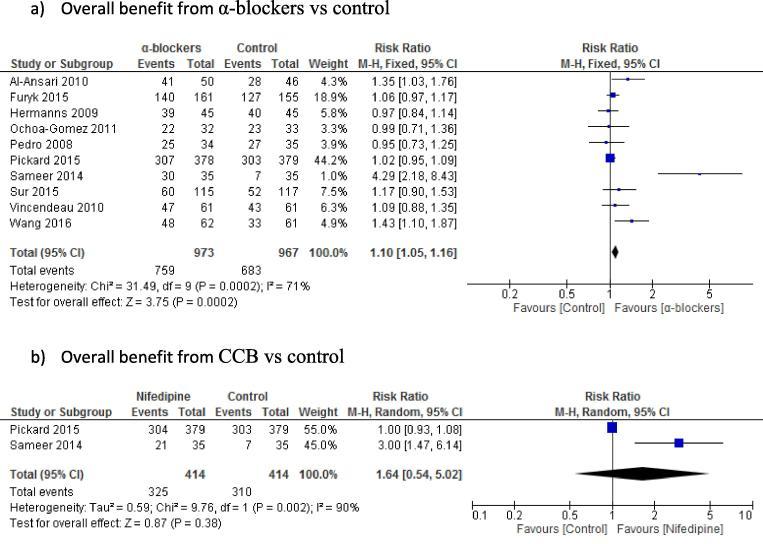
The MET group included 1387 vs 1381 patients in the control group. The analysis reveals α-blockers increased stone expulsion rates (78% vs 74%) ( < 0.001), whilst calcium channel blockers (CCBs) had no effect compared to controls (79% vs 75%) ( = 0.38). In the subgroup analysis, α-blockers had a shorter time to stone expulsion vs the control group ( < 0.001). There were no significant differences in expulsion rates between the treatment groups and control group for stones <5 mm in size ( = 0.48), proximal or mid-ureteric stones ( = 0.63 and = 0.22, respectively). However, α-blockers increased stone expulsion in stones >5 mm ( = 0.02), as well as distal ureteric stones ( < 0.001). The α-blocker group developed more side-effects (6.6% of patients; < 0.001). The numbers needed to treat for α-blockers was one in 14, for stones >5 mm one in eight, and for distal stones one in 10.
CONCLUSION
The primary findings show a small overall benefit for α-blockers as MET for ureteric stones but no benefit with CCBs. α-blockers show a greater benefit for large (>5 mm) ureteric stones and those located in the distal ureter, but no benefit for smaller or more proximal stones. α-blockers are associated with a greater risk of side-effects compared to placebo or CCBs.
目的
在低偏倚风险(RoB)的随机对照试验(RCT)中,进行一项系统评价和荟萃分析,以研究药物排石疗法(MET)的疗效和安全性。
方法
对1990年至2016年发表的文献进行Cochrane式系统评价,纳入低RoB文献并进行功效计算。进行汇总荟萃分析。
结果
MET组有1387例患者,对照组有1381例患者。分析显示,α受体阻滞剂提高了结石排出率(78%对74%)(P<0.001),而钙通道阻滞剂(CCB)与对照组相比无效果(79%对75%)(P=0.38)。在亚组分析中,α受体阻滞剂排出结石的时间比对照组短(P<0.001)。对于直径<5mm的结石(P=0.48)、输尿管上段或中段结石(分别为P=0.63和P=0.22),治疗组和对照组之间的排出率无显著差异。然而,α受体阻滞剂提高了直径>5mm结石的排出率(P=0.02),以及输尿管下段结石的排出率(P<0.001)。α受体阻滞剂组出现更多副作用(6.6%的患者;P<0.001)。α受体阻滞剂的治疗所需人数为14人中1人,直径>5mm结石为8人中1人,下段结石为10人中1人。
结论
主要研究结果表明,α受体阻滞剂作为输尿管结石的MET总体益处较小,而CCB则无益处。α受体阻滞剂对大的(>5mm)输尿管结石和位于输尿管下段的结石益处更大,但对较小或更靠近上段的结石无益处。与安慰剂或CCB相比,α受体阻滞剂出现副作用的风险更高。



 Zotero 插件