
与蛋白酶体的伙伴关系;糖原合成酶激酶3的破坏性质。
A partnership with the proteasome; the destructive nature of GSK3.
作者信息
Robertson Holly, Hayes John D, Sutherland Calum
机构信息
Division of Cancer Research, University of Dundee, Dundee DD1 9SY, Scotland, United Kingdom.
Division of Molecular and Clinical Medicine, University of Dundee, Dundee DD1 9SY, Scotland, United Kingdom.
出版信息
Biochem Pharmacol. 2018 Jan;147:77-92. doi: 10.1016/j.bcp.2017.10.016. Epub 2017 Nov 1.
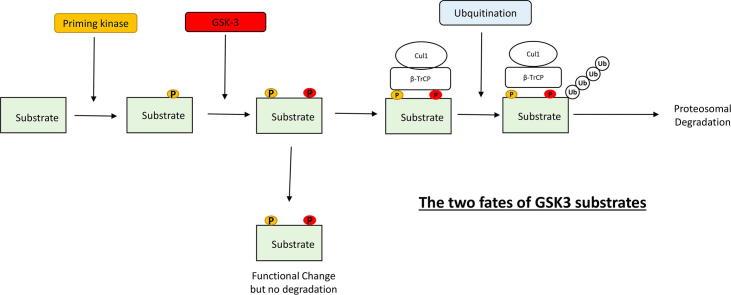
Glycogen Synthase Kinase-3 (GSK3) was originally reported as a key enzyme of glucose homeostasis through regulation of the rate of glycogen synthesis. It has subsequently been found to influence most cellular processes, including growth, differentiation and death, as part of its role in modulating response to hormonal, nutritional and cellular stress stimuli. More than 100 protein targets for GSK3 have been proposed although only a small fraction of these have been convincingly validated in physiological cell systems. The effects of GSK3 phosphorylation on substrates include alteration of enzyme activity, protein localisation, protein:protein interaction and protein stability. This latter form of regulation of GSK3 substrates is the focus of this review. There is an ever-growing list of GSK3 substrates that upon phosphorylation are targeted to the beta-transducin repeat containing protein (β-TrCP), thereby allowing ubiquitination of bound protein by cullin-1 and so initiating destruction at the proteasome. We propose the existence of a GSK3-β-TrCP 'destruction hit-list' that allows co-ordinated removal (or stabilisation) of a set of proteins with a common physiological purpose, through control of GSK3. We identify 29 proteins where there is relatively strong evidence for regulation by a GSK3-β-TrCP axis and note common features of regulation and pathophysiology. Furthermore, we assess the potential of pre-phosphorylation (priming) of these targets (normally a prerequisite for GSK3 recognition) to provide a second layer of regulation delineated by the priming kinase that allows GSK3 to mark them for destruction. Finally, we discuss whether this knowledge improves options for therapeutic intervention.
糖原合酶激酶-3(GSK3)最初被报道为通过调节糖原合成速率来维持葡萄糖稳态的关键酶。随后发现它影响大多数细胞过程,包括生长、分化和死亡,这是其在调节对激素、营养和细胞应激刺激反应中的作用的一部分。虽然已提出超过100个GSK3的蛋白质靶点,但其中只有一小部分在生理细胞系统中得到了令人信服的验证。GSK3对底物的磷酸化作用包括改变酶活性、蛋白质定位、蛋白质-蛋白质相互作用和蛋白质稳定性。GSK3底物的这种后一种调节形式是本综述的重点。越来越多的GSK3底物在磷酸化后靶向含β-转导蛋白重复序列的蛋白质(β-TrCP),从而使结合蛋白被cullin-1泛素化,进而在蛋白酶体中启动降解。我们提出存在一个GSK3-β-TrCP“降解命中列表”,通过控制GSK3,可以协调去除(或稳定)一组具有共同生理目的的蛋白质。我们确定了29种蛋白质,有相对有力的证据表明它们受GSK3-β-TrCP轴调节,并指出了调节和病理生理学的共同特征。此外,我们评估了这些靶点的预磷酸化(引发)潜力(通常是GSK3识别的先决条件),以提供由引发激酶划定的第二层调节,使GSK3能够标记它们以便降解。最后,我们讨论了这些知识是否改善了治疗干预的选择。

 Zotero 插件