
胰岛素样生长因子-1与神经炎症
Insulin-Like Growth Factor-1 and Neuroinflammation.
作者信息
Labandeira-Garcia Jose L, Costa-Besada Maria A, Labandeira Carmen M, Villar-Cheda Begoña, Rodríguez-Perez Ana I
机构信息
Laboratory of Neuroanatomy and Experimental Neurology, Department of Morphological Sciences, CIMUS, University of Santiago de Compostela, Santiago de Compostela, Spain.
Networking Research Center on Neurodegenerative Diseases (CIBERNED), Madrid, Spain.
出版信息
Front Aging Neurosci. 2017 Nov 3;9:365. doi: 10.3389/fnagi.2017.00365. eCollection 2017.
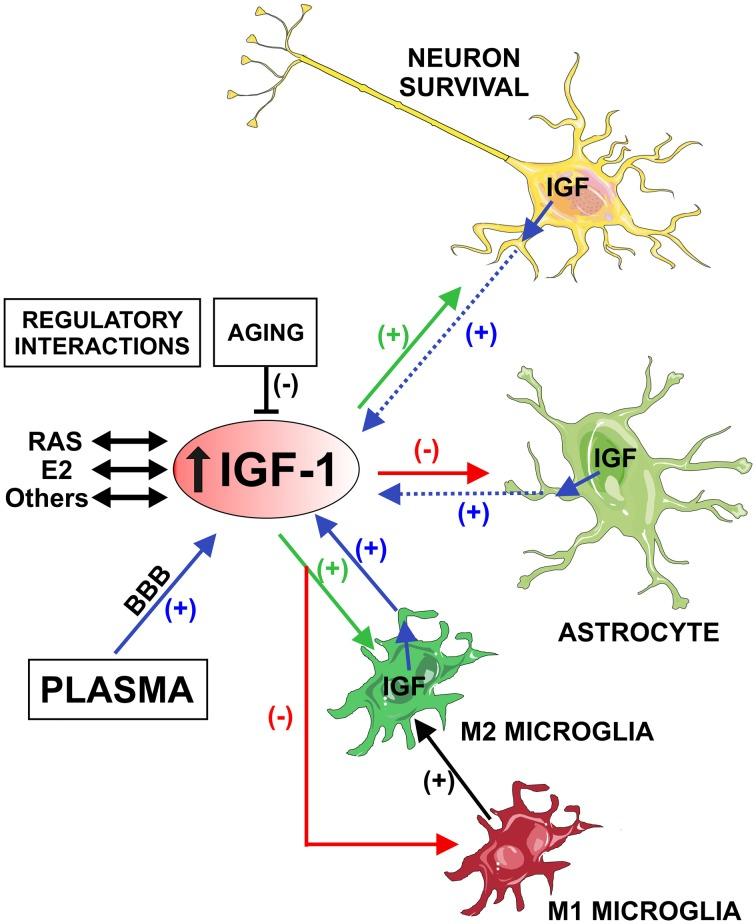
Insulin-like growth factor-1 (IGF-1) effects on aging and neurodegeneration is still controversial. However, it is widely admitted that IGF-1 is involved in the neuroinflammatory response. In peripheral tissues, several studies showed that IGF-1 inhibited the expression of inflammatory markers, although other studies concluded that IGF-1 has proinflammatory functions. Furthermore, proinflammatory cytokines such as TNF-α impaired IGF-1 signaling. In the brain, there are controversial results on effects of IGF-1 in neuroinflammation. In addition to direct protective effects on neurons, several studies revealed anti-inflammatory effects of IGF-1 acting on astrocytes and microglia, and that IGF-1 may also inhibit blood brain barrier permeability. Altogether suggests that the aging-related decrease in IGF-1 levels may contribute to the aging-related pro-inflammatory state. IGF-1 inhibits the astrocytic response to inflammatory stimuli, and modulates microglial phenotype (IGF-1 promotes the microglial M2 and inhibits of M1 phenotype). Furthermore, IGF-1 is mitogenic for microglia. IGF-1 and estrogen interact to modulate the neuroinflammatory response and microglial and astrocytic phenotypes. Brain renin-angiotensin and IGF-1 systems also interact to modulate neuroinflammation. Induction of microglial IGF-1 by angiotensin, and possibly by other pro-inflammatory inducers, plays a major role in the repression of the M1 microglial neurotoxic phenotype and the enhancement of the transition to an M2 microglial repair/regenerative phenotype. This mechanism is impaired in aged brains. Aging-related decrease in IGF-1 may contribute to the loss of capacity of microglia to undergo M2 activation. Fine tuning of IGF-1 levels may be critical for regulating the neuroinflammatory response, and IGF-1 may be involved in inflammation in a context-dependent mode.
胰岛素样生长因子-1(IGF-1)对衰老和神经退行性变的影响仍存在争议。然而,人们普遍认为IGF-1参与神经炎症反应。在周围组织中,多项研究表明IGF-1可抑制炎症标志物的表达,尽管其他研究得出IGF-1具有促炎功能的结论。此外,诸如肿瘤坏死因子-α等促炎细胞因子会损害IGF-1信号传导。在大脑中,关于IGF-1在神经炎症中的作用存在相互矛盾的结果。除了对神经元有直接保护作用外,多项研究还揭示了IGF-1作用于星形胶质细胞和小胶质细胞的抗炎作用,并且IGF-1还可能抑制血脑屏障通透性。总体而言,这表明与衰老相关的IGF-1水平下降可能导致与衰老相关的促炎状态。IGF-1可抑制星形胶质细胞对炎症刺激的反应,并调节小胶质细胞表型(IGF-1促进小胶质细胞的M2表型并抑制M1表型)。此外,IGF-1对小胶质细胞有促有丝分裂作用。IGF-1和雌激素相互作用以调节神经炎症反应以及小胶质细胞和星形胶质细胞表型。脑肾素-血管紧张素系统和IGF-1系统也相互作用以调节神经炎症。血管紧张素以及可能由其他促炎诱导剂诱导的小胶质细胞IGF-1,在抑制M1小胶质细胞神经毒性表型和增强向M2小胶质细胞修复/再生表型的转变中起主要作用。这种机制在衰老大脑中受损。与衰老相关的IGF-1水平下降可能导致小胶质细胞进行M2激活的能力丧失。精确调节IGF-1水平对于调节神经炎症反应可能至关重要,并且IGF-1可能以依赖于背景的方式参与炎症反应。
 Zotero 插件