
褪黑素作为头颈癌的一种潜在抑制剂。
Melatonin as a potential inhibitory agent in head and neck cancer.
作者信息
Yeh Chia-Ming, Su Shih-Chi, Lin Chiao-Wen, Yang Wei-En, Chien Ming-Hsien, Reiter Russel J, Yang Shun-Fa
机构信息
Institute of Medicine, Chung Shan Medical University, Taichung, Taiwan.
Whole-Genome Research Core Laboratory of Human Diseases, Chang Gung Memorial Hospital, Keelung, Taiwan.
出版信息
Oncotarget. 2017 Aug 9;8(52):90545-90556. doi: 10.18632/oncotarget.20079. eCollection 2017 Oct 27.
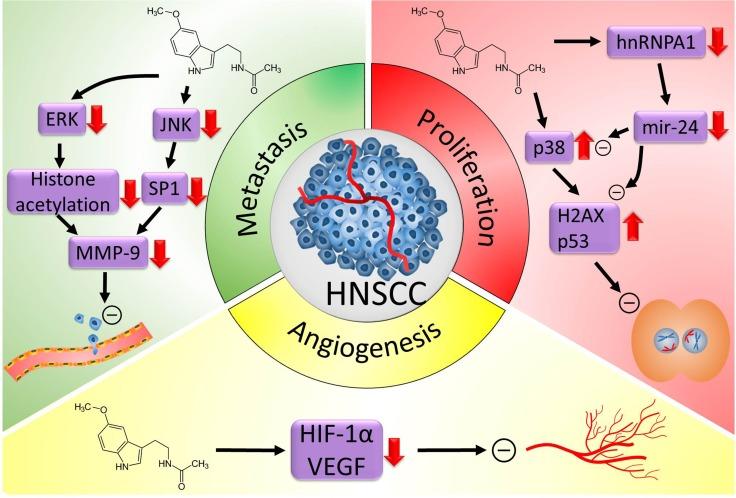
Melatonin is a molecule secreted by the pineal gland; it is an important regulator of sleep and circadian rhythms. Through multiple interrelated mechanisms, melatonin exhibits various inhibitory properties at different stages of tumor progression. Many studies have explored the oncostatic effects of melatonin on hormone-dependent tumors. In this review, we highlight recent advances in understanding the effects of melatonin on the development of head and neck cancers, including molecular mechanisms identified through experimental and clinical observations. Because melatonin exerts a wide range of effects, melatonin may influence many mechanisms that influence the development of cancer. These include cell proliferation, apoptosis, angiogenesis, extracellular matrix remodeling through matrix metalloproteinases, and genetic polymorphism. Thus, the evidence discussed in this article will serve as a basis for basic and clinical research to promote the use of melatonin for understanding and controlling the development of head and neck cancers.
褪黑素是一种由松果体分泌的分子;它是睡眠和昼夜节律的重要调节因子。通过多种相互关联的机制,褪黑素在肿瘤进展的不同阶段表现出多种抑制特性。许多研究探讨了褪黑素对激素依赖性肿瘤的抑癌作用。在本综述中,我们重点介绍了在理解褪黑素对头颈部癌症发展的影响方面的最新进展,包括通过实验和临床观察确定的分子机制。由于褪黑素具有广泛的作用,它可能会影响许多影响癌症发展的机制。这些机制包括细胞增殖、凋亡、血管生成、通过基质金属蛋白酶进行的细胞外基质重塑以及基因多态性。因此,本文讨论的证据将作为基础和临床研究的依据,以促进褪黑素在理解和控制头颈部癌症发展方面的应用。

 Zotero 插件