
去氧鬼臼毒素通过 p38 信号通路诱导舌癌细胞系血红素加氧酶-1 表达和凋亡反应。
Deoxyshikonin Mediates Heme Oxygenase-1 Induction and Apoptotic Response via p38 Signaling in Tongue Cancer Cell Lines.
机构信息
Department of Otolaryngology, Chung Shan Medical University Hospital, Taichung 402, Taiwan.
School of Medicine, Chung Shan Medical University, Taichung 402, Taiwan.
出版信息
Int J Mol Sci. 2022 Jun 26;23(13):7115. doi: 10.3390/ijms23137115.
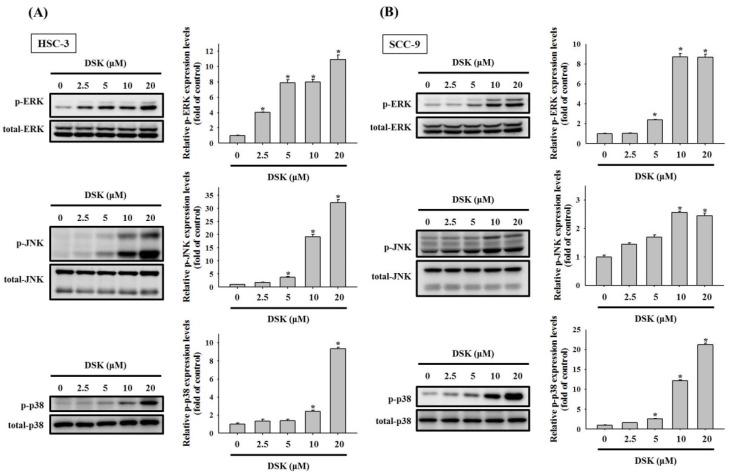
Deoxyshikonin (DSK), a phytochemical constituent, has been documented to elicit various oncostatic properties alone or in combination with established therapeutics. However, its role in restraining oral squamous cell carcinoma (OSCC) is mostly unclear. Here, we examined the tumor-suppressive effect of DSK and explored the molecular mechanisms underlying DSK's activities on controlling oral cancer. Our results showed that DSK dose-dependently lessened the cell viability of tongue cancer cell lines, involving induction of cell cycle arrest at the sub-G1 phase and apoptotic cell death. Moreover, a unique signature of apoptosis-related proteins, including augmented nuclear factor erythroid 2-related factor 2 (Nrf2)/heme oxygenase-1 (HO-1) expression and caspase activation, was observed in DSK-treated tongue cancer cell lines. Furthermore, DSK-mediated upregulation of HO-1 and cleavage of caspase-9 and -3 were significantly inhibited by pharmacological blockage of p38 kinase. Collectively, these data revealed that DSK halted cell cycle progression and elicited cell apoptosis in tongue cancer cell lines, reshaping a p38-dependent profile of apoptotic proteome. Our findings provided novel insights into the therapeutic implications of a natural compound on the management of OSCC.
去氧鬼臼毒素(DSK)是一种植物化学物质,已被证明具有单独或与既定疗法联合的多种抗肿瘤特性。然而,其在抑制口腔鳞状细胞癌(OSCC)方面的作用在很大程度上尚不清楚。在这里,我们研究了 DSK 的肿瘤抑制作用,并探讨了 DSK 控制口腔癌活性的分子机制。我们的结果表明,DSK 呈剂量依赖性降低舌癌细胞系的细胞活力,包括诱导细胞周期在 sub-G1 期停滞和细胞凋亡。此外,在 DSK 处理的舌癌细胞系中观察到与细胞凋亡相关的蛋白质的独特特征,包括核因子红细胞 2 相关因子 2(Nrf2)/血红素加氧酶-1(HO-1)表达和半胱氨酸天冬氨酸蛋白酶激活的增加。此外,DSK 介导的 HO-1 上调和 caspase-9 和 -3 的裂解被 p38 激酶的药理学阻断显著抑制。总的来说,这些数据表明 DSK 阻止了舌癌细胞系的细胞周期进程并引发了细胞凋亡,重塑了依赖于 p38 的凋亡蛋白质组谱。我们的研究结果为天然化合物在 OSCC 管理中的治疗意义提供了新的见解。


 Zotero 插件