
CRISPR-Cas9介导的RNA依赖性RNA靶向作用
RNA-dependent RNA targeting by CRISPR-Cas9.
作者信息
Strutt Steven C, Torrez Rachel M, Kaya Emine, Negrete Oscar A, Doudna Jennifer A
机构信息
Department of Molecular and Cell Biology, University of California, Berkeley, United States.
Sandia National Laboratories, Biotechnology and Bioengineering Department, Livermore, United States.
出版信息
Elife. 2018 Jan 5;7:e32724. doi: 10.7554/eLife.32724.
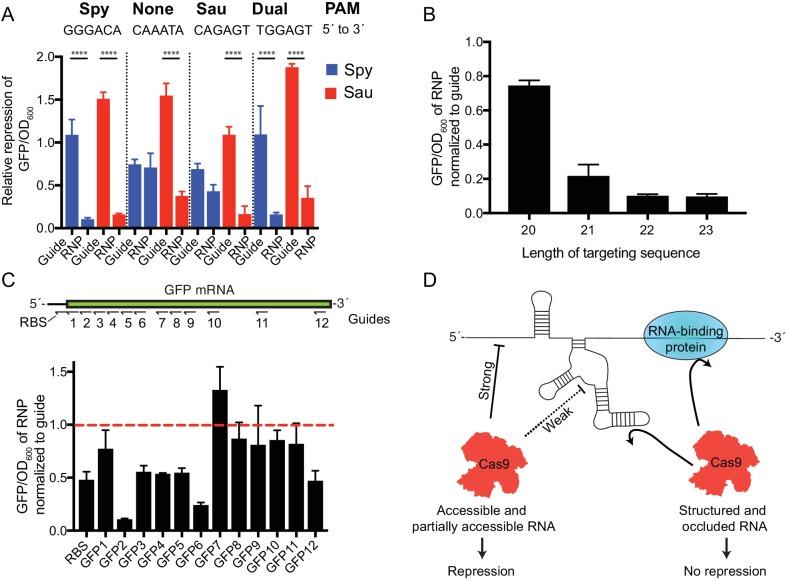
Double-stranded DNA (dsDNA) binding and cleavage by Cas9 is a hallmark of type II CRISPR-Cas bacterial adaptive immunity. All known Cas9 enzymes are thought to recognize DNA exclusively as a natural substrate, providing protection against DNA phage and plasmids. Here, we show that Cas9 enzymes from both subtypes II-A and II-C can recognize and cleave single-stranded RNA (ssRNA) by an RNA-guided mechanism that is independent of a protospacer-adjacent motif (PAM) sequence in the target RNA. RNA-guided RNA cleavage is programmable and site-specific, and we find that this activity can be exploited to reduce infection by single-stranded RNA phage in vivo. We also demonstrate that Cas9 can direct PAM-independent repression of gene expression in bacteria. These results indicate that a subset of Cas9 enzymes have the ability to act on both DNA and RNA target sequences, and suggest the potential for use in programmable RNA targeting applications.
Cas9对双链DNA(dsDNA)的结合与切割是II型CRISPR-Cas细菌适应性免疫的一个标志。所有已知的Cas9酶都被认为仅将DNA识别为天然底物,从而提供针对DNA噬菌体和质粒的保护。在此,我们表明来自II-A和II-C两个亚型的Cas9酶能够通过一种RNA引导机制识别并切割单链RNA(ssRNA),该机制独立于靶RNA中的原间隔序列临近基序(PAM)序列。RNA引导的RNA切割是可编程且位点特异性的,并且我们发现这种活性可用于在体内减少单链RNA噬菌体的感染。我们还证明了Cas9能够在细菌中指导不依赖PAM的基因表达抑制。这些结果表明一部分Cas9酶有能力作用于DNA和RNA靶序列,并暗示了其在可编程RNA靶向应用中的潜在用途。


 Zotero 插件