
VEGF 和 SEMA4D 对促进卵巢上皮性癌细胞血管生成有协同作用。
VEGF and SEMA4D have synergistic effects on the promotion of angiogenesis in epithelial ovarian cancer.
机构信息
Department of Gynecologic Oncology, Tianjin Medical University Cancer Institute and Hospital, Huanhuxi Road, Hexi District, Tianjin, 300060 China.
Key Laboratory of Cancer Prevention and Therapy, Tianjin, 300060 China.
出版信息
Cell Mol Biol Lett. 2018 Jan 3;23:2. doi: 10.1186/s11658-017-0058-9. eCollection 2018.
BACKGROUND
Anti-angiogenesis therapy that targets VEGF is one of the important treatment strategies in advanced ovarian cancer. However, depending on the pharmaceutical agent, treatment can have undesirable side effects. SEMA4D has recently gained interest for its role in promoting angiogenesis. Here, we try to further understand the mechanism by which SEMA4D promotes angiogenesis in ovarian cancer.
METHODS
Correlation and western blot assaya were used to detect the relationship between VEGF and SEMA4D in clinical tissues and cells. Vasculogenic mimicry and transwell migration analyses were used to detect the roles of VEGF, SEMA4D and plexin-B1 on vasculogenic mimicry and migration. Vascular density and SEMA4D expression was determined using immunofluorescence staining in clinical tissues of EOC. Western blot was used to detect the expressions of CD31, MMP2 and VE-cadherin. We also analyzed the relationship between VEGF-SEMA4D and malignant tumor prognosis.
RESULTS
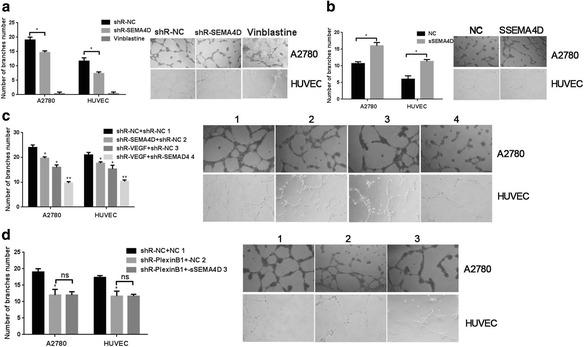
We found that knockdown of VEGF could suppress SEMA4D expression and that the expressions of VEGF and SEMA4D have a positive correlation in EOC cancer tissues. Vasculogenic mimicry and transwell migration analyses showed that SEMA4D and VEGF have a synergistic effect on the promotion of angiogenesis in A2780 and HUVEC cells. Soluble SEMA4D (sSEMA4D) could promote VM and migration in A2780 and HUVEC cells via the SEMA4D/plexin-B1 pathway, but the effect was not noted in stably transfected shR-plexin-B1 cells. In clinical tissues of EOC, the vascular density and SEMA4D/plexin-B1 expression were higher. When VEGF, SEMA4D and plexin-B1 was knocked down, the expression of CD31, MMP2 and VE-cadherin, which are the markers and initiators of angiogenesis and the epithelial-mesenchymal transition (EMT) process were reduced. VEGF and SEMA4D had a positive correlation with the malignant degree of ovarian cancer, and SEMA4D can serve as an independent prognostic factor.
CONCLUSIONS
VEGF and SEMA4D have synergistic effects on the promotion of angiogenesis in epithelial ovarian cancer. Targeting VEGF and the SEMA4D signaling pathway could be important for the therapy for EOC.
背景
针对血管内皮生长因子(VEGF)的抗血管生成治疗是晚期卵巢癌的重要治疗策略之一。然而,由于药物的不同,治疗可能会产生不良的副作用。SEMA4D 因其在促进血管生成中的作用而受到关注。在这里,我们试图进一步了解 SEMA4D 在卵巢癌中促进血管生成的机制。
方法
采用相关性分析和 Western blot 检测临床组织和细胞中 VEGF 与 SEMA4D 的关系。通过血管生成拟态和 Transwell 迁移分析检测 VEGF、SEMA4D 和 Plexin-B1 对血管生成拟态和迁移的作用。采用免疫荧光染色检测临床卵巢癌组织中的血管密度和 SEMA4D 表达。Western blot 检测 CD31、MMP2 和 VE-cadherin 的表达。还分析了 VEGF-SEMA4D 与恶性肿瘤预后的关系。
结果
我们发现,下调 VEGF 可抑制 SEMA4D 的表达,并且在卵巢癌组织中 VEGF 和 SEMA4D 的表达呈正相关。血管生成拟态和 Transwell 迁移分析表明,SEMA4D 和 VEGF 对 A2780 和 HUVEC 细胞的血管生成有协同促进作用。可溶性 SEMA4D(sSEMA4D)可通过 SEMA4D/Plexin-B1 途径促进 A2780 和 HUVEC 细胞的 VM 和迁移,但在稳定转染 shR-plexin-B1 细胞中未见此作用。在卵巢癌的临床组织中,血管密度和 SEMA4D/Plexin-B1 的表达较高。当 VEGF、SEMA4D 和 Plexin-B1 被敲低时,血管生成和上皮间质转化(EMT)过程的标志物和启动子 CD31、MMP2 和 VE-cadherin 的表达减少。VEGF 和 SEMA4D 与卵巢癌的恶性程度呈正相关,SEMA4D 可作为独立的预后因素。
结论
VEGF 和 SEMA4D 对上皮性卵巢癌的血管生成有协同促进作用。针对 VEGF 和 SEMA4D 信号通路可能是治疗卵巢癌的重要策略。




 Zotero 插件