
在[具体内容缺失]和[具体内容缺失]中的靶向表型筛选揭示了疟疾药物研发项目疟疾盒分子的新型作用模式。
Targeted Phenotypic Screening in and Reveals Novel Modes of Action of Medicines for Malaria Venture Malaria Box Molecules.
作者信息
Subramanian Gowtham, Belekar Meenakshi A, Shukla Anurag, Tong Jie Xin, Sinha Ameya, Chu Trang T T, Kulkarni Akshay S, Preiser Peter R, Reddy D Srinivasa, Tan Kevin S W, Shanmugam Dhanasekaran, Chandramohanadas Rajesh
机构信息
Pillar of Engineering Product Development, Singapore University of Technology and Design, Singapore.
Biochemical Sciences Division, CSIR National Chemical Laboratory, Pune, India.
出版信息
mSphere. 2018 Jan 17;3(1). doi: 10.1128/mSphere.00534-17. eCollection 2018 Jan-Feb.
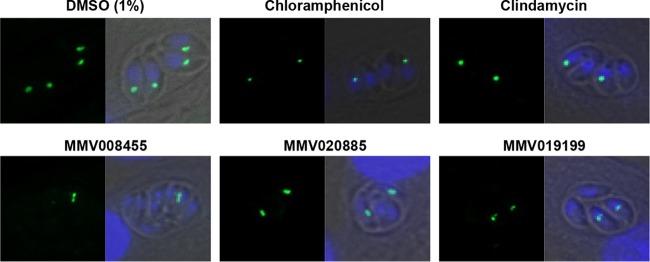
The Malaria Box collection includes 400 chemically diverse small molecules with documented potency against malaria parasite growth, but the underlying modes of action are largely unknown. Using complementary phenotypic screens against and , we report phenotype-specific hits based on inhibition of overall parasite growth, apicoplast segregation, and egress or host invasion, providing hitherto unavailable insights into the possible mechanisms affected. First, the Malaria Box library was screened against tachyzoite stage and the half-maximal effective concentrations (ECs) of molecules showing ≥80% growth inhibition at 10 µM were determined. Comparison of the ECs for and identified a subset of 24 molecules with nanomolar potency against both parasites. Thirty molecules that failed to induce acute growth inhibition in tachyzoites in a 2-day assay caused delayed parasite death upon extended exposure, with at least three molecules interfering with apicoplast segregation during daughter cell formation. Using flow cytometry and microscopy-based examinations, we prioritized 26 molecules with the potential to inhibit host cell egress/invasion during asexual developmental stages of . None of the inhibitors affected digestive vacuole integrity, ruling out a mechanism mediated by broadly specific protease inhibitor activity. Interestingly, five of the plasmodial egress inhibitors inhibited ionophore-induced egress of tachyzoites. These findings highlight the advantage of comparative and targeted phenotypic screens in related species as a means to identify lead molecules with a conserved mode of action. Further work on target identification and mechanism analysis will facilitate the development of antiparasitic compounds with cross-species efficacy. The phylum includes many human and animal pathogens, such as (human malaria) and (human and animal toxoplasmosis). Widespread resistance to current antimalarials and the lack of a commercial vaccine necessitate novel pharmacological interventions with distinct modes of action against malaria. For toxoplasmosis, new drugs to effectively eliminate tissue-dwelling latent cysts of the parasite are needed. The Malaria Box antimalarial collection, managed and distributed by the Medicines for Malaria Venture, includes molecules of novel chemical classes with proven antimalarial efficacy. Using targeted phenotypic assays of and , we have identified a subset of the Malaria Box molecules as potent inhibitors of plastid segregation and parasite invasion and egress, thereby providing early insights into their probable mode of action. Five molecules that inhibit the egress of both parasites have been identified for further mechanistic studies. Thus, the approach we have used to identify novel molecules with defined modes of action in multiple parasites can expedite the development of pan-active antiparasitic agents.
疟疾盒化合物库包含400种化学结构多样的小分子,这些小分子对疟原虫生长具有已证实的活性,但其潜在作用模式大多未知。通过针对[具体物种1]和[具体物种2]的互补表型筛选,我们报告了基于对寄生虫整体生长、顶质体分离、逸出或宿主入侵的抑制作用的表型特异性命中化合物,从而为可能受影响的机制提供了前所未有的见解。首先,针对速殖子阶段的[具体物种1]对疟疾盒文库进行筛选,并确定了在10 μM时显示≥80%生长抑制的分子的半数最大有效浓度(EC)。对[具体物种1]和[具体物种2]的EC进行比较,确定了24种对两种寄生虫均具有纳摩尔活性的分子子集。在为期2天的试验中未能在[具体物种1]速殖子中诱导急性生长抑制的30种分子,在延长暴露后导致寄生虫延迟死亡,其中至少有3种分子在子细胞形成过程中干扰顶质体分离。通过流式细胞术和基于显微镜的检查,我们对26种在[具体物种2]无性发育阶段具有抑制宿主细胞逸出/入侵潜力的分子进行了优先级排序。没有一种抑制剂影响消化泡完整性,排除了由广泛特异性蛋白酶抑制剂活性介导的机制。有趣的是,5种疟原虫逸出抑制剂抑制了离子载体诱导的[具体物种1]速殖子逸出。这些发现突出了在相关物种中进行比较和靶向表型筛选作为鉴定具有保守作用模式的先导分子的一种手段的优势。在靶点鉴定和机制分析方面的进一步工作将有助于开发具有跨物种疗效的抗寄生虫化合物。[具体门]包括许多人类和动物病原体,如[人类疟疾病原体]和[人类和动物弓形虫病病原体]。对当前抗疟药物的广泛耐药性以及缺乏商业疫苗,需要具有不同作用模式的新型药理学干预措施来对抗疟疾。对于弓形虫病,需要能够有效消除寄生虫组织内潜伏囊肿的新药。由疟疾药物事业组织管理和分发的疟疾盒抗疟化合物库包括具有已证实抗疟疗效的新型化学类别的分子。通过针对[具体物种1]和[具体物种2]的靶向表型分析,我们已确定疟疾盒分子的一个子集是质体分离以及寄生虫入侵和逸出的有效抑制剂,从而为其可能的作用模式提供了早期见解。已鉴定出5种抑制两种寄生虫逸出的分子用于进一步的机制研究。因此,我们用于在多种寄生虫中鉴定具有明确作用模式的新型分子的方法可以加速泛活性抗寄生虫药物的开发。




 Zotero 插件