
炎症相关的微卫星改变:机制及其在结直肠癌患者预后中的意义
Inflammation-associated microsatellite alterations: Mechanisms and significance in the prognosis of patients with colorectal cancer.
作者信息
Koi Minoru, Tseng-Rogenski Stephanie S, Carethers John M
机构信息
Division of Gastroenterology, Department of Internal Medicine and Comprehensive Cancer Center, University of Michigan, Ann Arbor, MI 48109-5368, United States.
出版信息
World J Gastrointest Oncol. 2018 Jan 15;10(1):1-14. doi: 10.4251/wjgo.v10.i1.1.
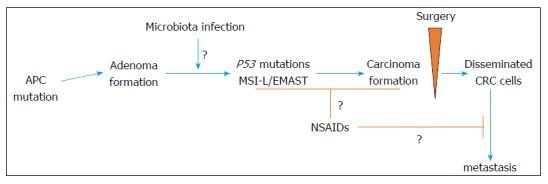
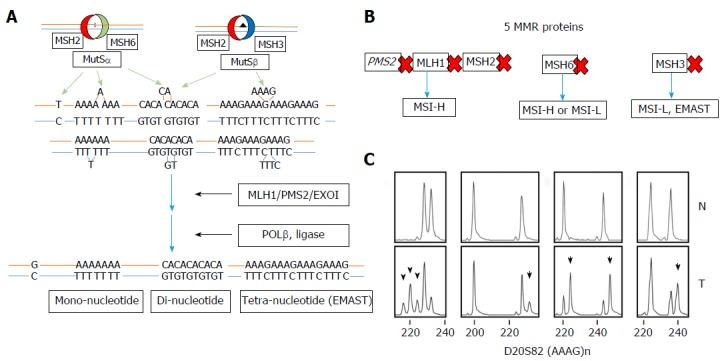
Microsatellite alterations within genomic DNA frameshift as a result of defective DNA mismatch repair (MMR). About 15% of sporadic colorectal cancers (CRCs) manifest hypermethylation of the DNA MMR gene , resulting in mono- and di-nucleotide frameshifts to classify it as microsatellite instability-high (MSI-H) and hypermutated, and due to frameshifts at coding microsatellites generating neo-antigens, produce a robust protective immune response that can be enhanced with immune checkpoint blockade. More commonly, approximately 50% of sporadic non-MSI-H CRCs demonstrate frameshifts at di- and tetra-nucleotide microsatellites to classify it as MSI-low/elevated microsatellite alterations at selected tetranucleotide repeats (EMAST) as a result of functional somatic inactivation of the DNA MMR protein MSH3 a nuclear-to-cytosolic displacement. The trigger for MSH3 displacement appears to be inflammation and/or oxidative stress, and unlike MSI-H CRC patients, patients with MSI-L/EMAST CRCs show poor prognosis. These inflammatory-associated microsatellite alterations are a consequence of the local tumor microenvironment, and in theory, if the microenvironment is manipulated to lower inflammation, the microsatellite alterations and MSH3 dysfunction should be corrected. Here we describe the mechanisms and significance of inflammatory-associated microsatellite alterations, and propose three areas to deeply explore the consequences and prevention of inflammation's effect upon the DNA MMR system.
由于DNA错配修复(MMR)缺陷,基因组DNA框架内会发生微卫星改变。约15%的散发性结直肠癌(CRC)表现出DNA错配修复基因的高甲基化,导致单核苷酸和双核苷酸移码,将其归类为微卫星高度不稳定(MSI-H)和高突变,并且由于编码微卫星处的移码产生新抗原,从而产生强大的保护性免疫反应,免疫检查点阻断可增强这种反应。更常见的是,约50%的散发性非MSI-H CRC在双核苷酸和四核苷酸微卫星处表现出移码,由于DNA错配修复蛋白MSH3功能体细胞失活,导致核转位至胞质,将其归类为微卫星低度不稳定/选定四核苷酸重复序列处微卫星改变升高(EMAST)。MSH3移位的触发因素似乎是炎症和/或氧化应激,与MSI-H CRC患者不同,MSI-L/EMAST CRC患者预后较差。这些与炎症相关的微卫星改变是局部肿瘤微环境的结果,理论上,如果对微环境进行调控以减轻炎症,微卫星改变和MSH3功能障碍应该会得到纠正。在此,我们描述了与炎症相关的微卫星改变的机制和意义,并提出了三个领域,以深入探讨炎症对DNA错配修复系统影响的后果和预防措施。

 Zotero 插件