
什么使得一种工具适合用于评估牙周疾病患者报告的结局?
What makes a tool appropriate to assess patient-reported outcomes of periodontal disease?
作者信息
Baiju Radha Madhavanpillai, Peter Elbe, Varghese Nettiyat Oommen, Sivaram Remadevi, Streiner David Iloyd
机构信息
Department of Periodontics, Government Dental College, Thrissur, India.
Department of Orthodontics, Government Dental College, Alleppey, India.
出版信息
J Indian Soc Periodontol. 2017 Mar-Apr;21(2):90-96. doi: 10.4103/jisp.jisp_144_17.
CONTEXT
Patient-reported outcomes (PROs) have become primary or secondary outcome measure in clinical trials and epidemiological studies in Medicine and Dentistry in general and Periodontology in particular. PROs are patients' self-perceptions about consequences of a disease or its treatment. They can be used to measure the impact of the disease or the effect of its treatment. There are insufficient data in Periodontology related to scale development methodology although, recently, there is an increase in the number of published studies utilizing such tools in major journals.
AIM
This paper is an overview of the development methodology of new PRO tools to study the impact of periodontal disease.
MATERIALS AND METHODS
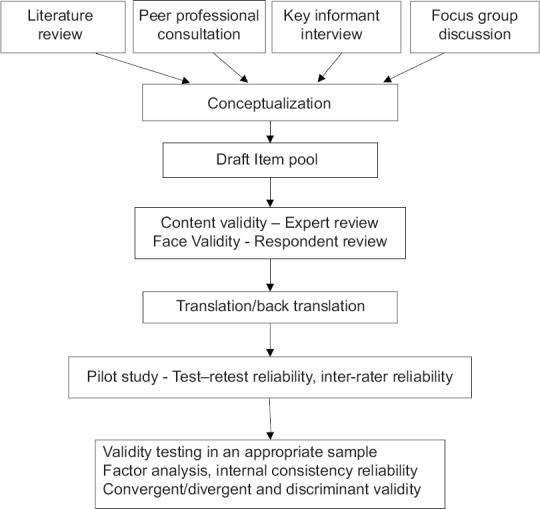
The iterative process begins with a research question. A well-constructed hypothesis enables validity assessment by hypothesis testing. The qualitative steps in item generation include literature review, focus group discussion, and key informant interviews. Expert paneling, content validity index, and pretesting are done to refine and sequence the items. Test-retest reliability, inter-rater reliability, and internal consistency reliability are assessed. The tool is administered in a representative sample to test construct validity by factor analysis.
CONCLUSION
The steps involved in developing a subjective perception scale are complicated and should be followed to establish the essential psychometric properties. The use of existing tool, if it fulfills the research objective, is recommended after cross-cultural adaptation and psychometric testing.
背景
患者报告结局(PROs)已成为医学和牙科学领域,尤其是牙周病学领域临床试验和流行病学研究的主要或次要结局指标。PROs是患者对疾病或其治疗后果的自我认知。它们可用于衡量疾病的影响或治疗效果。尽管最近在主要期刊上发表的使用此类工具的研究数量有所增加,但牙周病学领域中与量表开发方法相关的数据仍然不足。
目的
本文概述了用于研究牙周病影响的新PRO工具的开发方法。
材料与方法
迭代过程始于一个研究问题。一个精心构建的假设能够通过假设检验进行效度评估。项目生成中的定性步骤包括文献综述、焦点小组讨论和关键信息提供者访谈。进行专家评审、内容效度指数和预测试以完善项目并确定其顺序。评估重测信度、评分者间信度和内部一致性信度。通过因子分析在代表性样本中应用该工具来测试结构效度。
结论
开发主观感知量表所涉及的步骤很复杂,应遵循这些步骤来确立基本的心理测量特性。如果现有工具符合研究目的,建议在进行跨文化适应和心理测量测试后使用。
 Zotero 插件