
辐射后 DNA 靶向效应和非靶向效应的细胞反应综合建模。
Integrated Modelling of Cell Responses after Irradiation for DNA-Targeted Effects and Non-Targeted Effects.
机构信息
Graduate School of Health Sciences, Hokkaido University, Kita-12, Nishi-5, Kita-ku, Sapporo, 060-0812, Japan.
Faculty of Health Sciences, Hokkaido University of Science, Maeda 7-15, Teine-ku, Sapporo, 006-8585, Japan.
出版信息
Sci Rep. 2018 Mar 19;8(1):4849. doi: 10.1038/s41598-018-23202-y.
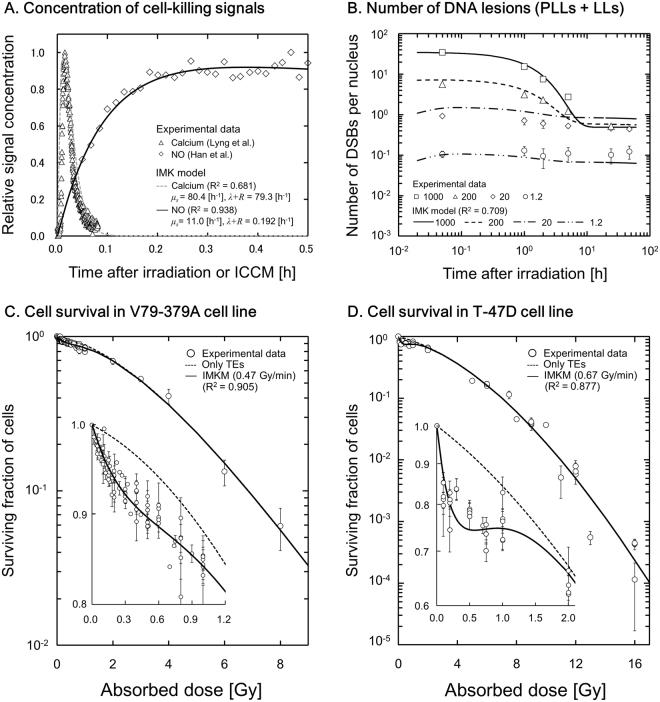
Intercellular communication after ionizing radiation exposure, so-called non-targeted effects (NTEs), reduces cell survival. Here we describe an integrated cell-killing model considering NTEs and DNA damage along radiation particle tracks, known as DNA-targeted effects (TEs) based on repair kinetics of DNA damage. The proposed model was applied to a series of experimental data, i.e., signal concentration, DNA damage kinetics, cell survival curve and medium transfer bystander effects (MTBEs). To reproduce the experimental data, the model considers the following assumptions: (i) the linear-quadratic (LQ) function as absorbed dose to express the hit probability to emit cell-killing signals, (ii) the potentially repair of DNA lesions induced by NTEs, and (iii) lower efficiency of repair for the damage in NTEs than that in TEs. By comparing the model results with experimental data, we found that signal-induced DNA damage and lower repair efficiency in non-hit cells are responsible for NTE-related repair kinetics of DNA damage, cell survival curve with low-dose hyper-radiosensitivity (HRS) and MTBEs. From the standpoint of modelling, the integrated cell-killing model with the LQ relation and a different repair function for NTEs provide a reasonable signal-emission probability and a new estimation of low-dose HRS linked to DNA repair efficiency.
细胞间通讯在电离辐射暴露后,即所谓的非靶向效应(NTE),会降低细胞存活率。在这里,我们描述了一个整合的细胞杀伤模型,该模型考虑了非靶向效应(NTE)和沿辐射粒子轨迹的 DNA 损伤,即所谓的 DNA 靶向效应(TE),基于 DNA 损伤的修复动力学。所提出的模型应用于一系列实验数据,即信号浓度、DNA 损伤动力学、细胞存活率曲线和介质传递旁观者效应(MTBE)。为了再现实验数据,该模型考虑了以下假设:(i)线性二次(LQ)函数作为吸收剂量来表示发出细胞杀伤信号的命中概率,(ii)NTE 诱导的 DNA 损伤的潜在修复,以及(iii)NTE 中损伤的修复效率低于 TEs 中的修复效率。通过将模型结果与实验数据进行比较,我们发现信号诱导的 DNA 损伤和非命中细胞中较低的修复效率是导致 NTE 相关的 DNA 损伤修复动力学、具有低剂量超放射敏感性(HRS)的细胞存活率曲线和 MTBE 的原因。从建模的角度来看,具有 LQ 关系和 NTE 不同修复功能的整合细胞杀伤模型提供了合理的信号发射概率,并对与 DNA 修复效率相关的低剂量 HRS 进行了新的估计。




 Zotero 插件