
硼中子俘获治疗后人黑色素瘤细胞杀伤的剂量率效应估算模型。
A Model for Estimating Dose-Rate Effects on Cell-Killing of Human Melanoma after Boron Neutron Capture Therapy.
机构信息
Nuclear Science and Engineering Center, Research Group for Radiation Transport Analysis, Ibaraki 319-1195, Japan.
Faculty of Health Sciences, Hokkaido University, Hokkaiddo 060-0812, Japan.
出版信息
Cells. 2020 Apr 30;9(5):1117. doi: 10.3390/cells9051117.
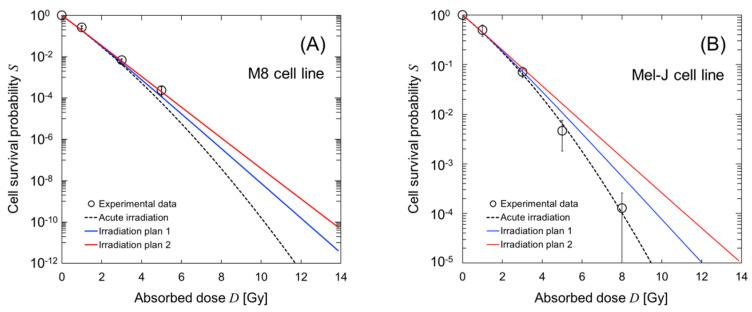
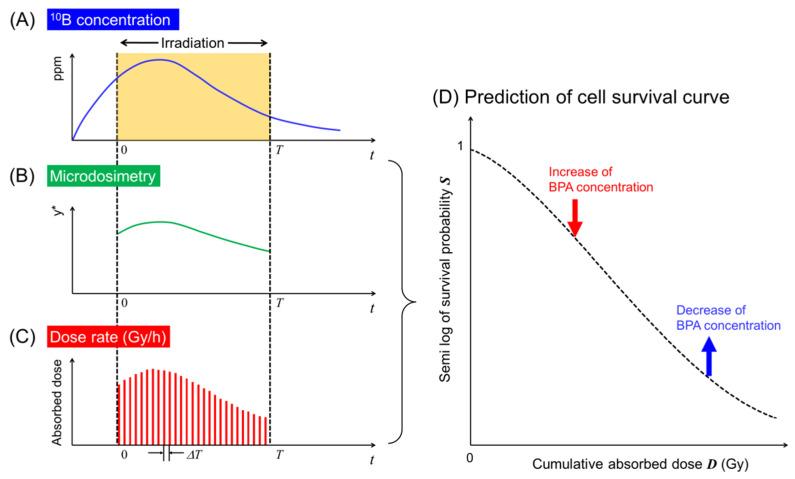
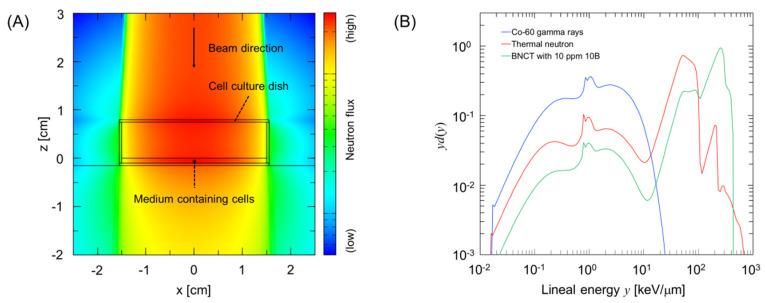
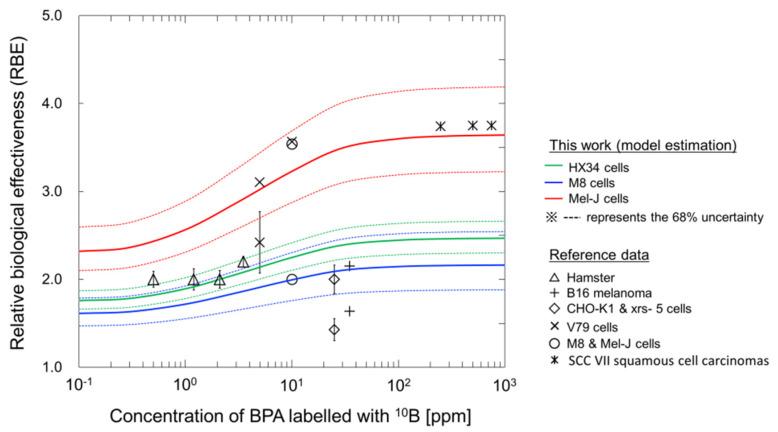
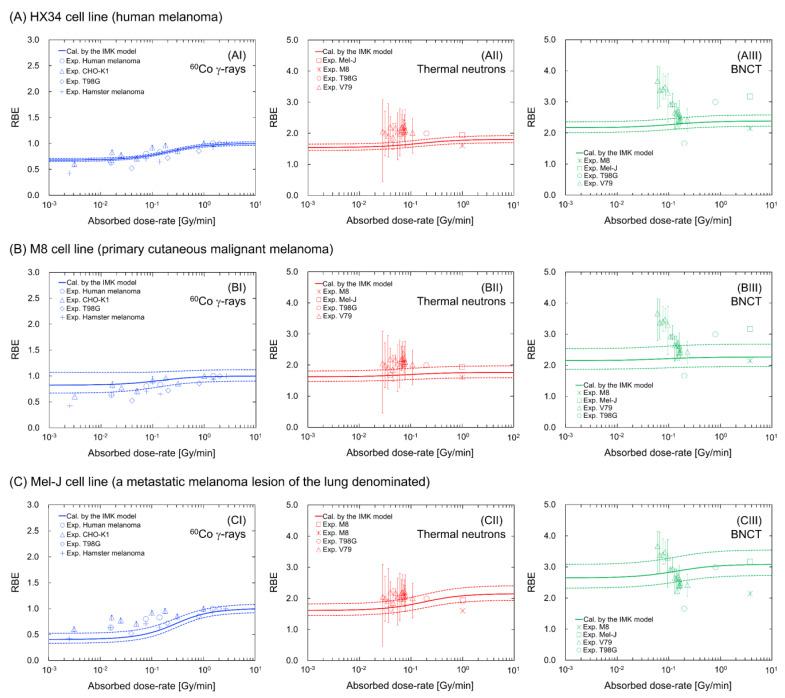
Boron neutron capture therapy (BNCT) is a type of radiation therapy for eradicating tumor cells through a B(n,α)Li reaction in the presence of B in cancer cells. When delivering a high absorbed dose to cancer cells using BNCT, both the timeline of B concentrations and the relative long dose-delivery time compared to photon therapy must be considered. Changes in radiosensitivity during such a long dose-delivery time can reduce the probability of tumor control; however, such changes have not yet been evaluated. Here, we propose an improved that accounts for changes in microdosimetric quantities and dose rates depending on the B concentration and investigate the cell recovery (dose-rate effects) of melanoma during BNCT irradiation. The integrated microdosimetric-kinetic model used in this study considers both sub-lethal damage repair and changes in microdosimetric quantities during irradiation. The model, coupled with the Monte Carlo track structure simulation code of the Particle and Heavy Ion Transport code System, shows good agreement with experimental data for acute exposure to Co γ-rays, thermal neutrons, and BNCT with B concentrations of 10 ppm. This indicates that microdosimetric quantities are important parameters for predicting dose-response curves for cell survival under BNCT irradiations. Furthermore, the model estimation at the endpoint of the mean activation dose exhibits a reduced impact of cell recovery during BNCT irradiations with high linear energy transfer (LET) compared to Co γ-rays irradiation with low LET. Throughout this study, we discuss the advantages of BNCT for enhancing the killing of cancer cells with a reduced dose-rate dependency. If the neutron spectrum and the timelines for drug and dose delivery are provided, the present model will make it possible to predict radiosensitivity for more realistic dose-delivery schemes in BNCT irradiations.
硼中子俘获治疗(BNCT)是一种通过癌细胞中的 B 进行 B(n,α)Li 反应来消除肿瘤细胞的放射治疗方法。当使用 BNCT 向癌细胞提供高吸收剂量时,必须考虑 B 浓度的时间变化和与光子治疗相比相对较长的剂量输送时间。在如此长的剂量输送时间内,放射敏感性的变化会降低肿瘤控制的可能性;然而,这种变化尚未得到评估。在这里,我们提出了一种改进的模型,该模型考虑了微剂量学数量和剂量率随 B 浓度的变化,并研究了 BNCT 照射期间黑色素瘤的细胞恢复(剂量率效应)。本研究中使用的集成微剂量学-动力学模型考虑了亚致死损伤修复和照射过程中微剂量学数量的变化。该模型与粒子和重离子输运代码系统的蒙特卡罗轨迹结构模拟代码相结合,与 Co γ 射线、热中子和 BNCT 的急性暴露的实验数据吻合良好,B 浓度为 10ppm。这表明微剂量学数量是预测 BNCT 照射下细胞存活剂量反应曲线的重要参数。此外,在平均激活剂量的终点处进行模型估计时,与低 LET 的 Co γ 射线照射相比,高 LET 的 BNCT 照射下细胞恢复的影响较小。在整个研究过程中,我们讨论了 BNCT 增强具有降低剂量率依赖性的癌细胞杀伤的优势。如果提供了中子谱和药物及剂量输送的时间线,那么目前的模型将有可能预测 BNCT 照射中更现实的剂量输送方案的放射敏感性。


 Zotero 插件