
基于随机模型分析包括癌症干细胞在内的前列腺癌细胞的高剂量耐受现象。
Analysis of the high-dose-range radioresistance of prostate cancer cells, including cancer stem cells, based on a stochastic model.
机构信息
Department of Radiation Sciences, Division of Medical Life Sciences, Hirosaki University Graduate School of Health Sciences, 66-1 Hon-cho, Hirosaki Aomori, Japan.
Graduate School of Health Sciences, Hokkaido University, Kita-12 Nishi-8, Kita-ku, Sapporo, Hokkaido, Japan.
出版信息
J Radiat Res. 2019 May 1;60(3):298-307. doi: 10.1093/jrr/rrz011.
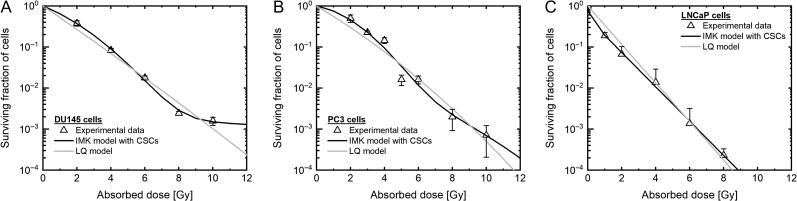
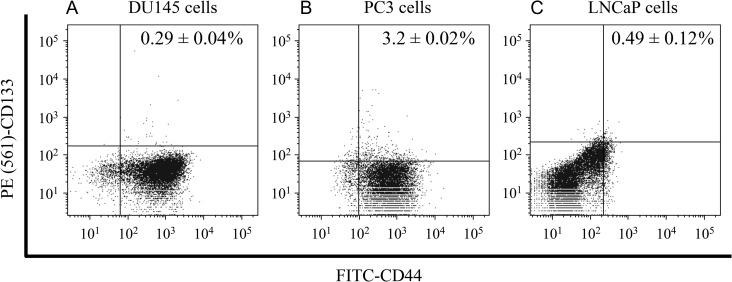
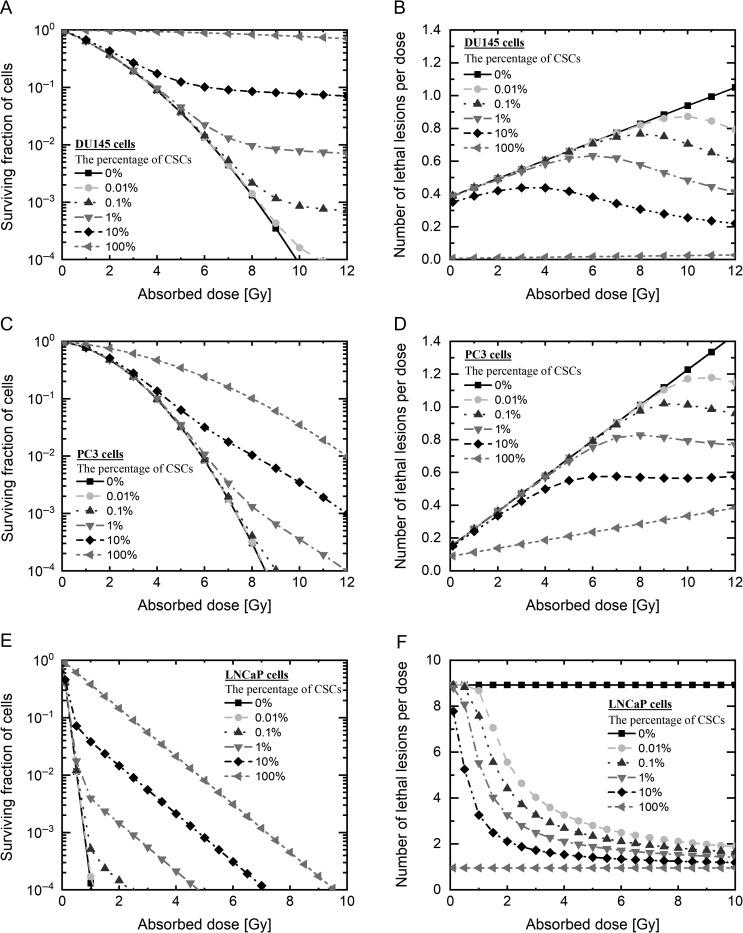
In radiotherapy, cancer stem cells (CSCs) are well recognized as one of the radioresistant cell types. Even in a small subpopulation, CSCs may have an influence on tumor control probability, represented by cell killing after irradiation. However, the relationship between the percentage content of CSCs and the cell survival dose-response curve has not yet been quantitatively clarified. In this study, we developed a cell-killing model for two cell populations (CSCs and progeny cells) to predict the surviving fractions, and compared it with the conventional linear-quadratic (LQ) model. Three prostate cancer cell lines (DU145, PC3 and LNCaP) were exposed to X-rays at doses ranging from 0 to 10 Gy. After the irradiation, we performed clonogenic survival assays to generate the cell survival curves, and carried out flow-cytometric analyses to estimate the percentage content of CSCs for each cell line. The cell survival curves for DU145 cells and PC3 cells seemed not to follow the conventional LQ model in the high dose range (>8 Gy). However, the outputs of the developed model agreed better with the experimental cell survival curves than those of the LQ model. The percentage content of CSCs predicted by the developed model was almost coincident with the measured percentage content for both DU145 cells and PC3 cells. The experiments and model analyses indicate that a small subpopulation of radioresistant CSCs has lower radiosensitivity in the high-dose range, which may lessen the clinical outcome for patients with prostate cancer after high-dose radiation therapy.
在放射治疗中,癌症干细胞(CSC)被认为是一种具有放射抗性的细胞类型。即使在一小部分亚群中,CSC 也可能对肿瘤控制概率产生影响,这种影响可以通过照射后的细胞杀伤来体现。然而,CSC 的百分比含量与细胞存活剂量-反应曲线之间的关系尚未得到定量阐明。在本研究中,我们开发了一个用于两种细胞群体(CSC 和祖细胞)的细胞杀伤模型,以预测存活分数,并将其与传统的线性二次(LQ)模型进行比较。我们用 X 射线照射三种前列腺癌细胞系(DU145、PC3 和 LNCaP),剂量范围从 0 到 10Gy。照射后,我们进行集落形成存活测定以生成细胞存活曲线,并进行流式细胞术分析以估计每个细胞系的 CSC 百分比含量。DU145 细胞和 PC3 细胞的细胞存活曲线在高剂量范围(>8Gy)似乎不符合传统的 LQ 模型。然而,与 LQ 模型相比,开发的模型的输出与实验细胞存活曲线更吻合。开发的模型预测的 CSC 百分比含量与 DU145 细胞和 PC3 细胞的实测百分比含量几乎一致。实验和模型分析表明,一小部分具有放射抗性的 CSC 在高剂量范围内具有较低的放射敏感性,这可能会降低接受高剂量放射治疗的前列腺癌患者的临床疗效。




 Zotero 插件