
4-甲基伞形酮给药通过细胞间通讯增强人纤维肉瘤的放射敏感性。
4-Methylumbelliferone administration enhances radiosensitivity of human fibrosarcoma by intercellular communication.
机构信息
Department of Radiation Science, Graduate School of Health Sciences, Hirosaki University, 66-1 Hon-cho, Hirosaki, Aomori, 036-8564, Japan.
Nuclear Science and Engineering Center, Research Group for Radiation Transport Analysis, Japan Atomic Energy Agency, 2-4 Shirakata, Tokai, Ibaraki, 319-1195, Japan.
出版信息
Sci Rep. 2021 Apr 15;11(1):8258. doi: 10.1038/s41598-021-87850-3.
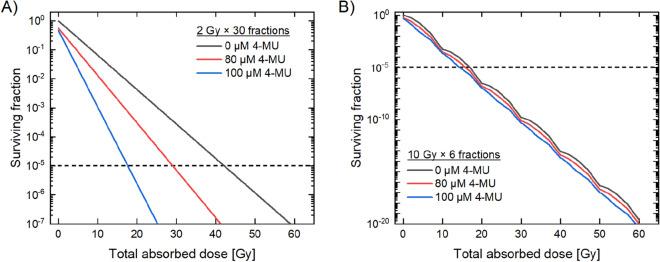
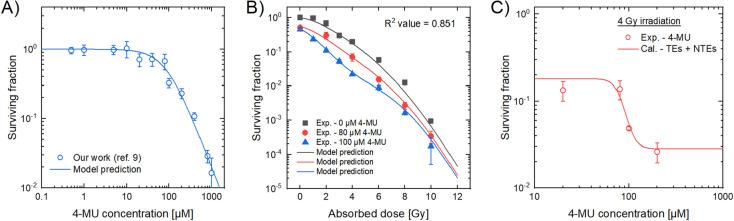
Hyaluronan synthesis inhibitor 4-methylumbelliferone (4-MU) is a candidate of radiosensitizers which enables both anti-tumour and anti-metastasis effects in X-ray therapy. The curative effects under such 4-MU administration have been investigated in vitro; however, the radiosensitizing mechanisms remain unclear. Here, we investigated the radiosensitizing effects under 4-MU treatment from cell experiments and model estimations. We generated experimental surviving fractions of human fibrosarcoma cells (HT1080) after 4-MU treatment combined with X-ray irradiation. Meanwhilst, we also modelled the pharmacological effects of 4-MU treatment and theoretically analyzed the synergetic effects between 4-MU treatment and X-ray irradiation. The results show that the enhancement of cell killing by 4-MU treatment is the greatest in the intermediate dose range of around 4 Gy, which can be reproduced by considering intercellular communication (so called non-targeted effects) through the model analysis. As supposed to be the involvement of intercellular communication in radiosensitization, the oxidative stress level associated with reactive oxygen species (ROS), which leads to DNA damage induction, is significantly higher by the combination of 4-MU treatment and irradiation than only by X-ray irradiation, and the radiosensitization by 4-MU can be suppressed by the ROS inhibitors. These findings suggest that the synergetic effects between 4-MU treatment and irradiation are predominantly attributed to intercellular communication and provide more efficient tumour control than conventional X-ray therapy.
透明质酸合成抑制剂 4-甲基伞形酮(4-MU)是放射增敏剂的候选药物,可在 X 射线治疗中同时发挥抗肿瘤和抗转移作用。已经在体外研究了这种 4-MU 给药下的治疗效果;然而,放射增敏机制仍不清楚。在这里,我们从细胞实验和模型估计中研究了 4-MU 治疗下的放射增敏作用。我们生成了人类纤维肉瘤细胞(HT1080)在 4-MU 处理联合 X 射线照射后的实验存活分数。同时,我们还模拟了 4-MU 处理的药理作用,并从理论上分析了 4-MU 处理与 X 射线照射之间的协同作用。结果表明,4-MU 处理增强细胞杀伤的效果在约 4 Gy 的中间剂量范围内最大,通过模型分析考虑细胞间通讯(所谓的非靶向效应)可以重现这种效果。由于认为细胞间通讯参与了放射增敏作用,与活性氧(ROS)相关的氧化应激水平,这导致 DNA 损伤诱导,在 4-MU 处理和照射的组合中比仅在 X 射线照射中显著更高,并且 4-MU 的放射增敏作用可以通过 ROS 抑制剂来抑制。这些发现表明,4-MU 处理和照射之间的协同作用主要归因于细胞间通讯,并提供比传统 X 射线治疗更有效的肿瘤控制。



 Zotero 插件