
2000 年至 2015 年间,抗生素消费在全球范围内增长,并在地理上趋同。
Global increase and geographic convergence in antibiotic consumption between 2000 and 2015.
机构信息
Center for Disease Dynamics, Economics & Policy, Washington, DC 20005;
Department of Emergency Medicine, Johns Hopkins School of Medicine, Baltimore, MD 21209.
出版信息
Proc Natl Acad Sci U S A. 2018 Apr 10;115(15):E3463-E3470. doi: 10.1073/pnas.1717295115. Epub 2018 Mar 26.
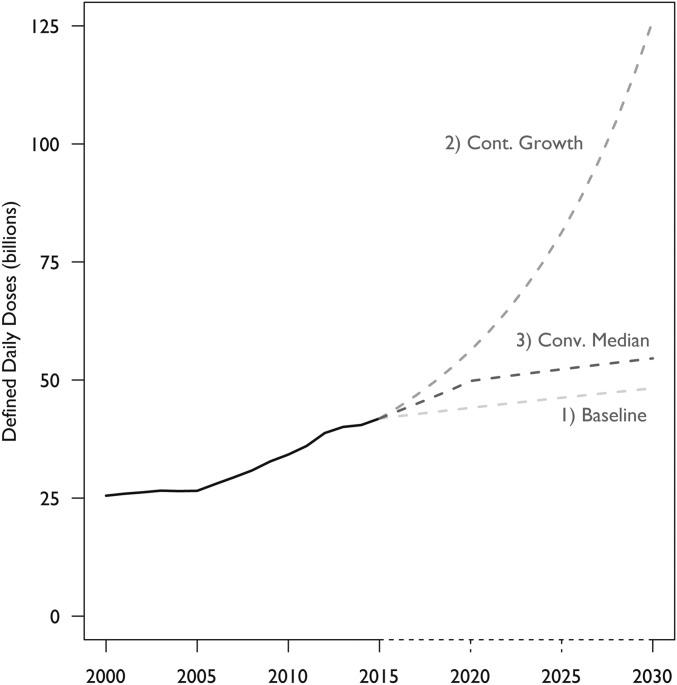
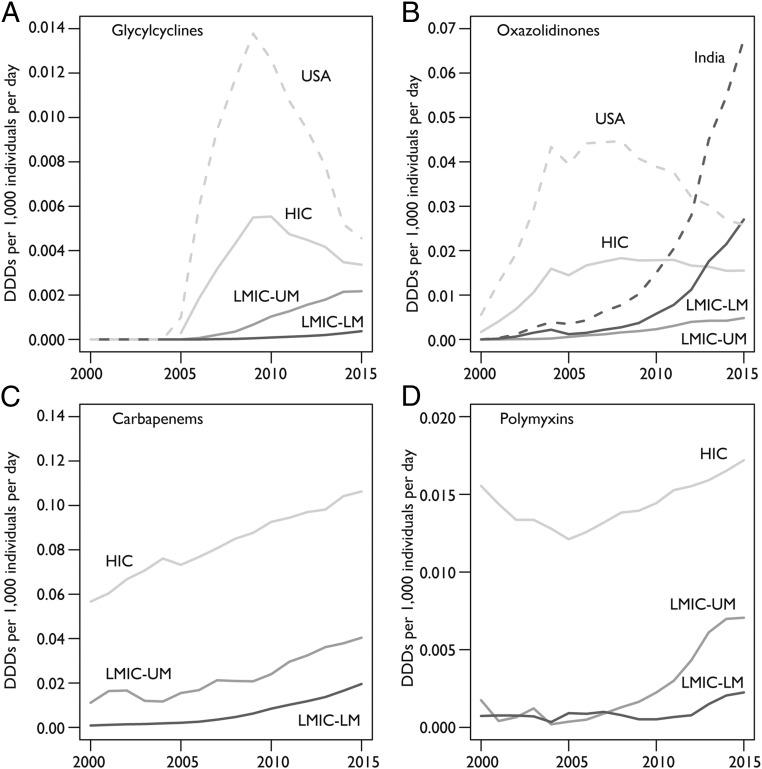
Tracking antibiotic consumption patterns over time and across countries could inform policies to optimize antibiotic prescribing and minimize antibiotic resistance, such as setting and enforcing per capita consumption targets or aiding investments in alternatives to antibiotics. In this study, we analyzed the trends and drivers of antibiotic consumption from 2000 to 2015 in 76 countries and projected total global antibiotic consumption through 2030. Between 2000 and 2015, antibiotic consumption, expressed in defined daily doses (DDD), increased 65% (21.1-34.8 billion DDDs), and the antibiotic consumption rate increased 39% (11.3-15.7 DDDs per 1,000 inhabitants per day). The increase was driven by low- and middle-income countries (LMICs), where rising consumption was correlated with gross domestic product per capita (GDPPC) growth ( = 0.004). In high-income countries (HICs), although overall consumption increased modestly, DDDs per 1,000 inhabitants per day fell 4%, and there was no correlation with GDPPC. Of particular concern was the rapid increase in the use of last-resort compounds, both in HICs and LMICs, such as glycylcyclines, oxazolidinones, carbapenems, and polymyxins. Projections of global antibiotic consumption in 2030, assuming no policy changes, were up to 200% higher than the 42 billion DDDs estimated in 2015. Although antibiotic consumption rates in most LMICs remain lower than in HICs despite higher bacterial disease burden, consumption in LMICs is rapidly converging to rates similar to HICs. Reducing global consumption is critical for reducing the threat of antibiotic resistance, but reduction efforts must balance access limitations in LMICs and take account of local and global resistance patterns.
跟踪抗生素在时间和国家间的使用模式,可以为优化抗生素处方和最小化抗生素耐药性提供政策信息,例如设定和执行人均消费目标,或投资于抗生素替代品。在这项研究中,我们分析了 76 个国家 2000 年至 2015 年抗生素消费的趋势和驱动因素,并预测了 2030 年全球抗生素总消费量。2000 年至 2015 年间,以限定日剂量(DDD)表示的抗生素使用量增加了 65%(211 亿至 348 亿 DDD),抗生素使用率增加了 39%(每人每天 11.3 至 15.7 DDD)。这种增长是由低收入和中等收入国家(LMICs)推动的,在这些国家,消费的增长与人均国内生产总值(GDPPC)增长呈正相关(=0.004)。在高收入国家(HICs),尽管总体消费略有增加,但每人每天的 DDD 下降了 4%,且与 GDPPC 没有相关性。特别令人担忧的是,包括糖肽类、恶唑烷酮类、碳青霉烯类和多粘菌素类在内的最后手段化合物的使用迅速增加,这一现象在 HICs 和 LMICs 中都存在。假设没有政策变化,2030 年全球抗生素消费的预测值比 2015 年估计的 420 亿 DDD 高出 200%。尽管大多数 LMICs 的抗生素使用率仍然低于 HICs,尽管它们的细菌疾病负担更高,但 LMICs 的消费正在迅速接近 HICs 的水平。减少全球抗生素消费对于降低抗生素耐药性的威胁至关重要,但减少抗生素消费的努力必须平衡 LMICs 的获取限制,并考虑到当地和全球的耐药模式。


 Zotero 插件