
听力图正常但噪声环境下言语感知受损:无耳蜗突触病变证据且与终生噪声暴露无关。
Impaired speech perception in noise with a normal audiogram: No evidence for cochlear synaptopathy and no relation to lifetime noise exposure.
作者信息
Guest Hannah, Munro Kevin J, Prendergast Garreth, Millman Rebecca E, Plack Christopher J
机构信息
Manchester Centre for Audiology and Deafness, University of Manchester, Manchester Academic Health Science Centre, UK; NIHR Manchester Biomedical Research Centre, Central Manchester University Hospitals NHS Foundation Trust, Manchester Academic Health Science Centre, UK.
Manchester Centre for Audiology and Deafness, University of Manchester, Manchester Academic Health Science Centre, UK; NIHR Manchester Biomedical Research Centre, Central Manchester University Hospitals NHS Foundation Trust, Manchester Academic Health Science Centre, UK.
出版信息
Hear Res. 2018 Jul;364:142-151. doi: 10.1016/j.heares.2018.03.008. Epub 2018 Mar 9.
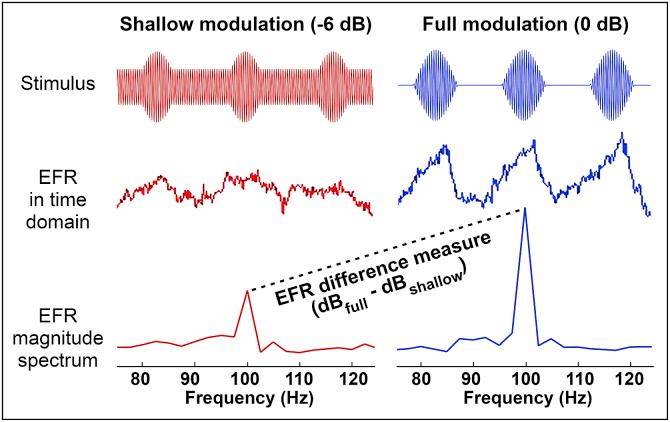
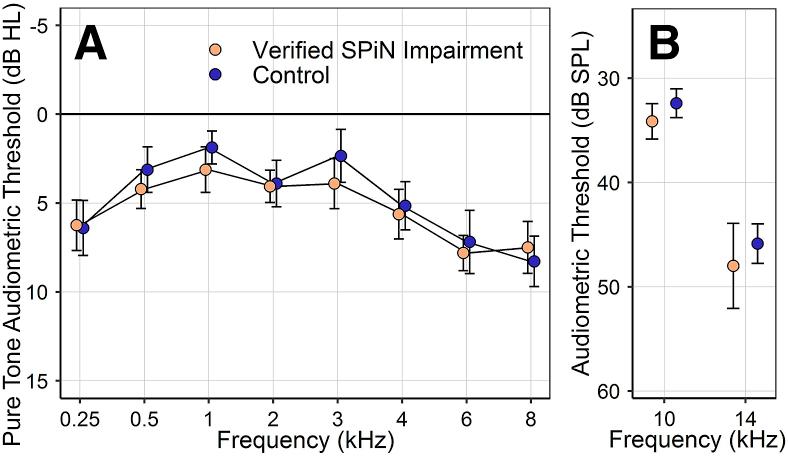
In rodents, noise exposure can destroy synapses between inner hair cells and auditory nerve fibers ("cochlear synaptopathy") without causing hair cell loss. Noise-induced cochlear synaptopathy usually leaves cochlear thresholds unaltered, but is associated with long-term reductions in auditory brainstem response (ABR) amplitudes at medium-to-high sound levels. This pathophysiology has been suggested to degrade speech perception in noise (SPiN), perhaps explaining why SPiN ability varies so widely among audiometrically normal humans. The present study is the first to test for evidence of cochlear synaptopathy in humans with significant SPiN impairment. Individuals were recruited on the basis of self-reported SPiN difficulties and normal pure tone audiometric thresholds. Performance on a listening task identified a subset with "verified" SPiN impairment. This group was matched with controls on the basis of age, sex, and audiometric thresholds up to 14 kHz. ABRs and envelope-following responses (EFRs) were recorded at high stimulus levels, yielding both raw amplitude measures and within-subject difference measures. Past exposure to high sound levels was assessed by detailed structured interview. Impaired SPiN was not associated with greater lifetime noise exposure, nor with any electrophysiological measure. It is conceivable that retrospective self-report cannot reliably capture noise exposure, and that ABRs and EFRs offer limited sensitivity to synaptopathy in humans. Nevertheless, the results do not support the notion that noise-induced synaptopathy is a significant etiology of SPiN impairment with normal audiometric thresholds. It may be that synaptopathy alone does not have significant perceptual consequences, or is not widespread in humans with normal audiograms.
在啮齿动物中,噪声暴露可破坏内毛细胞与听神经纤维之间的突触(“耳蜗突触病变”),而不会导致毛细胞丢失。噪声诱发的耳蜗突触病变通常不会改变耳蜗阈值,但与中到高强度声音水平下听觉脑干反应(ABR)幅度的长期降低有关。有人提出这种病理生理机制会降低噪声中的言语感知(SPiN),这或许可以解释为什么在听力测验正常的人群中,SPiN能力差异如此之大。本研究首次对有明显SPiN损伤的人类进行耳蜗突触病变证据的检测。根据自我报告的SPiN困难和纯音听力测验阈值正常招募个体。一项听力任务的表现确定了一组有“经证实”的SPiN损伤的受试者。该组在年龄、性别和高达14kHz的听力测验阈值基础上与对照组进行匹配。在高刺激水平下记录ABR和包络跟随反应(EFR),得出原始幅度测量值和受试者内差异测量值。通过详细的结构化访谈评估过去暴露于高强度声音的情况。SPiN受损与更高的终生噪声暴露无关,也与任何电生理测量无关。可以想象,回顾性自我报告无法可靠地记录噪声暴露情况,而且ABR和EFR对人类突触病变的敏感性有限。然而,研究结果并不支持噪声诱发的突触病变是听力测验阈值正常的SPiN损伤的重要病因这一观点。可能是单独的突触病变没有显著的感知后果,或者在听力图正常的人群中并不普遍。



 Zotero 插件