
《1990-2016 年巴西被忽视热带病负担:来自 2016 年全球疾病负担研究的国家级分析》
The burden of Neglected Tropical Diseases in Brazil, 1990-2016: A subnational analysis from the Global Burden of Disease Study 2016.
机构信息
Federal Institute of Education, Science and Technology of Ceará, Caucaia, Ceará, Brazil.
Institute of Studies in Public Health, Federal University of Rio de Janeiro, Rio de Janeiro, Rio de Janeiro, Brazil.
出版信息
PLoS Negl Trop Dis. 2018 Jun 4;12(6):e0006559. doi: 10.1371/journal.pntd.0006559. eCollection 2018 Jun.
BACKGROUND
Neglected Tropical Diseases (NTDs) are important causes of morbidity, disability, and mortality among poor and vulnerable populations in several countries worldwide, including Brazil. We present the burden of NTDs in Brazil from 1990 to 2016 based on findings from the Global Burden of Diseases, Injuries, and Risk Factors Study 2016 (GBD 2016).
METHODOLOGY
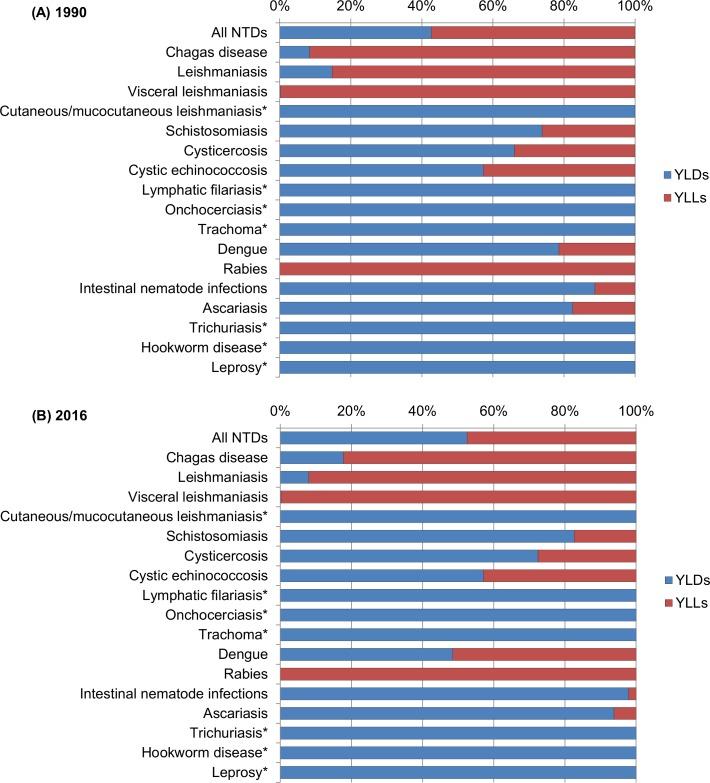
We extracted data from GBD 2016 to assess years of life lost (YLLs), years lived with disability (YLDs), and disability-adjusted life-years (DALYs) for NTDs by sex, age group, causes, and Brazilian states, from 1990 to 2016. We included all NTDs that were part of the priority list of the World Health Organization (WHO) in 2016 and that are endemic/autochthonous in Brazil. YLDs were calculated by multiplying the prevalence of sequelae multiplied by its disability weight. YLLs were estimated by multiplying each death by the reference life expectancy at each age. DALYs were computed as the sum of YLDs and YLLs.
PRINCIPAL FINDINGS
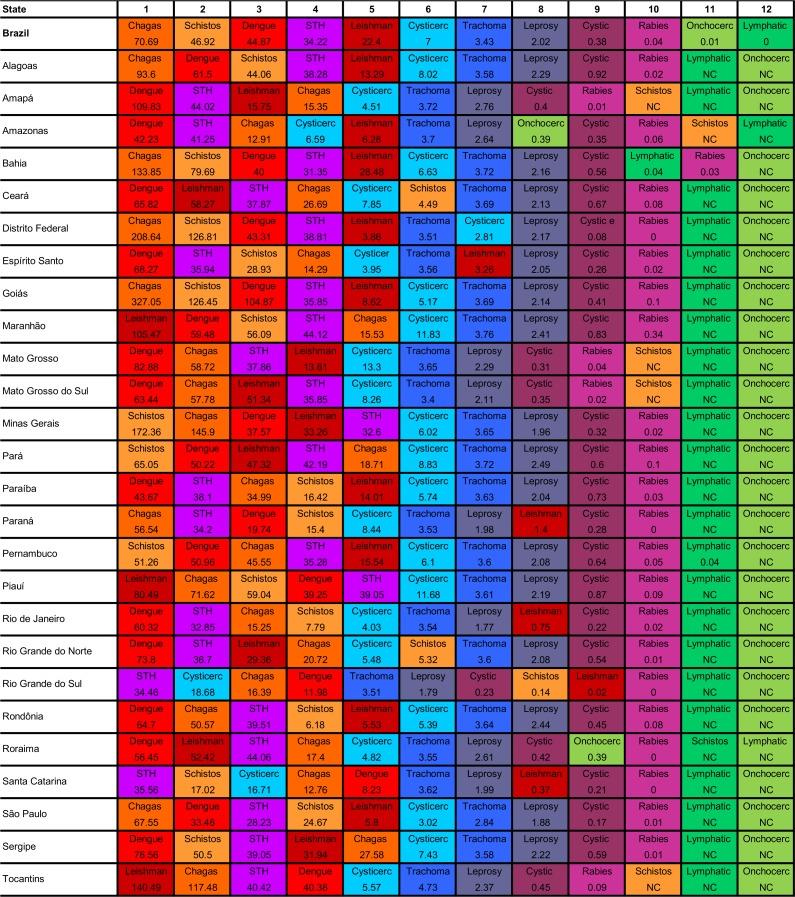
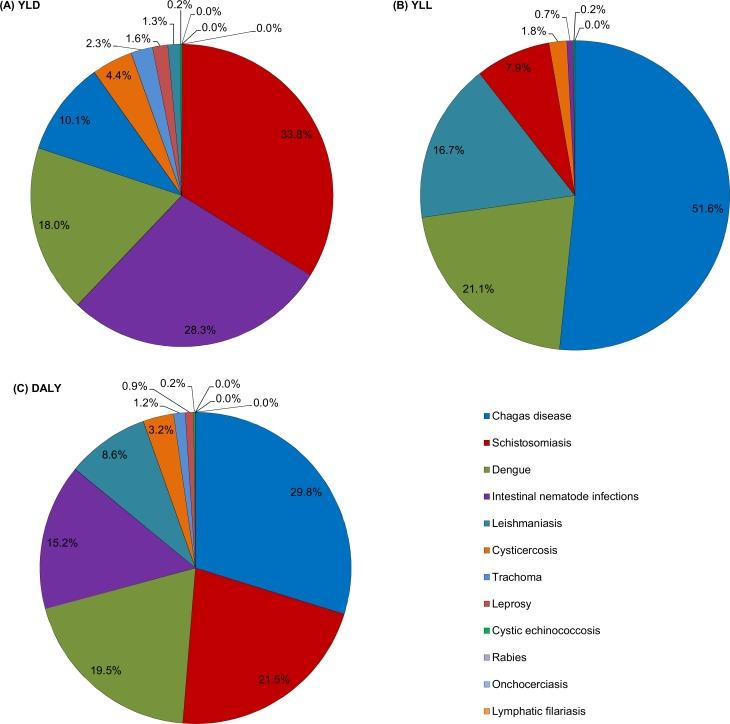
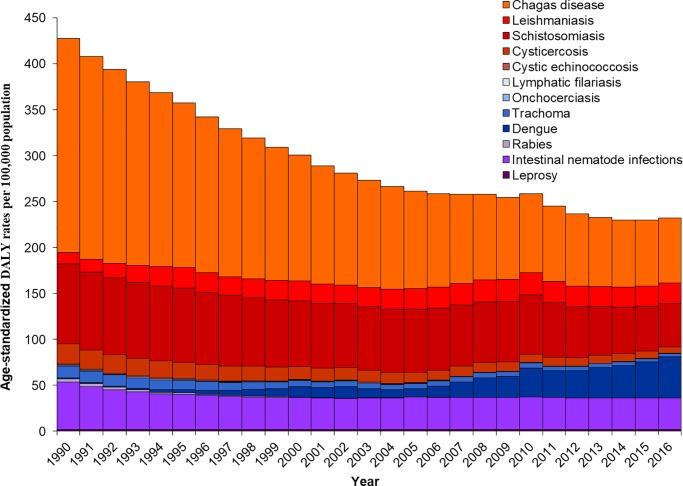
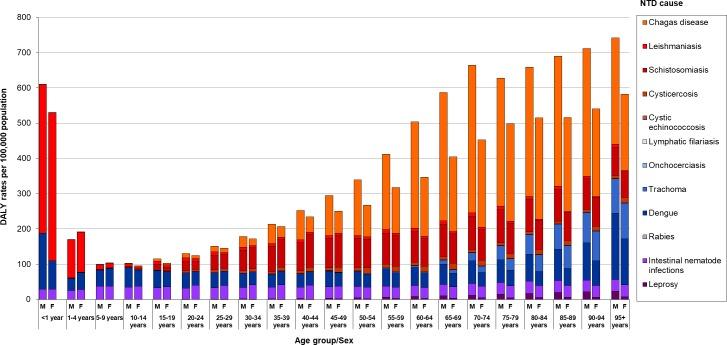
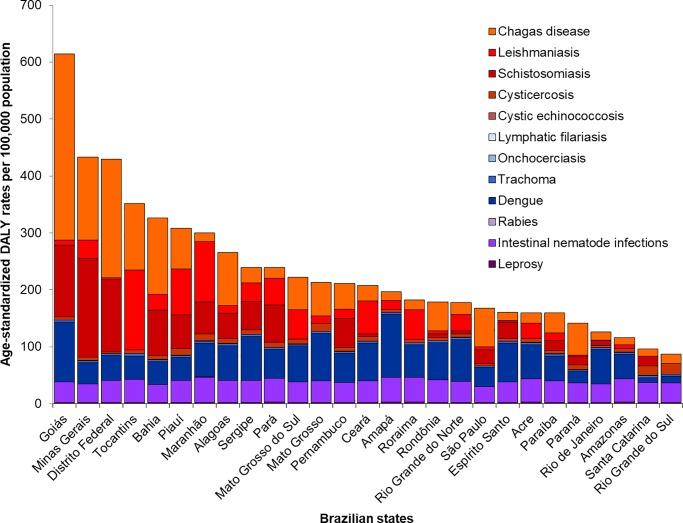
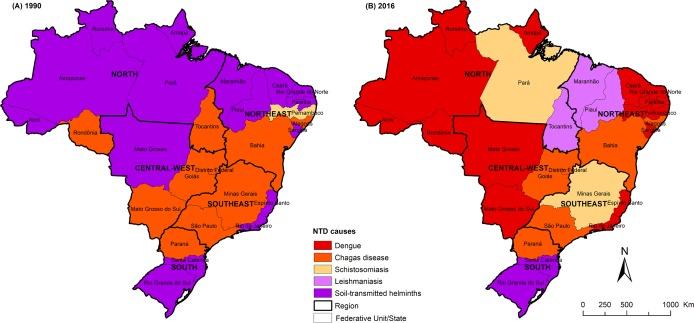
In 2016, there were 475,410 DALYs (95% uncertainty interval [UI]: 337,334-679,482; age-standardized rate of 232.0 DALYs/100,000 population) from the 12 selected NTDs, accounting for 0.8% of national all-cause DALYs. Chagas disease was the leading cause of DALYs among all NTDs, followed by schistosomiasis and dengue. The sex-age-specific NTD burden was higher among males and in the youngest and eldest (children <1 year and those aged ≥70 years). The highest age-standardized DALY rates due to all NTDs combined at the state level were observed in Goiás (614.4 DALYs/100,000), Minas Gerais (433.7 DALYs/100,000), and Distrito Federal (430.0 DALYs/100,000). Between 1990 and 2016, the national age-standardized DALY rates from all NTDs decreased by 45.7%, with different patterns among NTD causes and Brazilian states. Most NTDs decreased in the period, with more pronounced reduction in DALY rates for onchocerciasis, lymphatic filariasis, and rabies. By contrast, age-standardized DALY rates due to dengue, visceral leishmaniasis, and trichuriasis increased substantially. Age-standardized DALY rates decreased for most Brazilian states, increasing only in the states of Amapá, Ceará, Rio Grande do Norte, and Sergipe.
CONCLUSIONS/SIGNIFICANCE: GBD 2016 findings show that, despite the reduction in disease burden, NTDs are still important and preventable causes of disability and premature death in Brazil. The data call for renewed and comprehensive efforts to control and prevent the NTD burden in Brazil through evidence-informed and efficient and affordable interventions. Multi-sectoral and integrated control and surveillance measures should be prioritized, considering the population groups and geographic areas with the greatest morbidity, disability, and most premature deaths due to NTDs in the country.
背景
在包括巴西在内的世界上几个国家,被忽视的热带病(NTDs)是导致贫困人口和弱势群体发病、失能和死亡的重要原因。我们根据 2016 年全球疾病、伤害和危险因素研究(GBD 2016)的结果,介绍了巴西从 1990 年到 2016 年的 NTD 负担情况。
方法
我们从 GBD 2016 中提取数据,以评估按性别、年龄组、病因和巴西州划分的 1990 年至 2016 年 NTD 导致的生命年损失(YLLs)、残疾生命年(YLDs)和伤残调整生命年(DALYs)。我们包括了 2016 年世界卫生组织(WHO)优先名单中的所有 NTDs,以及巴西流行的地方病/本土病。YLDs 通过将后遗症的患病率乘以其残疾权重来计算。YLLs 通过将每个死亡乘以相应的参考预期寿命来估计。DALYs 是 YLDs 和 YLLs 的总和。
主要发现
2016 年,12 种选定的 NTDs 导致 475410 个 DALYs(95%不确定区间[UI]:337334-679482;年龄标准化率为 232.0 DALYs/100000 人口),占全国所有病因 DALYs 的 0.8%。恰加斯病是所有 NTDs 中导致 DALYs 的主要原因,其次是血吸虫病和登革热。特定性别和年龄的 NTD 负担在男性和最年轻和最年长的人群(儿童<1 岁和≥70 岁的人群)中更高。按州划分,所有 NTDs 合并导致的最高年龄标准化 DALY 率出现在戈亚斯州(614.4 DALYs/100000)、米纳斯吉拉斯州(433.7 DALYs/100000)和联邦区(430.0 DALYs/100000)。1990 年至 2016 年间,巴西全国 NTDs 的年龄标准化 DALY 率下降了 45.7%,不同 NTD 病因和巴西各州的模式不同。大多数 NTDs 在这一时期有所减少,盘尾丝虫病、淋巴丝虫病和狂犬病的 DALY 率下降更为显著。相比之下,登革热、内脏利什曼病和鞭虫病的年龄标准化 DALY 率大幅上升。大多数巴西州的年龄标准化 DALY 率下降,只有阿马帕州、塞阿拉州、北里奥格兰德州和塞尔希培州有所增加。
结论/意义:GBD 2016 的结果表明,尽管疾病负担有所减轻,但 NTDs 仍然是巴西导致残疾和过早死亡的重要且可预防的原因。这些数据呼吁通过循证、高效和负担得起的干预措施,重新开展和全面努力控制和预防巴西的 NTD 负担。应优先考虑多部门和综合的控制和监测措施,考虑到该国因 NTDs 而发病、失能和死亡人数最多的人群和地理区域。
 Zotero 插件