
CRISPR 碱基编辑器:无需双链断裂的基因组编辑。
CRISPR base editors: genome editing without double-stranded breaks.
机构信息
Laboratory for Genome Engineering, Biological and Environmental Sciences and Engineering Division, King Abdullah University of Science and Technology (KAUST), Thuwal 23955-6900, Saudi Arabia.
Laboratory for Genome Engineering, Biological and Environmental Sciences and Engineering Division, King Abdullah University of Science and Technology (KAUST), Thuwal 23955-6900, Saudi Arabia
出版信息
Biochem J. 2018 Jun 11;475(11):1955-1964. doi: 10.1042/BCJ20170793.
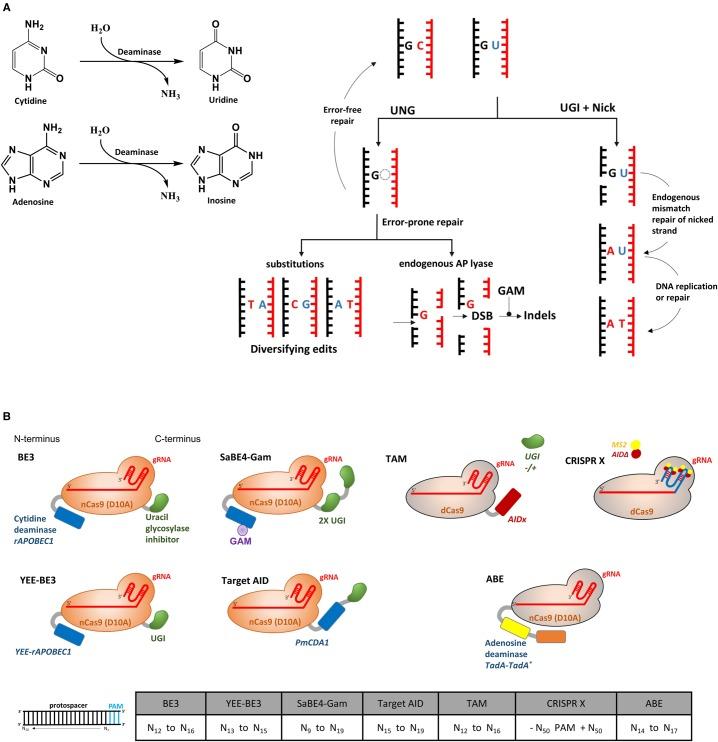
The CRISPR (clustered regularly interspaced short palindromic repeat)/Cas9 adaptive immunity system has been harnessed for genome editing applications across eukaryotic species, but major drawbacks, such as the inefficiency of precise base editing and off-target activities, remain. A catalytically inactive Cas9 variant (dead Cas9, dCas9) has been fused to diverse functional domains for targeting genetic and epigenetic modifications, including base editing, to specific DNA sequences. As base editing does not require the generation of double-strand breaks, dCas9 and Cas9 nickase have been used to target deaminase domains to edit specific loci. Adenine and cytidine deaminases convert their respective nucleotides into other DNA bases, thereby offering many possibilities for DNA editing. Such base-editing enzymes hold great promise for applications in basic biology, trait development in crops, and treatment of genetic diseases. Here, we discuss recent advances in precise gene editing using different platforms as well as their potential applications in basic biology and biotechnology.
CRISPR(成簇规律间隔短回文重复)/Cas9 适应性免疫系统已被用于真核生物的基因组编辑应用中,但仍存在主要缺陷,例如精确碱基编辑的效率低下和脱靶活性。一种无催化活性的 Cas9 变体(失活 Cas9,dCas9)已与多种功能结构域融合,用于靶向遗传和表观遗传修饰,包括碱基编辑,以特定的 DNA 序列。由于碱基编辑不需要产生双链断裂,因此 dCas9 和 Cas9 切口酶已被用于将脱氨酶结构域靶向特定基因座进行编辑。腺嘌呤和胞嘧啶脱氨酶将其各自的核苷酸转化为其他 DNA 碱基,从而为 DNA 编辑提供了许多可能性。这些碱基编辑酶在基础生物学、作物性状开发和遗传疾病治疗方面具有广阔的应用前景。在这里,我们讨论了使用不同平台进行精确基因编辑的最新进展及其在基础生物学和生物技术中的潜在应用。

 Zotero 插件