
疾病相关颗粒与关节炎症;作用机制的深入了解和潜在治疗靶点。
Disease-Associated Particulates and Joint Inflammation; Mechanistic Insights and Potential Therapeutic Targets.
机构信息
School of Biochemistry and Immunology, School of Medicine, Trinity College Dublin, Trinity Biomedical Sciences Institute, The University of Dublin, Dublin, Ireland.
出版信息
Front Immunol. 2018 May 28;9:1145. doi: 10.3389/fimmu.2018.01145. eCollection 2018.
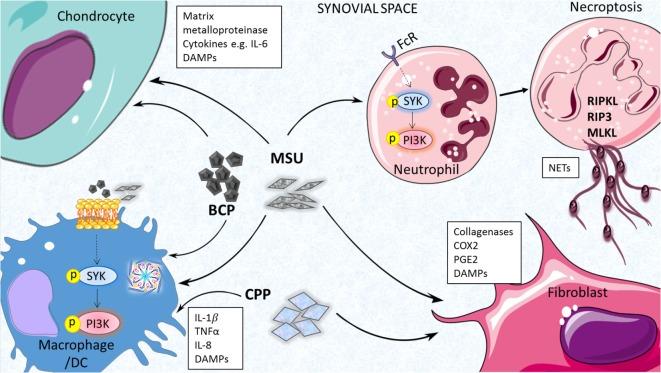
It is now well established that intra-articular deposition of endogenous particulates, such as osteoarthritis-associated basic calcium phosphate crystals, gout-associated monosodium urate crystals, and calcium deposition disease-associated calcium pyrophosphate crystals, contributes to joint destruction through the production of cartilage-degrading enzymes and pro-inflammatory cytokines. Furthermore, exogenous wear-debris particles, generated from prosthetic implants, drive periprosthetic osteolysis which impacts on the longevity of total joint replacements. Over the last few years, significant insight has been gained into the mechanisms through which these particulates exert their effects. Not only has this increased our understanding of the pathological processes associated with crystal deposition but it has also led to the identification of a number of therapeutic targets to treat particulate-associated disease. In this review, we discuss recent developments regarding the cellular events triggered by joint-associated particulates, as well as future directions in therapy for particulate-related arthropathies.
现在已经证实,关节内内源性颗粒物质的沉积,如与骨关节炎相关的碱性磷酸钙晶体、与痛风相关的单钠尿酸盐晶体和钙沉积病相关的焦磷酸钙晶体,通过产生软骨降解酶和促炎细胞因子导致关节破坏。此外,来自假体植入物的外源性磨损碎片会导致假体周围骨溶解,从而影响全关节置换的使用寿命。在过去的几年中,人们对这些颗粒物质发挥作用的机制有了更深入的了解。这不仅增加了我们对与晶体沉积相关的病理过程的理解,还导致了确定了一些治疗颗粒相关疾病的治疗靶点。在这篇综述中,我们讨论了关节相关颗粒物质引发的细胞事件的最新进展,以及针对颗粒相关关节炎的治疗的未来方向。

 Zotero 插件