
细胞 N-豆蔻酰转移酶在病毒组装、病毒成熟和感染性方面发挥着关键的小核糖核酸病毒属特异性作用。
Cellular N-myristoyltransferases play a crucial picornavirus genus-specific role in viral assembly, virion maturation, and infectivity.
机构信息
Center for Medical Biochemistry, Max F. Perutz Laboratories (MFPL), Medical University of Vienna, Vienna Biocenter (VBC), Vienna, Austria.
Institute of Applied Synthetic Chemistry, TU Wien, Vienna, Austria.
出版信息
PLoS Pathog. 2018 Aug 6;14(8):e1007203. doi: 10.1371/journal.ppat.1007203. eCollection 2018 Aug.
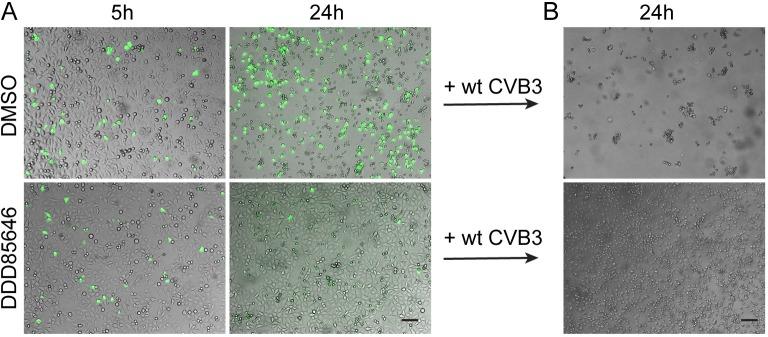
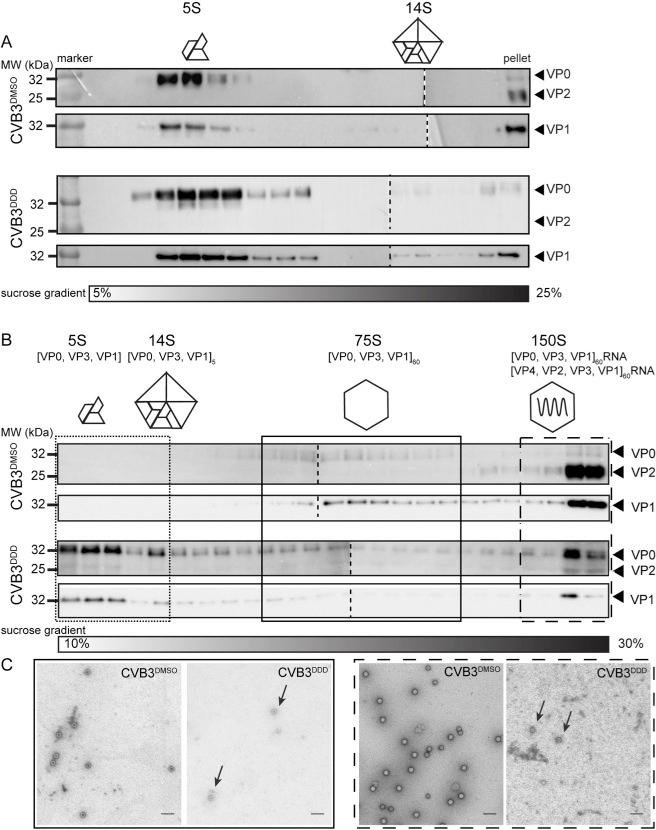
In nearly all picornaviruses the precursor of the smallest capsid protein VP4 undergoes co-translational N-terminal myristoylation by host cell N-myristoyltransferases (NMTs). Curtailing this modification by mutation of the myristoylation signal in poliovirus has been shown to result in severe assembly defects and very little, if any, progeny virus production. Avoiding possible pleiotropic effects of such mutations, we here used pharmacological abrogation of myristoylation with the NMT inhibitor DDD85646, a pyrazole sulfonamide originally developed against trypanosomal NMT. Infection of HeLa cells with coxsackievirus B3 in the presence of this drug decreased VP0 acylation at least 100-fold, resulting in a defect both early and late in virus morphogenesis, which diminishes the yield of viral progeny by about 90%. Virus particles still produced consisted mainly of provirions containing RNA and uncleaved VP0 and, to a substantially lesser extent, of mature virions with cleaved VP0. This indicates an important role of myristoylation in the viral maturation cleavage. By electron microscopy, these RNA-filled particles were indistinguishable from virus produced under control conditions. Nevertheless, their specific infectivity decreased by about five hundred fold. Since host cell-attachment was not markedly impaired, their defect must lie in the inability to transfer their genomic RNA into the cytosol, likely at the level of endosomal pore formation. Strikingly, neither parechoviruses nor kobuviruses are affected by DDD85646, which appears to correlate with their native capsid containing only unprocessed VP0. Individual knockout of the genes encoding the two human NMT isozymes in haploid HAP1 cells further demonstrated the pivotal role for HsNMT1, with little contribution by HsNMT2, in the virus replication cycle. Our results also indicate that inhibition of NMT can possibly be exploited for controlling the infection by a wide spectrum of picornaviruses.
在几乎所有的小核糖核酸病毒中,最小衣壳蛋白 VP4 的前体通过宿主细胞 N-豆蔻酰转移酶(NMTs)进行共翻译 N 端豆蔻酰化。通过突变脊髓灰质炎病毒中的豆蔻酰化信号来截断这种修饰,已被证明会导致严重的组装缺陷,几乎没有(如果有的话)产生后代病毒。为了避免这种突变可能产生的多效性影响,我们在这里使用 NMT 抑制剂 DDD85646 来抑制豆蔻酰化,DDD85646 是一种最初针对原生动物 NMT 开发的吡唑磺酰胺。在存在这种药物的情况下,用柯萨奇病毒 B3 感染 HeLa 细胞,VP0 酰化至少减少了 100 倍,导致病毒形态发生的早期和晚期都出现缺陷,从而使病毒后代的产量减少约 90%。仍然产生的病毒颗粒主要由含有 RNA 和未切割 VP0 的前病毒组成,并且在很大程度上由具有切割 VP0 的成熟病毒组成。这表明豆蔻酰化在病毒成熟切割中起着重要作用。通过电子显微镜观察,这些充满 RNA 的颗粒与在对照条件下产生的病毒无法区分。尽管如此,它们的特异性感染力降低了约 500 倍。由于宿主细胞的附着没有明显受损,它们的缺陷必须在于无法将其基因组 RNA 转移到细胞质中,可能是在内体孔形成的水平上。引人注目的是,DDD85646 既不会影响 parechoviruses 也不会影响 kobuviruses,这似乎与它们天然衣壳仅包含未加工的 VP0 有关。在 HAP1 细胞中单敲除编码两种人 NMT 同工酶的基因进一步证明了 HsNMT1 在病毒复制周期中的关键作用,而 HsNMT2 的贡献很小。我们的结果还表明,抑制 NMT 可能可用于控制广泛的小核糖核酸病毒的感染。




 Zotero 插件