
超氧化物歧化酶活性赋予(p)ppGpp 介导的抗生素耐受静止期。
Superoxide dismutase activity confers (p)ppGpp-mediated antibiotic tolerance to stationary-phase .
机构信息
Department of Microbiology and Immunology, McGill University, Montreal, QC H3A OG4, Canada.
Meakins-Christie Laboratories, Research Institute of the McGill University Health Centre, Montreal, QC H4A 3J1, Canada.
出版信息
Proc Natl Acad Sci U S A. 2018 Sep 25;115(39):9797-9802. doi: 10.1073/pnas.1804525115. Epub 2018 Sep 10.
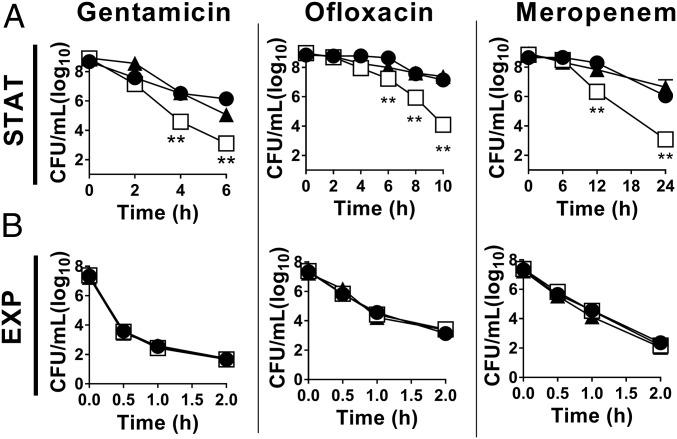
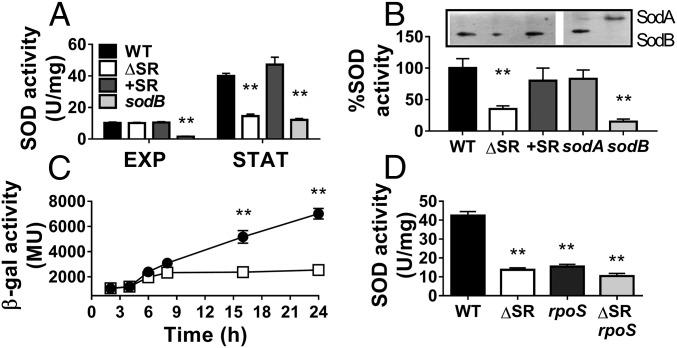
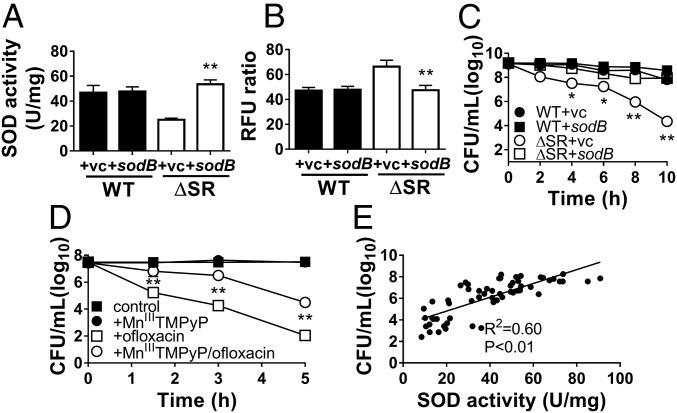
Metabolically quiescent bacteria represent a large proportion of those in natural and host environments, and they are often refractory to antibiotic treatment. Such drug tolerance is also observed in the laboratory during stationary phase, when bacteria face stress and starvation-induced growth arrest. Tolerance requires (p)ppGpp signaling, which mediates the stress and starvation stringent response (SR), but the downstream effectors that confer tolerance are unclear. We previously demonstrated that the SR is linked to increased antioxidant defenses in We now demonstrate that superoxide dismutase (SOD) activity is a key factor in SR-mediated multidrug tolerance in stationary-phase Inactivation of the SR leads to loss of SOD activity and decreased multidrug tolerance during stationary phase. Genetic or chemical complementation of SOD activity of the mutant (ΔSR) is sufficient to restore antibiotic tolerance to WT levels. Remarkably, we observe high membrane permeability and increased drug internalization upon ablation of SOD activity. Combined, our results highlight an unprecedented mode of SR-mediated multidrug tolerance in stationary-phase and suggest that inhibition of SOD activity may potentiate current antibiotics.
代谢静止的细菌在自然环境和宿主环境中占很大比例,它们通常对抗生素治疗有抵抗力。这种药物耐受性在实验室的静止期也观察到,此时细菌面临压力和饥饿诱导的生长停滞。耐受性需要(p)ppGpp 信号转导,它介导应激和饥饿严格反应(SR),但赋予耐受性的下游效应物尚不清楚。我们之前证明了 SR 与抗氧化防御的增加有关,我们现在证明超氧化物歧化酶(SOD)活性是 SR 介导的静止期多药耐受性的关键因素。SR 的失活导致 SOD 活性丧失和静止期多药耐受性降低。突变体(ΔSR)的 SOD 活性的遗传或化学互补足以将抗生素耐受性恢复到 WT 水平。值得注意的是,我们观察到在 SOD 活性缺失时,膜通透性增加和药物内化增加。综上所述,我们的研究结果强调了静止期 SR 介导的多药耐受性的一种前所未有的模式,并表明抑制 SOD 活性可能增强当前的抗生素。



 Zotero 插件