
全球、区域和国家儿童和青少年(5-14 岁)死亡率趋势:1990 年至 2016 年的实证数据分析。
Global, regional, and national mortality trends in older children and young adolescents (5-14 years) from 1990 to 2016: an analysis of empirical data.
机构信息
Centre of Demographic Research, Université Catholique de Louvain, Louvain-la-Neuve, Belgium.
Division of Data, Research, and Policy, UNICEF, New York, NY, USA.
出版信息
Lancet Glob Health. 2018 Oct;6(10):e1087-e1099. doi: 10.1016/S2214-109X(18)30353-X.
BACKGROUND
From 1990 to 2016, the mortality of children younger than 5 years decreased by more than half, and there are plentiful data regarding mortality in this age group through which we can track global progress in reducing the under-5 mortality rate. By contrast, little is known on how the mortality risk among older children (5-9 years) and young adolescents (10-14 years) has changed in this time. We aimed to estimate levels and trends in mortality of children aged 5-14 years in 195 countries from 1990 to 2016.
METHODS
In this analysis of empirical data, we expanded the United Nations Inter-agency Group for Child Mortality Estimation database containing data on children younger than 5 years with 5530 data points regarding children aged 5-14 years. Mortality rates from 1990 to 2016 were obtained from nationally representative birth histories, data on household deaths reported in population censuses, and nationwide systems of civil registration and vital statistics. These data were used in a Bayesian B-spline bias-reduction model to generate smoothed trends with 90% uncertainty intervals, to determine the probability of a child aged 5 years dying before reaching age 15 years.
FINDINGS
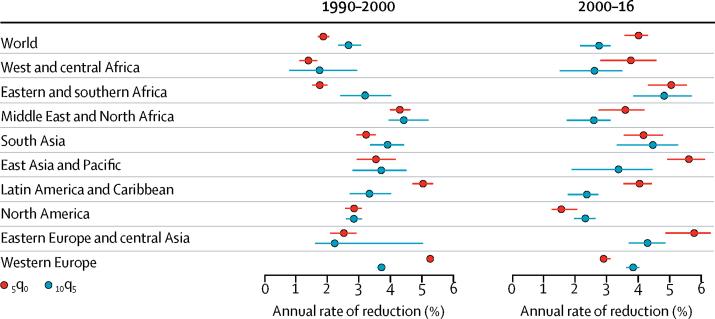
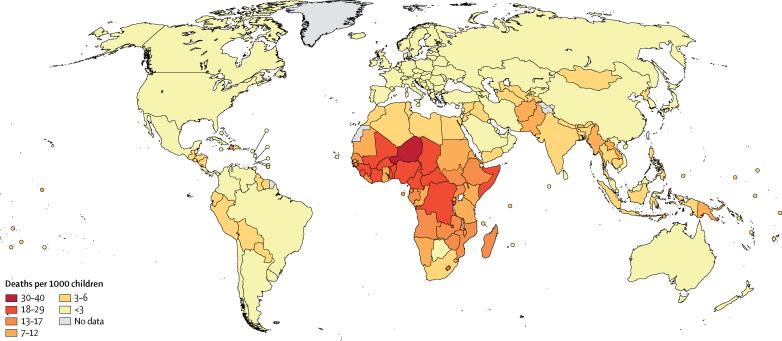
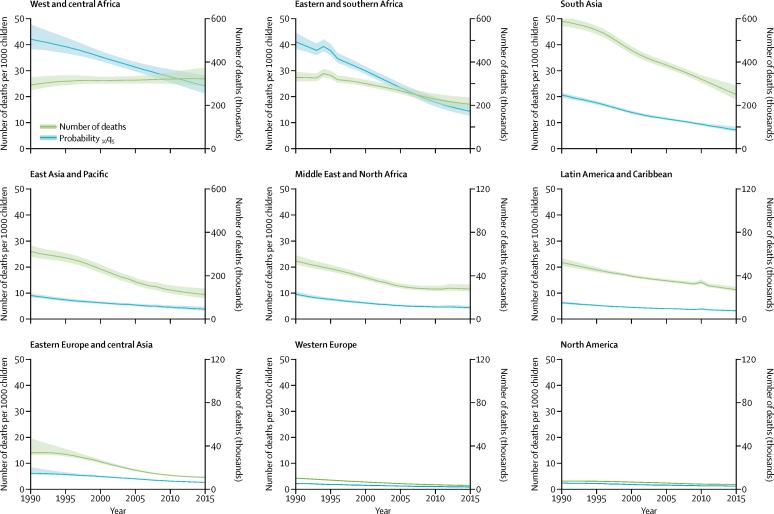
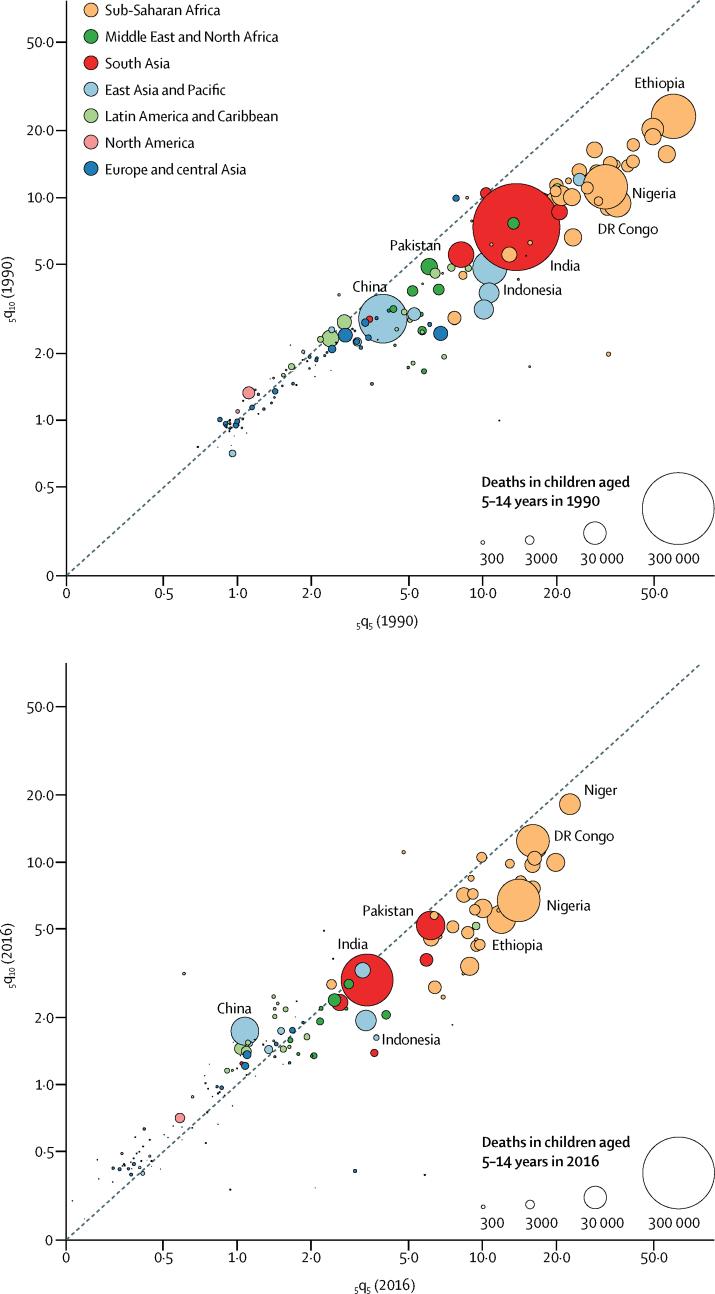
Globally, the probability of a child dying between the ages 5 years and 15 years was 7·5 deaths (90% uncertainty interval 7·2-8·3) per 1000 children in 2016, which was less than a fifth of the risk of dying between birth and age 5 years, which was 41 deaths (39-44) per 1000 children. The mortality risk in children aged 5-14 years decreased by 51% (46-54) between 1990 and 2016, despite not being specifically targeted by health interventions. The annual number of deaths in this age group decreased from 1·7 million (1·7 million-1·8 million) to 1 million (0·9 million-1·1 million) in 1990-2016. In 1990-2000, mortality rates in children aged 5-14 years decreased faster than among children aged 0-4 years. However, since 2000, mortality rates in children younger than 5 years have decreased faster than mortality rates in children aged 5-14 years. The annual rate of reduction in mortality among children younger than 5 years has been 4·0% (3·6-4·3) since 2000, versus 2·7% (2·3-3·0) in children aged 5-14 years. Older children and young adolescents in sub-Saharan Africa are disproportionately more likely to die than those in other regions; 55% (51-58) of deaths of children of this age occur in sub-Saharan Africa, despite having only 21% of the global population of children aged 5-14 years. In 2016, 98% (98-99) of all deaths of children aged 5-14 years occurred in low-income and middle-income countries, and seven countries alone accounted for more than half of the total number of deaths of these children.
INTERPRETATION
Increased efforts are required to accelerate reductions in mortality among older children and to ensure that they benefit from health policies and interventions as much as younger children.
FUNDING
UN Children's Fund, Bill & Melinda Gates Foundation, United States Agency for International Development.
背景
从 1990 年到 2016 年,5 岁以下儿童的死亡率下降了一半以上,关于这一年龄组的死亡率有大量数据,我们可以通过这些数据来跟踪全球降低 5 岁以下儿童死亡率的进展情况。相比之下,人们对这一时期年龄较大的儿童(5-9 岁)和青少年(10-14 岁)的死亡风险如何变化知之甚少。我们的目的是估计 195 个国家 5-14 岁儿童的死亡率水平和趋势。
方法
在对经验数据的这项分析中,我们扩大了联合国儿童死亡率估计机构间小组的数据库,其中包含了 5 岁以下儿童的数据,并增加了 5530 个 5-14 岁儿童的数据点。1990 年至 2016 年的死亡率数据来自全国代表性的出生记录、人口普查中报告的家庭死亡数据以及全国民事登记和生命统计系统。这些数据被用于贝叶斯 B-样条偏差减少模型,以生成具有 90%不确定性区间的平滑趋势,从而确定 5 岁儿童在 15 岁之前死亡的概率。
结果
在全球范围内,2016 年 5-14 岁儿童死亡的概率为每 1000 名儿童中有 7.5 例(90%置信区间为 7.2-8.3),这不到出生至 5 岁之间死亡风险的五分之一,每 1000 名儿童中有 41 例(39-44)。尽管没有专门针对卫生干预措施,但 1990 年至 2016 年期间,5-14 岁儿童的死亡率下降了 51%(46-54)。这一年龄组的年死亡人数从 1990-2016 年的 170 万(170 万-180 万)降至 100 万(90 万-110 万)。1990-2000 年,5-14 岁儿童的死亡率下降速度快于 0-4 岁儿童。然而,自 2000 年以来,5 岁以下儿童的死亡率下降速度快于 5-14 岁儿童的死亡率下降速度。自 2000 年以来,5 岁以下儿童的死亡率年降幅为 4.0%(3.6-4.3),而 5-14 岁儿童的死亡率年降幅为 2.7%(2.3-3.0)。撒哈拉以南非洲的大龄儿童和青少年比其他地区的儿童更容易死亡;这一年龄组 55%(51-58)的死亡发生在撒哈拉以南非洲,尽管该地区仅占全球 5-14 岁儿童人口的 21%。2016 年,98%(98-99)的 5-14 岁儿童死亡发生在低收入和中等收入国家,仅七个国家就占这些儿童死亡总数的一半以上。
解释
需要加大努力,加快降低大龄儿童的死亡率,并确保他们像幼儿一样受益于卫生政策和干预措施。
资金来源
联合国儿童基金会、比尔及梅琳达·盖茨基金会、美国国际开发署。

 Zotero 插件