
阿泊利莫德,一种候选抗癌治疗药物,不仅能抑制 PIKfyve 介导的 PtdIns(3,5)P2 的合成,还能抑制 PtdIns5P 的合成,并诱导巴弗洛霉素 A1 逆转的异常内膜扩张。
Apilimod, a candidate anticancer therapeutic, arrests not only PtdIns(3,5)P2 but also PtdIns5P synthesis by PIKfyve and induces bafilomycin A1-reversible aberrant endomembrane dilation.
机构信息
Department of Physiology, Wayne State University School of Medicine, Detroit, Michigan, United States of America.
出版信息
PLoS One. 2018 Sep 21;13(9):e0204532. doi: 10.1371/journal.pone.0204532. eCollection 2018.
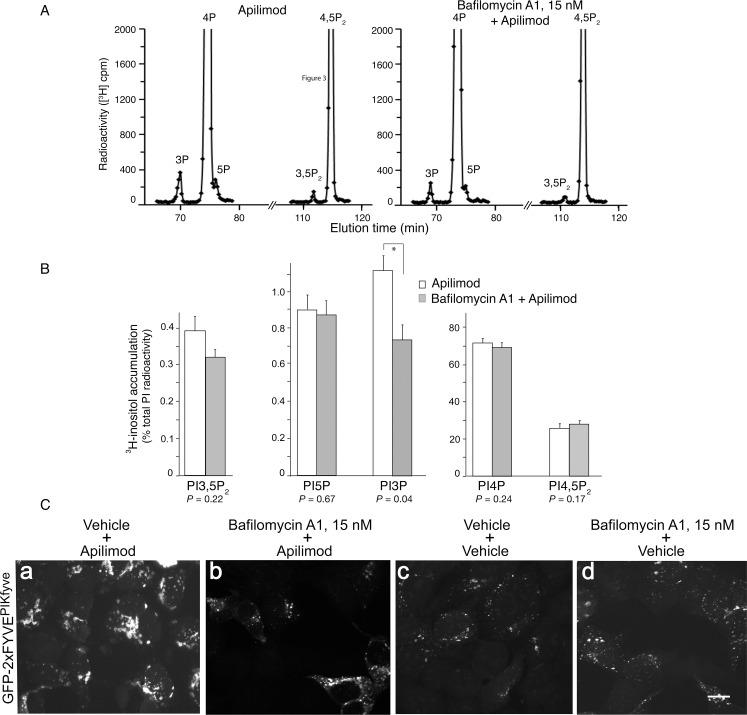
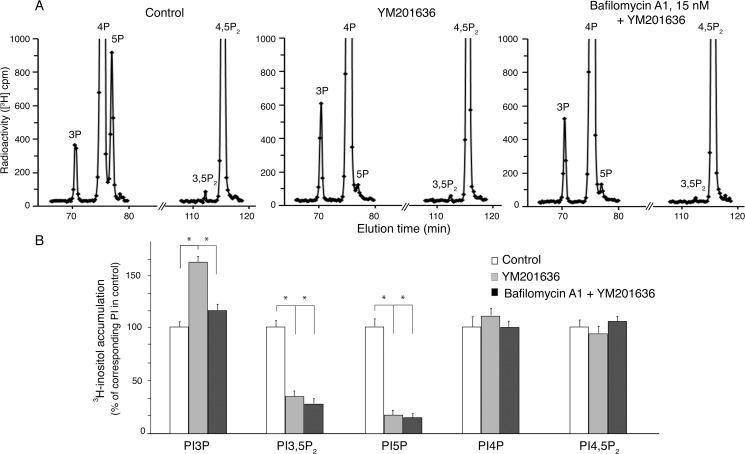
PIKfyve, an evolutionarily conserved kinase synthesizing PtdIns5P and PtdIns(3,5)P2, is crucial for mammalian cell proliferation and viability. Accordingly, PIKfyve inhibitors are now in clinical trials as anti-cancer drugs. Among those, apilimod is the most promising, yet its potency to inhibit PIKfyve and affect endomembrane homeostasis is only partially characterized. We demonstrate here for the first time that apilimod powerfully inhibited in vitro synthesis of PtdIns5P along with that of PtdIns(3,5)P2. HPLC-based resolution of intracellular phosphoinositides (PIs) revealed that apilimod triggered a marked reduction of both lipids in the context of intact cells. Notably, there was also a profound rise in PtdIns3P resulting from arrested PtdIns3P consumption for PtdIns(3,5)P2 synthesis. As typical for PIKfyve inhibition and the concomitant PtdIns(3,5)P2 reduction, apilimod induced the appearance of dilated endomembrane structures in the form of large translucent cytoplasmic vacuoles. Remarkably, bafilomycin A1 (BafA1) fully reversed the aberrant cell phenotype back to normal and completely precluded the appearance of cytoplasmic vacuoles when added prior to apilimod. Inspection of the PI profiles ruled out restoration of the reduced PtdIns(3,5)P2 pool as a molecular mechanism underlying BafA1 rescue. Rather, we found that BafA1 markedly attenuated the PtdIns3P elevation under PIKfyve inhibition. This was accompanied by profoundly decreased endosomal recruitment of fusogenic EEA1. Together, our data demonstrate that apilimod inhibits not only PtdIns(3,5)P2 but also PtdIns5P synthesis and that the cytoplasmic vacuolization triggered by the inhibitor is precluded or reversed by BafA1 through a mechanism associated, in part, with reduction in both PtdIns3P levels and EEA1 membrane recruitment.
PIKfyve 是一种进化上保守的激酶,能够合成 PtdIns5P 和 PtdIns(3,5)P2,对于哺乳动物细胞的增殖和存活至关重要。因此,PIKfyve 抑制剂目前正在临床试验中作为抗癌药物。在这些抑制剂中,apilimod 是最有前途的,但它抑制 PIKfyve 和影响内膜系统稳态的能力仅部分得到了表征。我们在这里首次证明,apilimod 能够强有力地抑制体外 PtdIns5P 的合成以及 PtdIns(3,5)P2 的合成。基于 HPLC 的细胞内磷酸肌醇(PI)分辨率显示,apilimod 在完整细胞中引发了这两种脂质的明显减少。值得注意的是,由于 PtdIns(3,5)P2 合成消耗了 PtdIns3P,因此 PtdIns3P 也显著增加。与典型的 PIKfyve 抑制和随之而来的 PtdIns(3,5)P2 减少一样,apilimod 诱导了以大的透明细胞质空泡形式出现的扩张的内膜结构。值得注意的是,巴弗洛霉素 A1(BafA1)完全将异常的细胞表型逆转回正常,并在添加到 apilimod 之前完全阻止了细胞质空泡的出现。对 PI 谱的检查排除了恢复减少的 PtdIns(3,5)P2 池作为 BafA1 挽救的分子机制。相反,我们发现 BafA1 在 PIKfyve 抑制下显著减弱了 PtdIns3P 的升高。这伴随着内体募集融合 EEAl 的显著减少。总之,我们的数据表明,apilimod 不仅抑制 PtdIns(3,5)P2 的合成,还抑制 PtdIns5P 的合成,并且抑制剂触发的细胞质空泡化通过与部分与降低 PtdIns3P 水平和 EEAl 膜募集相关的机制被 BafA1 排除或逆转。


 Zotero 插件