
优先化的记忆访问解释了规划和海马体重放。
Prioritized memory access explains planning and hippocampal replay.
机构信息
Princeton Neuroscience Institute, Princeton University, Princeton, NJ, USA.
Department of Psychology, Princeton University, Princeton, NJ, USA.
出版信息
Nat Neurosci. 2018 Nov;21(11):1609-1617. doi: 10.1038/s41593-018-0232-z. Epub 2018 Oct 22.
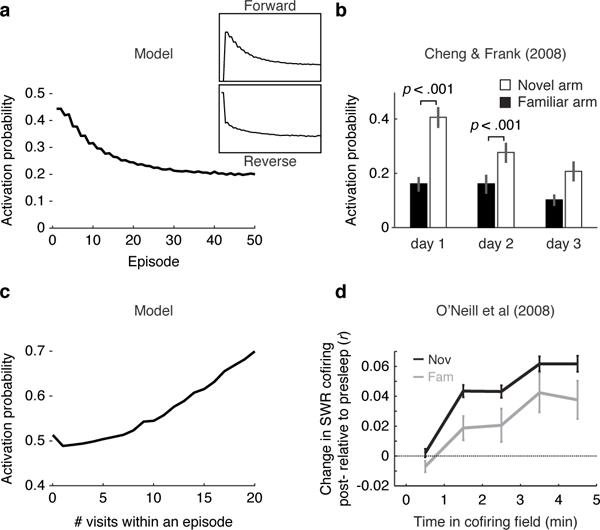
To make decisions, animals must evaluate candidate choices by accessing memories of relevant experiences. Yet little is known about which experiences are considered or ignored during deliberation, which ultimately governs choice. We propose a normative theory predicting which memories should be accessed at each moment to optimize future decisions. Using nonlocal 'replay' of spatial locations in hippocampus as a window into memory access, we simulate a spatial navigation task in which an agent accesses memories of locations sequentially, ordered by utility: how much extra reward would be earned due to better choices. This prioritization balances two desiderata: the need to evaluate imminent choices versus the gain from propagating newly encountered information to preceding locations. Our theory offers a simple explanation for numerous findings about place cells; unifies seemingly disparate proposed functions of replay including planning, learning, and consolidation; and posits a mechanism whose dysfunction may underlie pathologies like rumination and craving.
为了做出决策,动物必须通过访问与相关经验相关的记忆来评估候选选择。然而,在审议过程中,哪些经验被考虑或忽略,哪些经验最终决定了选择,这些问题还知之甚少。我们提出了一个规范性理论,预测在每个时刻应该访问哪些记忆,以优化未来的决策。我们利用海马体中非局部的“回放”空间位置作为访问记忆的窗口,模拟了一个空间导航任务,在这个任务中,一个代理者按效用顺序依次访问位置的记忆:由于更好的选择可以获得多少额外的奖励。这种优先级平衡了两个理想目标:评估当前选择的必要性与将新遇到的信息传播到先前位置的收益。我们的理论为许多关于位置细胞的发现提供了一个简单的解释;统一了回放看似不同的提议功能,包括规划、学习和巩固;并提出了一种机制,其功能障碍可能是像沉思和渴望等病理学的基础。


 Zotero 插件