
通过合成与重演构建海马结构中的未来行为。
Constructing future behavior in the hippocampal formation through composition and replay.
作者信息
Bakermans Jacob J W, Warren Joseph, Whittington James C R, Behrens Timothy E J
机构信息
Wellcome Centre for Integrative Neuroimaging, University of Oxford, Oxford, UK.
Department of Basic Neuroscience, University of Geneva, Geneva, Switzerland.
出版信息
Nat Neurosci. 2025 May;28(5):1061-1072. doi: 10.1038/s41593-025-01908-3. Epub 2025 Mar 10.
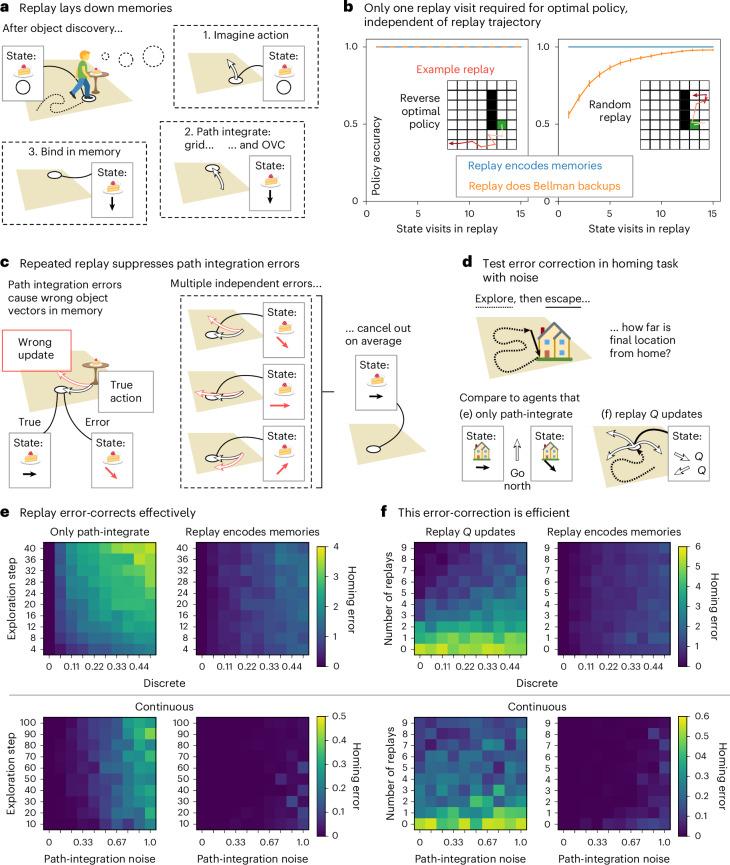
The hippocampus is critical for memory, imagination and constructive reasoning. Recent models have suggested that its neuronal responses can be well explained by state spaces that model the transitions between experiences. Here we use simulations and hippocampal recordings to reconcile these views. We show that if state spaces are constructed compositionally from existing building blocks, or primitives, hippocampal responses can be interpreted as compositional memories, binding these primitives together. Critically, this enables agents to behave optimally in new environments with no new learning, inferring behavior directly from the composition. We predict a role for hippocampal replay in building and consolidating these compositional memories. We test these predictions in two datasets by showing that replay events from newly discovered landmarks induce and strengthen new remote firing fields. When the landmark is moved, replay builds a new firing field at the same vector to the new location. Together, these findings provide a framework for reasoning about compositional memories and demonstrate that such memories are formed in hippocampal replay.
海马体对记忆、想象和建设性推理至关重要。最近的模型表明,其神经元反应可以通过对经历之间转换进行建模的状态空间得到很好的解释。在此,我们使用模拟和海马体记录来调和这些观点。我们表明,如果状态空间由现有的构建块或原语组成构建而成,海马体反应可以被解释为组合记忆,将这些原语绑定在一起。至关重要的是,这使智能体能够在无需新学习的新环境中表现最佳,直接从组合中推断行为。我们预测海马体重放在构建和巩固这些组合记忆中发挥作用。我们在两个数据集中测试了这些预测,结果表明来自新发现地标的重放事件会诱导并加强新的远程放电场。当地标移动时,重放会在到新位置的相同向量处构建一个新的放电场。总之,这些发现为推理组合记忆提供了一个框架,并证明此类记忆在海马体重放中形成。



 Zotero 插件