
从童年到成年,强化学习与记忆特异性的关联日益紧密。
Reinforcement learning increasingly relates to memory specificity from childhood to adulthood.
作者信息
Nussenbaum Kate, Hartley Catherine A
机构信息
New York University, New York, NY, USA.
Princeton University, Princeton, NJ, USA.
出版信息
Nat Commun. 2025 Apr 30;16(1):4074. doi: 10.1038/s41467-025-59379-w.
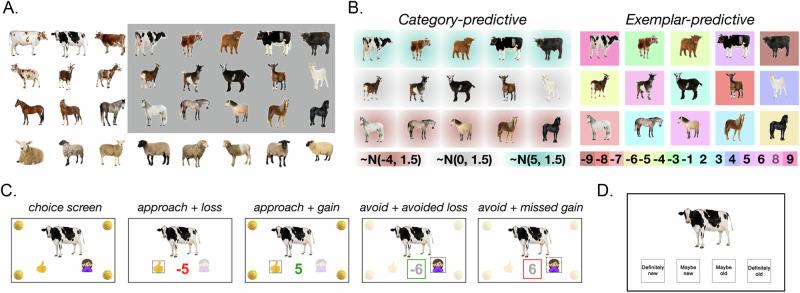
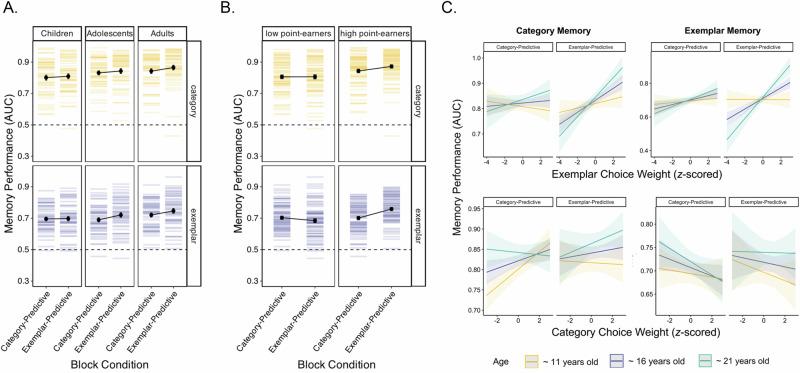
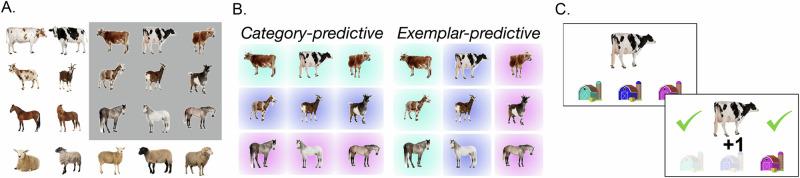
In some contexts, abstract stimulus representations can effectively promote reward pursuit, whereas in others, detailed representations are needed to guide choice. Here, we ask how, across development, the reward statistics of the environment influence the specificity of both value-guided learning computations and recognition memory. Across two experiments (N = 224), we show that participants ages 8 - 25 years adaptively up- and down-weight detailed versus broader stimulus representations and that these learning computations relate to mnemonic specificity. When participants place greater weight on granular representations during learning, they better remember stimulus details, whereas when they place greater weight on broader representations, they show enhanced memory only for categorical information. Moreover, the strength of the coupling between learning and memory specificity increases with age. We demonstrate that from early in life, reward shapes the granularity with which the world is partitioned, and increasingly across development, the specificity with which experiences are remembered.
在某些情况下,抽象的刺激表征可以有效地促进对奖励的追求,而在其他情况下,则需要详细的表征来指导选择。在此,我们探讨在整个发展过程中,环境的奖励统计如何影响价值引导学习计算和识别记忆的特异性。通过两项实验(N = 224),我们表明8至25岁的参与者会适应性地增加或减少对详细与宽泛刺激表征的权重,并且这些学习计算与记忆特异性相关。当参与者在学习过程中更重视精细表征时,他们能更好地记住刺激细节,而当他们更重视宽泛表征时,他们仅对类别信息有增强的记忆。此外,学习与记忆特异性之间的耦合强度随年龄增长而增加。我们证明,从生命早期开始,奖励就塑造了对世界进行划分的精细程度,并且在整个发展过程中,记忆经历的特异性也在不断增强。




 Zotero 插件