
利用机器学习算法预测糖尿病视网膜病变并识别可解释的生物医学特征。
Predicting diabetic retinopathy and identifying interpretable biomedical features using machine learning algorithms.
机构信息
Graduate Institute of Biomedical Informatics, College of Medical Science and Technology, Taipei Medical University, Taipei, 106, Taiwan.
Division of Endocrinology and Metabolism, Department of Internal Medicine, Sijhih Cathay General Hospital, New Taipei City, 221, Taiwan.
出版信息
BMC Bioinformatics. 2018 Aug 13;19(Suppl 9):283. doi: 10.1186/s12859-018-2277-0.
BACKGROUND
The risk factors of diabetic retinopathy (DR) were investigated extensively in the past studies, but it remains unknown which risk factors were more associated with the DR than others. If we can detect the DR related risk factors more accurately, we can then exercise early prevention strategies for diabetic retinopathy in the most high-risk population. The purpose of this study is to build a prediction model for the DR in type 2 diabetes mellitus using data mining techniques including the support vector machines, decision trees, artificial neural networks, and logistic regressions.
RESULTS
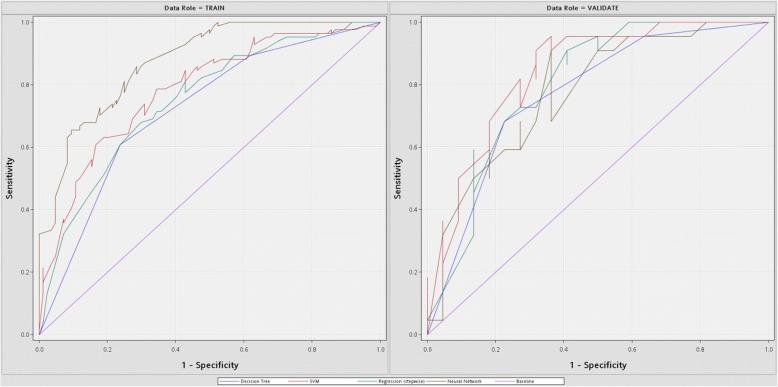
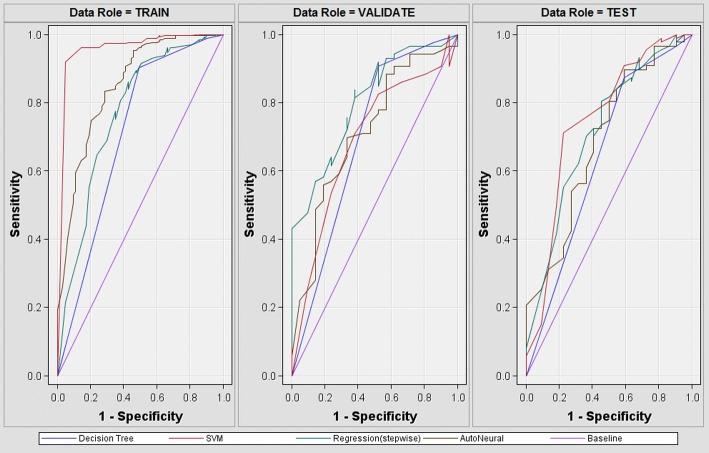
Experimental results demonstrated that prediction performance by support vector machines performed better than the other machine learning algorithms and achieved 79.5% and 0.839 in accuracy and area under the receiver operating characteristic curve using percentage split (i.e., data set divided into 80% as trainning and 20% as test), respectively. Evaluated by three-way data split scheme (i.e., data set divided into 60% as training, 20% as validation, and 20% as independent test), our method obtained slightly lower performance compared to percentage split, which suggested that three-way data split is a better way to evaluate the real performance and prevent overestimation. Moreover, we incorporated approaches proposed in previous studies to evaluate our data set and our prediction performance outperformed the other previous studies in most evaluation measures. This lends support to our assumption that appropriate machine learning algorithms combined with discriminative clinical features can effectively detect diabetic retinopathy.
CONCLUSIONS
Our method identifies use of insulin and duration of diabetes as novel interpretable features to assist with clinical decisions in identifying the high-risk populations for diabetic retinopathy. If duration of DM increases by 1 year, the odds ratio to have DMR is increased by 9.3%. The odds ratio to have DR is increased by 3.561 times for patients who use insulin compared to patients who do not use insulin. Our results can be used to facilitate development of clinical decision support systems for clinical practice in the future.
背景
过去的研究广泛探讨了糖尿病视网膜病变(DR)的危险因素,但仍不清楚哪些危险因素与 DR 的相关性更高。如果我们能更准确地检测到 DR 的相关危险因素,那么我们就可以在高危人群中对糖尿病视网膜病变进行早期预防。本研究旨在使用数据挖掘技术(包括支持向量机、决策树、人工神经网络和逻辑回归)为 2 型糖尿病建立 DR 预测模型。
结果
实验结果表明,支持向量机的预测性能优于其他机器学习算法,在使用百分比分割(即将数据集分为 80%作为训练集,20%作为测试集)时,准确率和接收者操作特征曲线下的面积分别达到 79.5%和 0.839。通过三向数据分割方案(即将数据集分为 60%作为训练集、20%作为验证集和 20%作为独立测试集)评估,我们的方法与百分比分割相比性能略有下降,这表明三向数据分割是评估实际性能和防止高估的更好方法。此外,我们结合了先前研究中提出的方法来评估我们的数据集,并且我们的预测性能在大多数评估指标上都优于其他先前的研究。这支持了我们的假设,即适当的机器学习算法结合有区别的临床特征可以有效地检测糖尿病视网膜病变。
结论
我们的方法确定了使用胰岛素和糖尿病持续时间作为识别糖尿病视网膜病变高危人群的新的可解释特征。如果糖尿病持续时间增加 1 年,那么发生 DMR 的几率比增加 9.3%。与不使用胰岛素的患者相比,使用胰岛素的患者发生 DR 的几率增加了 3.561 倍。我们的研究结果可用于为未来的临床实践开发临床决策支持系统。

 Zotero 插件