
李杏品种 J8-1 的盐胁迫响应及其与扁桃腈生物合成途径水杨酸的相互作用。
The Salt-Stress Response of the Transgenic Plum Line J8-1 and Its Interaction with the Salicylic Acid Biosynthetic Pathway from Mandelonitrile.
机构信息
Biotechnology of Fruit Trees Group, Department Plant Breeding, CEBAS-CSIC, Campus Universitario de Espinardo, 25, 30100 Murcia, Spain.
IRTA, XaRTA-Postharvest, Edifici Fruitcentre, Parc Científic i Tecnològic Agroalimentari de Lleida, 25003 Lleida, Catalonia, Spain.
出版信息
Int J Mol Sci. 2018 Nov 8;19(11):3519. doi: 10.3390/ijms19113519.
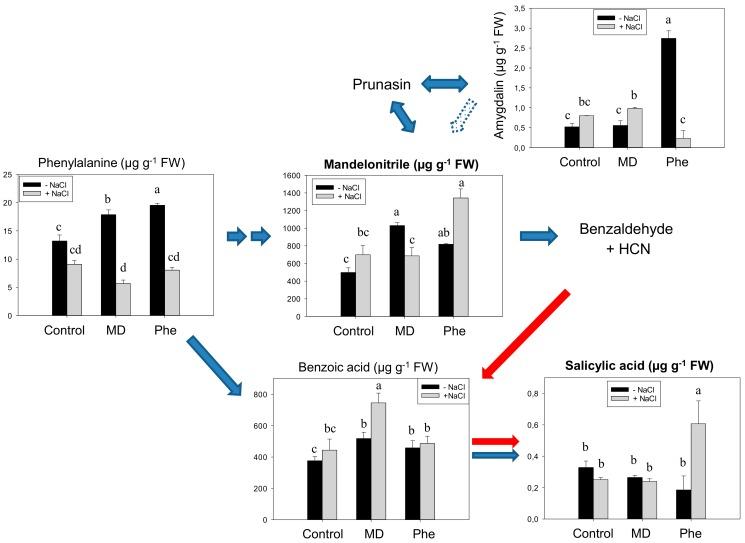
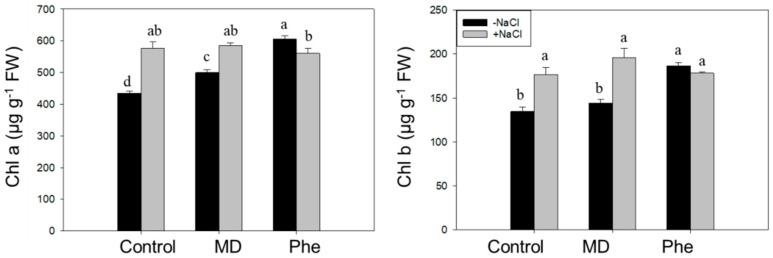
Salinity is considered as one of the most important abiotic challenges that affect crop productivity. Plant hormones, including salicylic acid (SA), are key factors in the defence signalling output triggered during plant responses against environmental stresses. We have previously reported in peach a new SA biosynthetic pathway from mandelonitrile (MD), the molecule at the hub of the cyanogenic glucoside turnover in sp. In this work, we have studied whether this new SA biosynthetic pathway is also present in plum and the possible role this pathway plays in plant plasticity under salinity, focusing on the transgenic plum line J8-1, which displays stress tolerance via an enhanced antioxidant capacity. The SA biosynthesis from MD in non-transgenic and J8-1 micropropagated plum shoots was studied by metabolomics. Then the response of J8-1 to salt stress in presence of MD or Phe (MD precursor) was assayed by measuring: chlorophyll content and fluorescence parameters, stress related hormones, levels of non-enzymatic antioxidants, the expression of two genes coding redox-related proteins, and the content of soluble nutrients. The results from in vitro assays suggest that the SA synthesis from the MD pathway demonstrated in peach is not clearly present in plum, at least under the tested conditions. Nevertheless, in J8-1 NaCl-stressed seedlings, an increase in SA was recorded as a result of the MD treatment, suggesting that MD could be involved in the SA biosynthesis under NaCl stress conditions in plum plants. We have also shown that the plum line J8-1 was tolerant to NaCl under greenhouse conditions, and this response was quite similar in MD-treated plants. Nevertheless, the MD treatment produced an increase in SA, jasmonic acid (JA) and reduced ascorbate (ASC) contents, as well as in the coefficient of non-photochemical quenching (qN) and the gene expression of () and () under salinity conditions. This response suggested a crosstalk between different signalling pathways (NPR1/Trx and SA/JA) leading to salinity tolerance in the transgenic plum line J8-1.
盐度被认为是影响作物生产力的最重要非生物胁迫因素之一。植物激素,包括水杨酸(SA),是植物对环境胁迫反应中防御信号输出的关键因素。我们之前在桃中报道了一个新的 SA 生物合成途径,来自扁桃腈(MD),这是 sp 中氰苷葡萄糖苷周转的分子中心。在这项工作中,我们研究了这个新的 SA 生物合成途径是否也存在于李树中,以及这条途径在盐胁迫下对植物可塑性可能起到的作用,重点研究了 J8-1 转基因李树株系,该株系通过增强抗氧化能力表现出对胁迫的耐受性。通过代谢组学研究了非转基因和 J8-1 微繁殖李树芽中 MD 到 SA 的生物合成。然后通过测量叶绿素含量和荧光参数、应激相关激素、非酶抗氧化剂水平、两个编码氧化还原相关蛋白的基因的表达以及可溶性养分含量,检测 J8-1 在 MD 或 Phe(MD 前体)存在下对盐胁迫的反应。体外试验结果表明,在至少测试条件下,在李树中未明显检测到在桃中展示的 MD 途径的 SA 合成。然而,在 J8-1 盐胁迫的幼苗中,由于 MD 处理,记录到 SA 的增加,表明 MD 可能参与李树植物在 NaCl 胁迫条件下的 SA 生物合成。我们还表明,J8-1 李树株系在温室条件下耐盐,在 MD 处理的植物中也有类似的反应。然而,MD 处理会导致 SA、茉莉酸(JA)和还原型抗坏血酸(ASC)含量增加,以及非光化学猝灭系数(qN)和基因表达()和()在盐胁迫条件下增加。这种反应表明,不同信号通路(NPR1/Trx 和 SA/JA)之间存在串扰,导致转基因李树株系 J8-1 耐盐。





 Zotero 插件